Criticism of 'World's Highest Price Mass Production' in Ultra-Large Wooden Architecture
Criticism is mounting within Japan as the government’s financial burden related to the Osaka-Kansai Expo 2025 continues to increase.
Osaka Expo 'Additional National Funding' Draws Criticism: "Budget Waste"
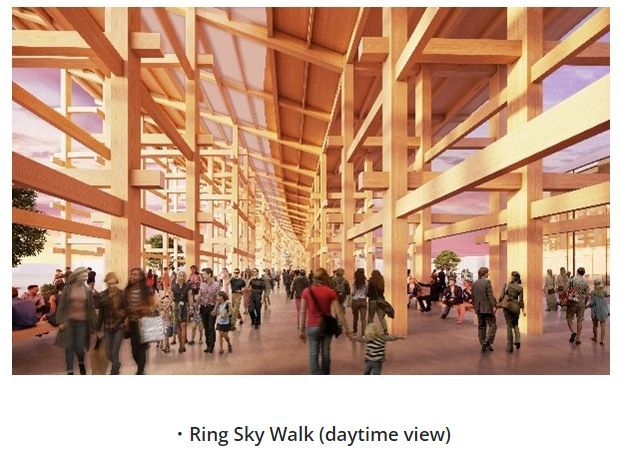 The 2025 Osaka Expo landmark wooden structure "Ring" is being mocked as the "most expensive parasol in the world."
 [Photo source=Captured from Osaka Expo official website]
According to major local media such as the Tokyo Shimbun on the 28th, the Japanese government reported at the Upper House Budget Committee meeting held the previous day that an additional national funding burden of approximately 83.7 billion yen (about 730.7 billion KRW) is expected, separate from the construction costs of the expo site. The detailed breakdown includes 36 billion yen for the construction of the Japan Pavilion, 24 billion yen for supporting participating developing countries, 19.9 billion yen for security expenses, and 3.8 billion yen for promotion.
Following this report, opposition lawmakers pointed out, "It seems the government is trying to gloss over the expo cost issues carelessly."
In response, Prime Minister Fumio Kishida said, "The total cost is still under investigation," and added, "We will strive to present the overall picture as clearly as possible."
Last month, the Japan Association for the 2025 World Exposition, which is hosting the expo, stated that due to rising construction material and labor costs, an increase in construction expenses is inevitable, presenting the expected construction cost of the expo site as 235 billion yen (about 2.05 trillion KRW). This amount is 1.9 times the initial estimate of 125 billion yen. The construction costs are to be shared equally by the central government, local governments, and the business community, increasing the Japanese government’s share to 78.3 billion yen (about 682.8 billion KRW).
Opposition lawmakers criticized the government for pouring enormous funds into the expo and pointed out that some facilities represent budget waste.
In particular, criticism is pouring in over the so-called "Ring," a symbolic wooden structure that will encircle the center of the venue in a circular shape.
The "Ring" is a wooden structure approximately 12 to 20 meters high and about 2 kilometers in circumference, constructed by fitting wood pieces together without using nails. Once completed, it is expected to be the largest wooden structure in the world.
The association explained that the "Ring" serves as a landmark and provides practical shade for visitors, but local media reported that since it may be dismantled after the expo ends, it is being mocked as "the world’s most expensive parasol."
Will the Tokyo Olympics Nightmare Repeat? Survey Shows "Osaka Expo Not Needed"
Locally, concerns are growing that the Osaka Expo might end up like the Tokyo Olympics, spending a lot of money without achieving economic benefits.
The cost of hosting the Tokyo Olympics was about 1.35 trillion yen (approximately 14 trillion KRW at the exchange rate at the time) as of the end of 2019, but additional expenses arose due to the postponement caused by the COVID-19 pandemic.
Initially, Japan planned to cover part of the additional costs with expected revenue from the Tokyo Olympics, but this plan fell through when the games were held without spectators to prevent the spread of COVID-19.
Meanwhile, public opinion in Japan regarding the Osaka Expo is not very favorable.
In a survey conducted by local media from the 3rd to the 5th targeting 1,040 people, 68.6% responded that the Osaka Expo is "not necessary." Only 28.3% said it was "necessary."
© The Asia Business Daily(www.asiae.co.kr). All rights reserved.
![Clutching a Stolen Dior Bag, Saying "I Hate Being Poor but Real"... The Grotesque Con of a "Human Knockoff" [Slate]](https://cwcontent.asiae.co.kr/asiaresize/183/2026021902243444107_1771435474.jpg)












