Three Years Ago, Capital Market Act Amendment Including Short Selling Computerization Failed
TF for Building Naked Short Selling Computerization System Keeps Possibility Open and Reconsiders
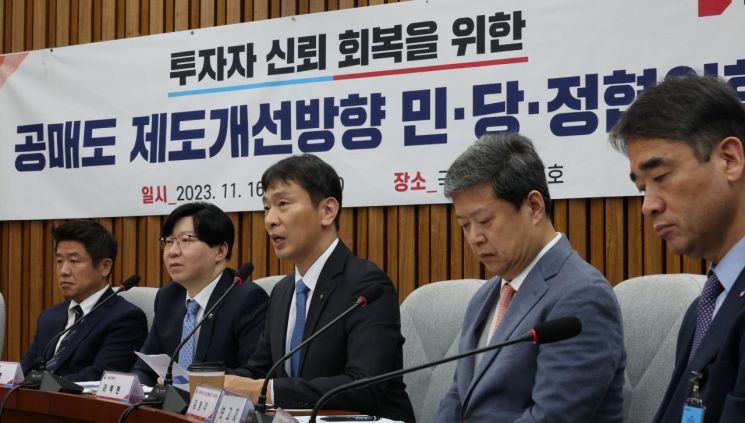 Lee Bok-hyun, Governor of the Financial Supervisory Service, is speaking at the Private-Public Council for Short Selling System Improvement held at the National Assembly on the 16th.
 [Photo by Yonhap News]
As interest in improving the short-selling system heats up, discussions on computerization have also begun in earnest. Although progress was previously hindered by practical limitations, the Financial Supervisory Service (FSS) and Korea Exchange (KRX) have formed a task force (TF) to review the matter from scratch, drawing attention to whether a system will be established.
Discussions on introducing a computerized short-selling system began in September 2020 when Kim Byung-wook, a member of the Democratic Party of Korea, took the lead in proposing amendments to the "Capital Markets and Financial Investment Services Act (Capital Markets Act)." The amendment stipulated that "anyone entering into a securities lending transaction contract must have procedures set by the Financial Services Commission (FSC) and publicly announced, such as using electronic information processing devices to prove the contents of the concluded securities lending transaction contract." It also required that when a securities lending transaction contract is concluded, the details must be reported immediately according to the procedures and methods announced by the FSC.
The reason for proposing such an amendment was that "it has been continuously pointed out that it is difficult to detect illegal acts such as naked short selling in advance, and sanctions as a post-control measure are weak, so illegal short selling is not eradicated." It also stated that "the negotiation, confirmation, and input stages of securities lending transactions are not automated and are all done manually, such as through chat, phone calls, or emails, creating an environment where naked short selling easily occurs, causing significant damage to individual investors."
However, the amendment ultimately failed to pass the National Assembly. It was judged that there were limitations in building a real-time system. According to the review report by the Political Affairs Committee, "To accurately determine whether a short sale has occurred, all transaction information of the seller must be identified, including account balances, securities lending information, information on the occurrence of undisclosed selling rights, and the volume of buy and sell orders before settlement." However, "since third parties other than the seller cannot grasp all related information, there was a limitation where a significant number of normal transactions, such as loaned stocks and investor collective accounts that do not constitute short selling, were mistakenly identified as abnormal transactions." It added, "Given the current situation where it is practically difficult to build a system that can monitor stock balances and trading volumes in real time, it is expected that the purpose of laws aiming to quickly detect illegal short selling by continuously managing the balances of institutions and foreign investors will be difficult to achieve realistically."
The financial authorities also expressed the opinion that it is difficult to build a computerized system that perfectly identifies naked short selling, and the industry raised concerns about the cost of expanding manual short-selling management to all securities firms. As a result, the amendment was replaced by an alternative proposed by the Political Affairs Committee. The alternative excluded computerization-related content and included the retention of securities lending transaction information to facilitate post-detection of illegal short selling. It stipulated that when entering into a securities lending transaction contract for the purpose of borrowed short selling, the relevant information must be retained for five years and submitted to the FSC and the exchange upon request.
However, in recent years, following the FSS's detection, it has been confirmed that illegal activities such as naked short selling by global investment banks (IBs) are actually taking place, intensifying demands for computerization. The financial authorities also expressed sympathy for the problems caused by the lack of a preventive computerized system.
The FSS plans to reconsider the computerization of short selling from scratch. On the 23rd, the FSS and the Korea Exchange formed a "Task Force (TF) for Building a Naked Short Selling Computerized System" together with the Korea Financial Investment Association and the industry, and held the first meeting. They are discussing ways to realize a system that blocks naked short selling in real time along with the internal computerized system construction of institutional investors engaging in short selling. An FSS official said, "There were previous discussions on computerization and conclusions were reached, but this time we want to thoroughly examine it from zero base," adding, "We plan to review all possibilities, including whether computerization is feasible and in what direction it should be built."
In line with this, the Korea Exchange and Korea Securities Depository, among other financial-related institutions, proposed that institutional investors build internal systems to electronically manage their sellable balances, and securities firms allow short-selling orders only if they confirm that the mandatory institutions have established internal computerized short-selling systems. Furthermore, they plan to re-examine the establishment of a real-time system to block naked short selling and facilitate public discussion.
Experts positively evaluate the attempt to computerize short selling through the formation of the TF and foresee that realization is possible. Professor Sung Tae-yoon of Yonsei University's Department of Economics said, "I do not think it is a technically impossible issue," and questioned, "Since all transactions, including stock trading, are computerized, how could short selling alone be impossible?" He added, "Individual investors are aware of the problem, and since asymmetry actually exists, computerization is a matter worth considering." Professor Kim Dae-jong of Sejong University's Department of Business Administration said, "If balance verification is possible, computerization of short selling could be feasible in a way similar to the existing stock trading system," and "It is fortunate that institutions have formed a TF to attempt computerization even at this stage."
© The Asia Business Daily(www.asiae.co.kr). All rights reserved.
![Clutching a Stolen Dior Bag, Saying "I Hate Being Poor but Real"... The Grotesque Con of a "Human Knockoff" [Slate]](https://cwcontent.asiae.co.kr/asiaresize/183/2026021902243444107_1771435474.jpg)
















