Statistics Korea Announces National Transfer Accounts Results
2021 Consumption Increased by 6.2% to 1148 Trillion Won
Labor Income Growth Limited to 5.7%
Public Health Consumption Among Elderly Rises Due to Aging Population
The national lifecycle deficit surged to over 100 trillion won, marking the largest increase in a decade. This was due to consumption growing faster than labor income. In particular, public health care consumption among the elderly expanded significantly amid the aging trend.
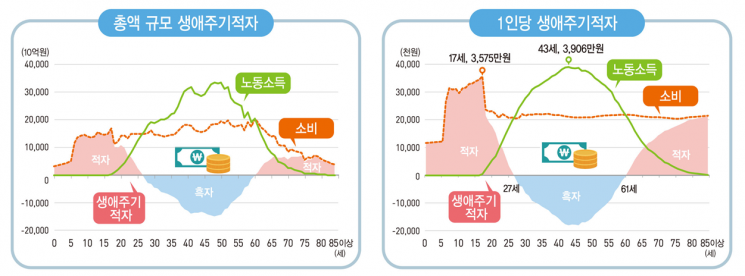
According to the "National Transfer Account Results" released by Statistics Korea on the 28th, the lifecycle deficit in 2021 was 108.813 trillion won, an 11.6% increase from the previous year. The lifecycle deficit refers to the difference between an individual's lifetime labor income and consumption. It is an indicator showing how much of their consumption people can satisfy through their own labor. The growth rate of the lifecycle deficit was the highest since a 12.7% increase in 2011.
The increase in the deficit size was because the growth in consumption outpaced income. Consumption reached 1,148.839 trillion won, up 6.2% from the previous year, while labor income was 1,040.026 trillion won, up 5.7%. Public consumption increased by 7.9% to 377.76 trillion won, and private consumption rose by 5.4% to 771.079 trillion won. Income consisted of wage income at 1,002.812 trillion won (5.4%) and self-employed labor income at 37.214 trillion won (13.3%).
The sector leading the consumption increase was public health consumption among the elderly. Public consumption for those aged 65 and over was 78.996 trillion won, of which public health consumption accounted for 45.912 trillion won, or 58.1%. Health consumption among the elderly has been growing annually as the elderly population increases. It rose 13.7% from 40.387 trillion won the previous year, with the growth rate accelerating from 9%. This is notable compared to the 15-64 age group (12.1%) and the 0-14 age group (7.9%).
Among children, education consumption showed a strong increase. Total public education consumption for ages 0-14 was 53.638 trillion won, up 6.3% from the previous year. Total private education consumption also rose 29.4% during the same period to 20.152 trillion won.
Per capita lifecycle deficit was highest at age 17 with 35.27 million won, and the surplus peaked at age 43 with 17.92 million won. The ages at which surplus begins and deficit re-enters were 27 and 61 respectively, unchanged from the previous year. However, the age of deficit re-entry has gradually been delayed from 56 in 2010.
The labor-age group of 15-64 years allocated 151.761 trillion won and 136.732 trillion won to the child and elderly groups, respectively.
© The Asia Business Daily(www.asiae.co.kr). All rights reserved.
![Clutching a Stolen Dior Bag, Saying "I Hate Being Poor but Real"... The Grotesque Con of a "Human Knockoff" [Slate]](https://cwcontent.asiae.co.kr/asiaresize/183/2026021902243444107_1771435474.jpg)
















