Signal of 'Additional Tightening' Due to PEPP Halt
Indicates Quantitative Tightening Ahead of Next Year's Rate Cut
"Measure to Prevent Policy Mismatch"
Christine Lagarde, President of the European Central Bank (ECB), hinted at an early termination of the bond purchase program worth 1.7 trillion euros (approximately 2,400 trillion won). Following interest rate hikes, she mentioned quantitative tightening, signaling the continuation of a tightening stance. However, the market interprets this as a preemptive measure to complete quantitative tightening before next year's interest rate cuts, aiming to prevent a 'policy mismatch.'
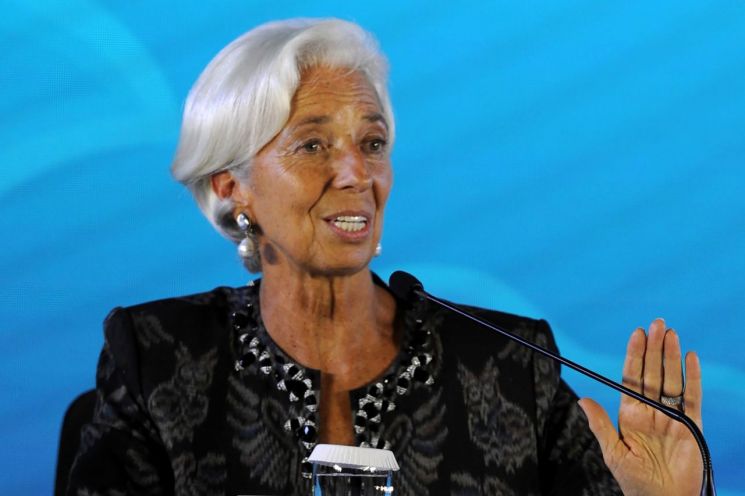
According to major foreign media on the 27th (local time), President Lagarde appeared at a European Parliament hearing and stated that the ECB could end the bond purchase program (PEPP) earlier than originally planned. Lagarde explained, "This issue will undergo internal discussions and reviews within the (ECB) Executive Board in the near future," adding, "We will reconsider this (early termination of PEPP) proposal."
PEPP is a liquidity supply mechanism activated by the ECB in response to the COVID-19 pandemic. The ECB purchased a total of 1.7 trillion euros in long-term bonds such as government bonds and continued to reinvest as maturities came due. The program was initially scheduled to operate until the end of next year, but President Lagarde hinted at an early termination.
Among ECB hawks (those favoring monetary tightening), there has been a strong call to stop PEPP operations. Critics argue that expanding market liquidity through government bond purchases while raising the benchmark interest rate is contradictory. The ECB began raising interest rates in July last year, increasing the rate from 0% to 4.5% by September this year, and then froze rates for the first time last month. Foreign media analyzed, "Lagarde's remarks are a clear signal that the ECB is preparing for additional tightening beyond interest rate hikes in monetary policy."
The market suggests that, assuming interest rate cuts next year, quantitative easing should be halted to avoid policy mismatches. There is concern that mixed signals could be sent to the market if quantitative tightening is implemented after interest rate cuts begin. Reinhard Cluse, Chief European Economist at Swiss UBS Bank, said, "Even if the ECB ends PEPP reinvestments a few quarters earlier, the market will not be very surprised," adding, "If quantitative tightening is not declared before interest rate cuts start next year, communication with the market could become very difficult."
The ECB is expected to gradually reduce the scale of bond purchases going forward. According to Morgan Stanley, by halving the amount of bond reinvestments over six months starting in April next year, the bond portfolio is expected to shrink by 87 billion euros by the end of next year and by 258 billion euros by the end of 2025.
However, there are significant concerns about the early termination of PEPP as the European economy slows down. Among ECB doves (those favoring monetary easing), there are arguments that initiating quantitative tightening amid slowing economic growth and high debt levels is akin to abandoning the 'first line of defense.' The ECB holds bonds amounting to 30% of all investment-grade bonds in the Eurozone.
Francesco Maria Di Bella, a bond researcher at UniCredit, an Italian bank, predicted, "The bonds that the market will need to absorb will increase due to the ECB's quantitative tightening," adding, "If the ECB decides to stop the PEPP portfolio, the situation could become more difficult."
© The Asia Business Daily(www.asiae.co.kr). All rights reserved.

















