Yu Uidong, Chairman of the Policy Committee, "Hope the government quickly prepares measures even before the Medical Act amendment"
Amid the government's announcement to institutionalize non-face-to-face medical consultations starting with overseas Koreans, Yoo Ui-dong, the Policy Committee Chairman of the People Power Party, stated that "(non-face-to-face medical consultations) do not necessarily need to be limited to overseas Koreans."
On the morning of the 28th, Yoo said at a floor negotiation meeting held at the National Assembly, "Considering the satisfaction of our citizens who received non-face-to-face medical consultations during the COVID-19 period, it is now necessary to institutionalize non-face-to-face medical consultations so that they can be safely and conveniently accessed."
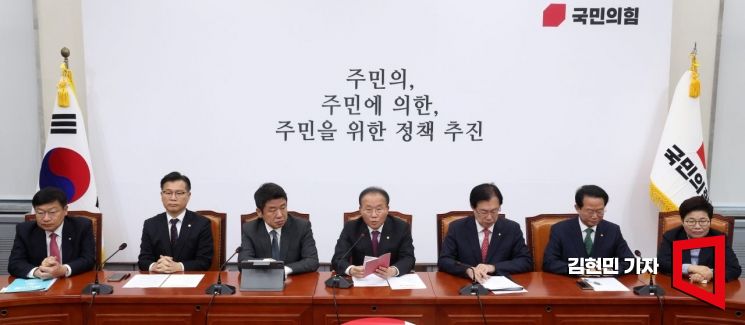 Yoon Jae-ok, floor leader of the People Power Party, is speaking at the floor countermeasure meeting held at the National Assembly on the 28th. Photo by Kim Hyun-min kimhyun81@
Yoo's proposal is an expansion beyond the government's plan, which announced the institutionalization of non-face-to-face medical consultations limited to overseas Koreans. Previously, the government held an emergency economic ministers' meeting and export investment countermeasures meeting chaired by Deputy Prime Minister and Minister of Economy and Finance Choo Kyung-ho to discuss regulatory innovation measures in new industries, including the institutionalization of non-face-to-face medical consultations. Currently, a pilot project for non-face-to-face medical consultations is underway for returning patients or patients in island regions, and the government intends to amend the Medical Service Act to allow non-face-to-face consultations for overseas Koreans and others.
During the COVID-19 period, non-face-to-face medical consultations were temporarily permitted, but when the system changed to a pilot project in June and limited the target to returning patients, public dissatisfaction grew. Yoo emphasized the need for institutionalization, saying, "Since the non-face-to-face medical consultation pilot project was implemented on June 1, although citizens who find it difficult to visit medical institutions have been receiving non-face-to-face consultations, there have been continuous voices expressing inconvenience in using the service."
Yoo said, "If measures are carefully prepared to increase citizens' access to medical care, reduce blind spots or medically vulnerable areas, and prevent the misuse of pharmaceuticals, it is necessary to institutionalize non-face-to-face medical consultations to promote public health," adding, "Even before the amendment of the Medical Service Act, I hope the government will comprehensively review the opinions raised during the pilot project process and promptly prepare measures to improve the system."
© The Asia Business Daily(www.asiae.co.kr). All rights reserved.

















