Taro Kono, Leading Politician Considered for Prime Minister Candidate
Japan Bans Smartphone Use in Parliament Unlike Korea
Taro Kono, a member of the House of Representatives and Japan's Minister of Digital Affairs, was stopped by the presiding committee chair while taking out his smartphone to search for information during a response to a question from an opposition lawmaker in the Diet.
This is due to regulations prohibiting the use of smartphones inside the Japanese Diet.
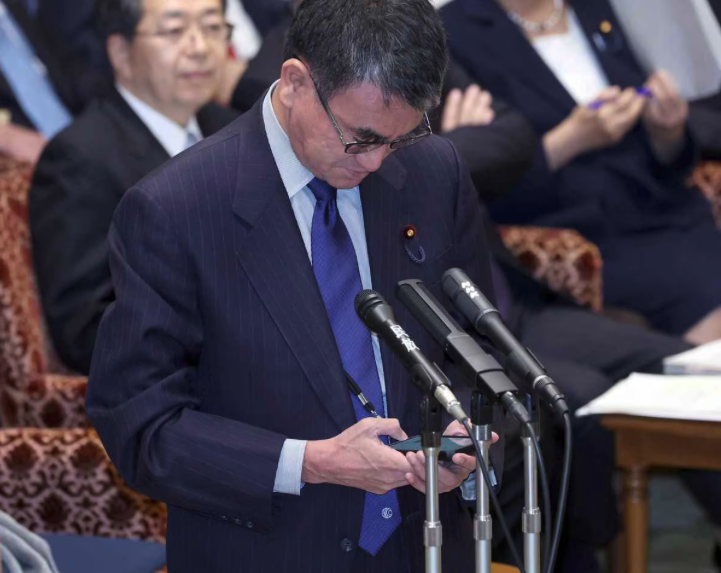 Taro Kono (河野太?), a member of the House of Representatives in the Japanese Cabinet responsible for digital affairs, was stopped by the chairperson of the relevant standing committee while taking out his smartphone to search during a question from an opposition party member in the National Diet.
 On the 27th, attending the House of Councillors (Upper House) Budget Committee, Minister Kono was asked by an opposition lawmaker, "Who was the Foreign Minister in March 2019?" and immediately took out his smartphone.
As Minister Kono said, "Let me check quickly," and tried to search, the committee chair overseeing the session immediately intervened, saying, "Smartphones are not allowed..." In response, Minister Kono said, "(Using a smartphone) is not allowed," and put the phone back into his pocket.
This scene was fully broadcast on Japanese television. Afterwards, Japanese netizens shared the incident on social networking services (SNS), criticizing the attitude of ignoring the regulations and using a smartphone.
Some, however, expressed the view that "What is wrong with using a smartphone to verify facts?"
Minister Kono is currently a leading politician considered a candidate for the next Prime Minister. During his tenure as Minister for Administrative Reform in 2020, he gained attention by advocating for the abolition of Japan's unique stamp culture in digital administration. Additionally, he has many followers on SNS. Minister Kono's X (formerly Twitter) followers number 2.63 million.
South Korean Lawmakers Who Caused Controversy by Using Smartphones in the National Assembly
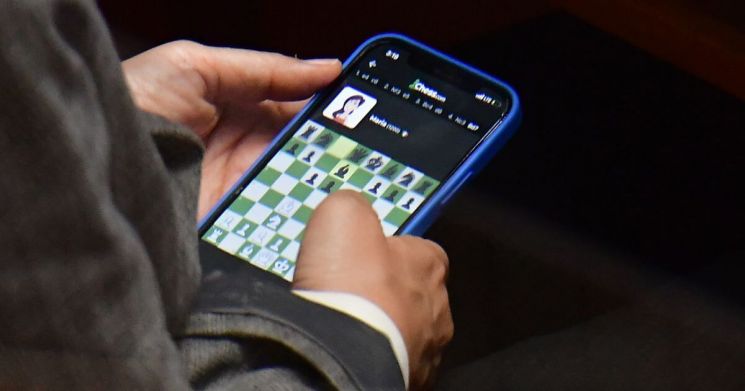 First, in 2022, Kwon In-sook, a member of the Democratic Party of Korea, was captured by the media playing a game on her smartphone during a plenary session of the National Assembly, which drew much criticism.
 [Photo by New Daily]
Unlike the Japanese Diet, the South Korean National Assembly allows phone calls and searches using mobile phones. As a result, politicians in South Korea have often caused controversies by exchanging text messages or searching on smartphones in the plenary hall, with photos taken during these moments.
First, in 2022, Kwon In-sook of the Democratic Party of Korea was heavily criticized after being caught playing games on her smartphone during a plenary session of the National Assembly.
In September 2019, during the 20th National Assembly, independent lawmaker Cheon Jeong-bae caused a major controversy when text messages he sent to his diplomat daughter were revealed. It was inferred that he offered to help his daughter's acquaintance during an overseas diplomatic mission audit.
There were also lawmakers who suffered even greater embarrassment than having their exchanged text messages exposed. These were lawmakers caught viewing 'nude photos' during National Assembly attendance hours, which are akin to working hours for office workers.
In 2014, Kwon Seong-dong, then a member of the Saenuri Party, was caught viewing bikini photos on his smartphone during a National Assembly Environment and Labor Committee audit of the Ministry of Employment and Labor. In 2013, Shim Jae-cheol, then a Saenuri Party Supreme Council member, caused controversy by viewing nude photos of women during a plenary session.
At the time, Shim explained, "It was a file sent by someone," but footage showing him directly searching for the word 'nude' also surfaced, spreading the scandal further.
© The Asia Business Daily(www.asiae.co.kr). All rights reserved.


















