"Focused Only on Increasing Staff Rather Than Improving Essential and Local Healthcare"
"Should Gradually Increase Considering Field Acceptability"
Shin Hyun-young, a member of the Democratic Party of Korea and a former doctor, commented on the government's plan to increase medical school admissions, saying, "It should be done gradually to ensure acceptance on the ground, even if the numbers are increased."
On the 28th, Shin appeared on KBS's special program 'Radio Today' and emphasized, "Whenever there is an excessive quantitative expansion, side effects always occur. To properly train medical students and produce high-quality doctors, it is important to increase admissions gradually."
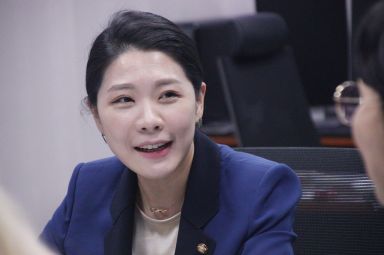
Regarding the Korean Medical Association's (KMA) strong opposition to increasing medical school admissions, Shin said, "I believe it is a criticism of the rushed investigation process in deciding on the formation of the nation's crucial healthcare workforce. The government needs to steadily build an evidence-based framework to determine how much to increase and when to reduce admissions, based on scientific evidence."
She continued, "Conducting demand surveys without such a framework is like entrusting fish to a cat. If you ask department heads or university presidents, the demand survey will inevitably be inflated. The government is announcing those results and stirring public opinion. Rather than improving essential medical systems like pediatrics and emergency medicine, public opinion has overwhelmingly shifted toward expanding medical school quotas."
She added, "For example, Chungnam National University originally had a quota of 110 students but called for 410, which is four times the quota, and Soonchunhyang University had 93 but called for 200, more than double. However, is the infrastructure and facilities in place to train that many doctors? In many cases, they are not."
Shin pointed out, "(When doctors are) overproduced, it leads to excessive medical care. Medical services should focus on essential areas, but if only practitioners like Korean medicine doctors increase, unnecessary medical care is provided, ultimately worsening the soundness of the national health insurance finances."
She diagnosed, "The biggest cause of the collapse of essential medical care is that when treating critically ill patients, medical accidents or unexpected outcomes occur. Ultimately, in cases that lead to lawsuits or criminal trials, the workload on medical staff becomes extremely severe. A safety net must be established through exemptions or reductions in criminal penalties and the introduction of a national liability insurance system, as President Yoon Suk-yeol also mentioned, so that patients can access not only cosmetic dermatology but also truly necessary departments like internal medicine, surgery, obstetrics and gynecology, and pediatrics."
She added, "Currently, there are urgent needs for doctors in local areas and various short-term solutions to address this, but those aspects are being neglected, and focusing only on medical school quotas invites criticism that this is a government and ruling party pledge for the general election."
© The Asia Business Daily(www.asiae.co.kr). All rights reserved.

















