'League of Legends' Korean Pro Teams Perpetual Deficit
Low League Revenue Share, Declining External Sponsorships
No Suitable Revenue Model, Player Salaries Account for 80% of Team Operating Costs
Game Company Holds IP... Only Game Company Benefits if Popularity Rises
"The process of playing and preparing for the game positively influences many people, and if the competitive spirit inspires others, I believe that is the most important meaning of sports."
Lee Sang-hyeok (Faker), the star player of the game 'League of Legends (LOL)', answered this way when asked if esports can be considered a sport after winning the gold medal at the '2022 Hangzhou Asian Games.' However, as the game IP (intellectual property) providers continue to monopolize the profits, esports teams are perpetually running deficits. There are concerns that within a few years, games as sports may no longer exist.
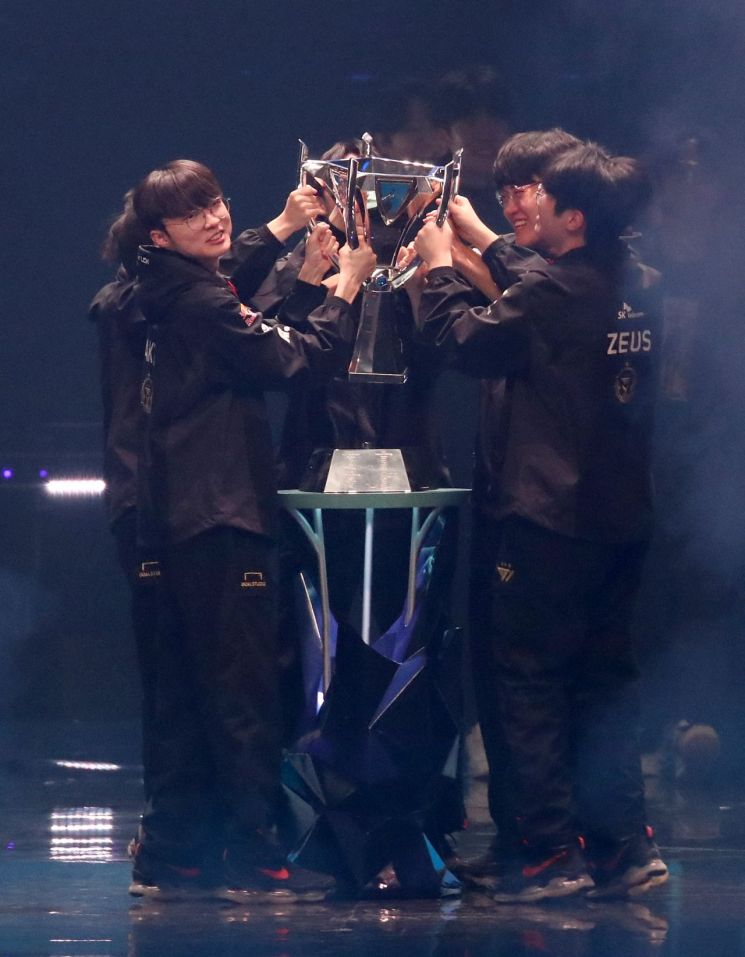 On the afternoon of the 19th, T1 players celebrated their 3-0 victory against Weibo Gaming in the 2023 League of Legends (LoL) World Championship (Worlds) finals held at Gocheok Sky Dome in Guro-gu, Seoul.
 [Image source=Yonhap News]
LoL World Championship Economic Impact 200 Billion KRW... Teams Perpetually in Deficit
On the 19th, the League of Legends World Championship, known as the LoL World Cup, was held in Korea for the first time in five years. The Seoul Gocheok Sky Dome, where the match took place, was sold out. Scalped tickets priced up to 3 million KRW appeared. A large screen was installed at Gwanghwamun Square, where 15,000 people gathered to watch the game. When Korea's T1 defeated China's WBG (Weibo Gaming) with a set score of 3-0, cheers erupted. Subsequently, reports flooded in stating that the economic effect of this LoL World Cup reached 200 billion KRW.
However, the teams belonging to the 'LCK,' Korea's top-tier professional LoL league, are perpetually running deficits. T1, the winner of the LoL World Cup, recorded an operating loss of 16.6 billion KRW last year. All other teams also posted deficits in the tens of billions of KRW. The LCK, which leads domestic competitions, has also recorded losses for two consecutive years. Platforms like Naver and AfreecaTV, which purchased broadcasting rights estimated to be worth tens of billions of KRW and streamed the matches live for free, also find it difficult to expect profits.
Although LoL enjoys worldwide popularity, the entire related industry is unable to escape deficits. This is due to the operating policies of Riot Games, the developer of LoL. Teams must pay a 10 billion KRW entry fee to participate in the LCK, divided over five years. This is more than the 6 billion KRW entry fee paid by Shinsegae Group when entering professional baseball's KBO. Riot Games Korea, the Korean subsidiary, distributes a portion of the revenue equally among teams, with total distributions last year amounting to 8.3 billion KRW?roughly equivalent to Faker's estimated annual salary.
The skyrocketing player salaries are also a burden for teams. T1's operating expenses last year were 18.3 billion KRW, with player salaries accounting for 80% of that. In recent years, Chinese league teams have offered high prices to recruit skilled Korean players, forcing domestic teams to raise salaries to prevent losing players.
Many players earn salaries ranging from several hundred million to several billion KRW, but the relatively low number of matches they play compared to other sports is also problematic. The LCK regular season operates two splits: 'Spring' and 'Summer.' Each team plays 18 matches per split.
Riot Games directly oversees league and tournament operations to protect its intellectual property (IP). To generate revenue, many offline tournaments need to be held to create additional income, but all are streamed online for free. Since Riot Games owns the IP, teams face restrictions in selling additional merchandise and services. Ultimately, the only way for teams to generate revenue is through external sponsorships, but as the economic downturn continues, sponsorship sizes are shrinking. It is a situation akin to pouring water into a bottomless pit.
The management difficulties of teams are a global issue. The American LoL league, LCS, changed its regulations to eliminate the need to operate a second-tier league in response to struggling teams. As a result, seven out of ten teams announced in May that they would give up operating their academy teams.
According to data from the Korea Creative Content Agency, the domestic esports industry peaked at 139.8 billion KRW in 2019 but has been declining steadily since. The industry size in 2021 was 104.8 billion KRW, shrinking by over 30 billion KRW in two years.
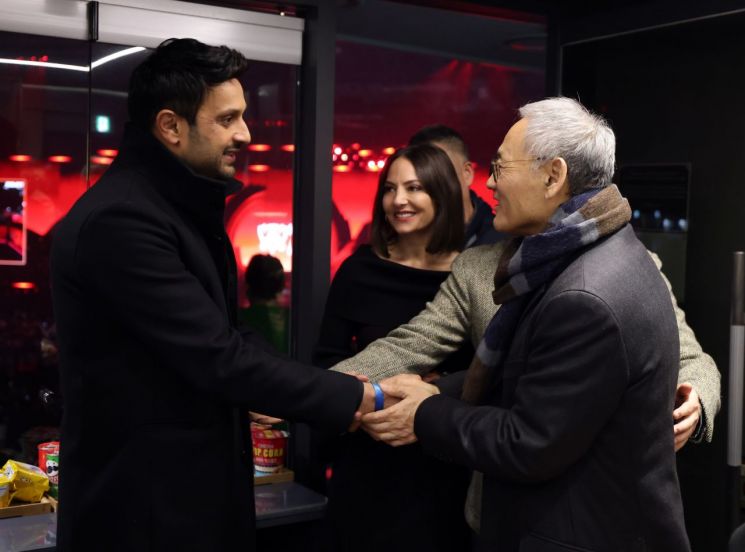 Yoo In-chon, Minister of Culture, Sports and Tourism, is greeting Dylan Jadeja, CEO of Riot Games, before watching the 2023 League of Legends (LoL) World Championship (Worlds) finals held at Gocheok Sky Dome in Guro-gu, Seoul on the 19th.
 [Photo by Yonhap News]
Korean Subsidiary Sent 200 Billion KRW to Headquarters
Concerns about the sustainability of esports arise due to Riot Games' 'stingy management,' but Riot Games steadily accumulates profits every year.
Riot Games Korea publishes games like 'LoL' and 'Valorant,' developed by its U.S. headquarters, in Korea and pays royalties in return. The royalties sent to the headquarters were 90.1 billion KRW in 2020, 92.2 billion KRW in 2021, and 92.7 billion KRW in 2022. Additionally, last year, it paid 111.6 billion KRW in dividends to the U.S. headquarters. Thus, Riot Games Korea sent over 200 billion KRW to the U.S. headquarters last year. Currently, Riot Games' headquarters is 100% owned by the Chinese company Tencent.
As concerns about esports sustainability persist, Riot Games has belatedly begun seeking ways to revive the ecosystem. The LCK will introduce a salary cap system starting from the 2024 season. Accordingly, if the total player salaries exceed the cap, a luxury tax must be paid. The cap will likely be announced by the end of the year.
There is also consideration of officially including esports as a category in Sports Toto. The National Sports Promotion Fund, raised through Sports Toto, is broadly classified into three uses: revitalizing professional sports, expanding the base of youth amateur sports, and professional sports policies and common projects. Teams are expected to receive support for marketing and player development costs, which could reduce their operating expenses.
Jeremy Lee, Riot Games' LoL head producer, who visited Korea on the 15th, said, "Riot is making esports a sustainable business and is doing its best to explore new methods." However, it is pointed out that this is a problem that could be easily solved if Riot Games reduced its greed just a little.
© The Asia Business Daily(www.asiae.co.kr). All rights reserved.



















