Bank of Korea Announces November Consumer Sentiment Survey
High Inflation and Interest Rates Weaken Consumer Confidence
Expected Inflation Rate Maintained at 3.4%
Housing Transactions Slump...Home Price Outlook Declines
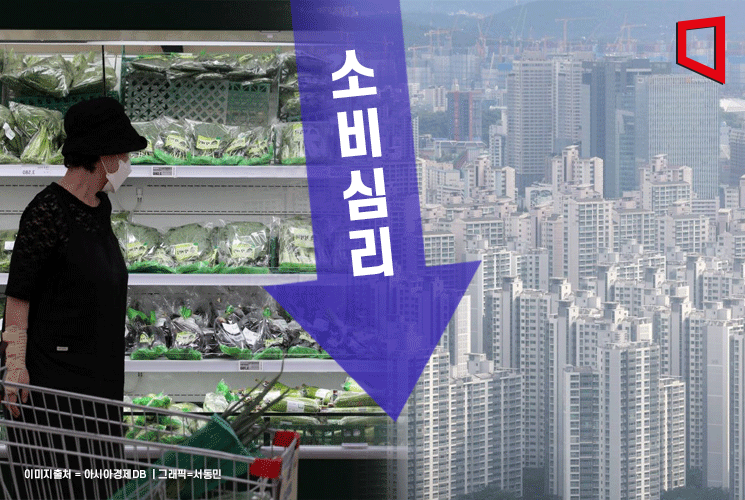
As the impact of high inflation and high interest rates intensifies, domestic consumer sentiment has deteriorated for four consecutive months. The expected inflation rate remained at the same level as the previous month, halting its upward trend, and the outlook for housing prices weakened significantly compared to the previous month due to the high loan interest rates.
According to the November Consumer Sentiment Survey released by the Bank of Korea on the 28th, the Consumer Confidence Index (CCSI) fell by 0.9 points from the previous month to 97.2. The CCSI is a psychological indicator calculated using six major indices from the Consumer Sentiment Index (CSI), and a value below the long-term average benchmark of 100 indicates pessimism.
The CCSI rose to 103.2 in July but has declined for four consecutive months: 103.1 in August, 99.7 in September, 98.1 in October, and 97.2 in November. This is interpreted as consumer sentiment freezing as the prolonged effects of interest rate hikes take hold.
Hwang Hee-jin, head of the Bank of Korea's Statistics and Survey Team, explained, "Despite reduced expectations for additional tightening in the U.S. and signs of export recovery, consumer sentiment declined due to continued domestic demand sluggishness caused by high inflation and high interest rates."
First, the Interest Rate Expectation Index dropped by 9 points in one month to 119. Last month, it was high at 128, but as U.S. inflation slowed, expectations for the end of base rate hikes seem to have spread.
The Inflation Expectation Index fell by 2 points to 149 despite the recent rise in consumer prices, as international oil prices stabilized. Geopolitical risks in the Middle East pushed oil prices above $90 per barrel in September, but demand weakened this month, bringing prices back down to the $70-$80 range.
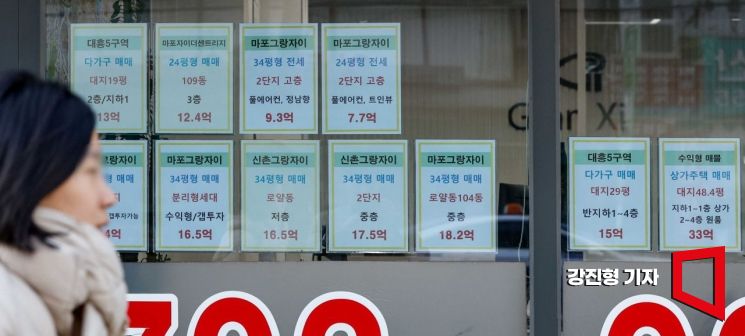 On the 21st, sale and jeonse prices were posted at a real estate office in an apartment complex in Seoul. Photo by Kang Jin-hyung aymsdream@
The expected inflation rate for the next year remained unchanged at 3.4%. Although it turned upward last month for the first time in eight months, the rise halted as economic and inflation slowdown expectations increased within a month.
The response proportions for major items expected to influence consumer prices over the next year were public utility charges (64.6%), agricultural, livestock, and fishery products (39.4%), and petroleum products (37.9%), in that order.
The Housing Price Expectation Index fell by 6 points to 102, marking a decline for two consecutive months since September (110). Despite weakening expectations for further interest rate hikes, the drop in the housing price expectation index indicates that the current housing market is not favorable.
Team leader Hwang explained, "The housing price expectation CSI fell by 6 points as nationwide housing sales price increases slowed and transaction volumes remained sluggish, while loan interest rates stayed at high levels."
This survey was conducted from the 10th to the 17th of this month, targeting 2,500 households nationwide (2,379 responses).
© The Asia Business Daily(www.asiae.co.kr). All rights reserved.
![User Who Sold Erroneously Deposited Bitcoins to Repay Debt and Fund Entertainment... What Did the Supreme Court Decide in 2021? [Legal Issue Check]](https://cwcontent.asiae.co.kr/asiaresize/183/2026020910431234020_1770601391.png)
















