Policy Forum on "Sustainable Inheritance, Gift Tax, and Real Estate Tax Improvement Measures" on the 27th
Opposition Lawmakers: "Need to Promote Entrepreneurial Spirit and Business Activities by Abolishing Surcharge on Major Shareholders in Corporate Inheritance Tax"
"Discussions on inheritance and gift taxes should not be viewed ideologically but approached practically and pragmatically."
On the 27th, at the 'Policy Forum on Sustainable Inheritance, Gift, and Real Estate Taxation Improvement Measures' held at the National Assembly, Kim Byung-wook, a member of the Democratic Party of Korea, said, "If the corporate inheritance tax surcharge system on major shareholders is abolished, entrepreneurial spirit will be elevated and corporate activities will be revitalized, ultimately leading to the development of South Korea's economy."
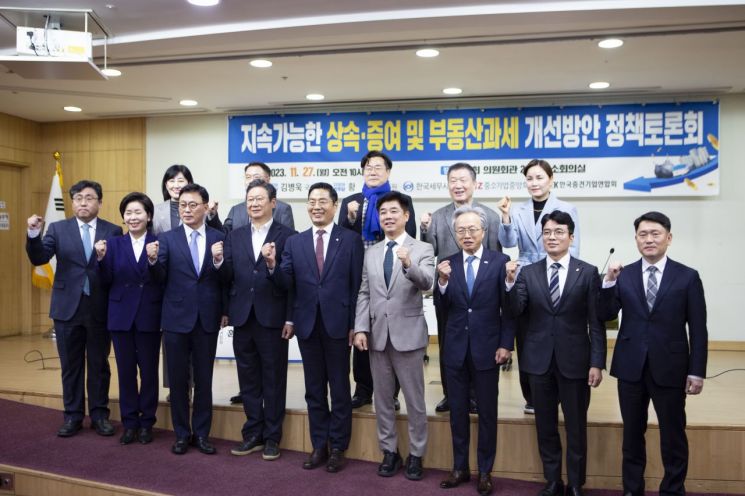
The event was co-hosted by the Korea Tax Association, Korea Federation of Small and Medium Business, Korea Federation of Medium-sized Enterprises, and Democratic Party lawmakers Kim Byung-wook and Hwang Hee. At the event, the two lawmakers emphasized the 'necessity of inheritance tax reform,' stating that it is necessary to create an environment for corporate growth by reforming inheritance tax, which accounts for only 1% of total tax revenue. This is a notable move considering the party's previous stance, which viewed inheritance tax reform as a 'tax cut for the wealthy' and held a critical perspective.
Lawmaker Kim said, "Before becoming a member of the National Assembly, I experienced the real economy and know how difficult it is to start and maintain a business. I believe those who maintain a business for more than 3 to 5 years are true patriots," praising domestic entrepreneurs. He also emphasized, "The National Assembly must provide sufficient support and institutional backing to make the country business-friendly," adding, "Among these, improving inheritance and gift taxes and real estate tax systems is important."
He continued, "After the rapid economic growth of the 1970s and 1980s, it is now time for the parent generation to pass businesses on to the next generation, but the 50% inheritance tax rate and the major shareholder surcharge issue have become contentious," and said, "The 20% surcharge on major shareholders in inheritance tax should not be viewed too punitively. It should be improved to maintain the positive function of mitigating wealth inheritance while ensuring smooth succession of corporate management."
He added, "In Sweden, a welfare state, inheritance tax was abolished in 2005 and replaced with a capital gains tax," explaining, "If it is difficult to switch inheritance tax to capital gains tax all at once, it is possible to consider applying it first to corporations or in order of small and medium-sized enterprises and medium-sized enterprises." He also mentioned, "We should also consider changing the inheritance tax imposed as an estate tax to an inheritance acquisition tax."
Lawmaker Hwang Hee also said, "It is undesirable for corporate growth to disappear or be abandoned due to inheritance tax," and added, "We need to increase tax revenue and create an environment for corporate growth through inheritance tax reform."
Lawmaker Hwang explained, "Currently, inheritance tax in South Korea accounts for only about 1% of total tax revenue, but with surcharges, it can be imposed up to 60%, which causes illegal and evasive inheritance issues every time," and said, "If inheritance tax is lowered to around the OECD average of 24-25%, tax revenue from inheritance tax could actually increase, and abolition of some parts should also be considered."
He also pointed out, "Looking at Korean companies, the rankings have not changed for decades," and said, "Regarding corporate succession of small and medium-sized enterprises, if the value exceeds 50 billion won, companies split, and if it exceeds 100 billion won, they sell off, which hinders corporate growth."
He said, "In the future technology era, technology should accumulate and companies should grow from small and medium-sized to large enterprises through startups, but this process is disappearing and being abandoned, which is undesirable," and added, "As times and environments change, it is time to consider revising the current inheritance tax system to fit reality."
Attending the forum were Koo Jae-i, president of the Korea Tax Association; Kim Yeon-jung, research director of the Korea Tax Association; Lee Jeon-o, standing executive director of the Korea Tax Research Institute; Park Hoon, president of the Korea Taxpayers Association; Kim Sun-myung, vice president of the Korea Tax Association; Choo Moon-gap, head of the Korea Federation of Small and Medium Business; and Choi Young-jeon, director of the Property Taxation Division at the Ministry of Strategy and Finance. At the National Assembly, besides the hosts Kim Byung-wook and Hwang Hee, Democratic Party lawmakers Park Chan-dae, Park Kwang-on, Lim Oh-kyung, and Yang Hyang-ja, representative of Korea Hope, also attended.
© The Asia Business Daily(www.asiae.co.kr). All rights reserved.

















