Real Estate R114, 2024 First Half Outlook Survey
In the housing market outlook for the first half of next year, the proportion of respondents expecting a 'rise' slightly exceeded those expecting a 'decline.' This is the first time in two years that the number of respondents predicting an increase has surpassed those predicting a decrease. In the jeonse and wolse rental market, expectations of price increases overwhelmingly outnumbered those of price decreases.
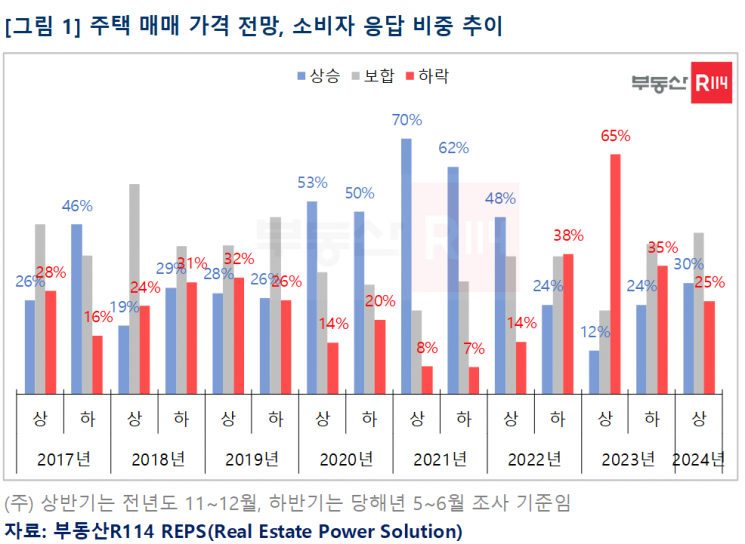
According to a survey conducted by Real Estate R114 on the 27th (targeting 1,167 people nationwide), 3 out of 10 respondents overall predicted that housing sale prices will rise next year. Until the previous survey, more respondents expected a decline (decline 35%, rise 24%), but this time the situation reversed (rise 30%, decline 25%).
This is the first time in two years since the first half of 2022 housing outlook survey that the rise response has overtaken the decline. However, the outlook for stable prices accounted for the largest share, with 4 to 5 out of 10 respondents, indicating that opinions on rises and declines are evenly matched.
Respondents who predicted a rise in sale prices cited reasons such as ‘a sudden change in the policy of rapid base interest rate hikes’ (30.42%), ‘price increases in high-end apartments in key areas’ (23.94%), and ‘activation of the apartment pre-sale market’ (11.83%). On the other hand, those who expected prices to fall expressed concerns about ‘the possibility of an economic recession’ (47.14%) and ‘potential increases in loan interest rates’ (13.13%).
Regarding rental prices such as jeonse and wolse, expectations of price increases overwhelmingly outnumbered those of decreases. For jeonse prices, 38.99% expected a rise, while 15.60% expected a fall, making the rise prediction 2.5 times more common. For wolse prices, 45.84% expected a rise, compared to 8.23% expecting a fall, which is 5.6 times more.
The main reason for the expectation of jeonse price increases was ‘increased jeonse demand due to weakened buying sentiment,’ accounting for 30.99%. This was followed by ‘shortage of jeonse supply due to landlords’ preference for wolse’ (20.66%) and ‘temporary increase in jeonse residency for subscription purposes’ (17.14%). Those who predicted jeonse price declines cited ‘risk of landlords having to return tenant deposits (reverse jeonse)’ (32.97%) as a major factor.
Meanwhile, the key variables for the real estate market in the first half of next year were mostly seen as ‘the speed of domestic and international economic recovery and other external economic conditions’ (19.71%) and ‘whether the Bank of Korea will raise the base interest rate further’ (17.31%).
A representative from Real Estate R114 said, “Although there is still time before next year’s general election, the political sphere has recently been competitively raising real estate issues, including discussions on the Seoul Mega City, so it is necessary to closely monitor market changes depending on the election results.”
© The Asia Business Daily(www.asiae.co.kr). All rights reserved.
![Clutching a Stolen Dior Bag, Saying "I Hate Being Poor but Real"... The Grotesque Con of a "Human Knockoff" [Slate]](https://cwcontent.asiae.co.kr/asiaresize/183/2026021902243444107_1771435474.jpg)












