"Appeal Trials Cannot Be Exempt from the Principle of Speedy Trial"
The processing period for civil substantive cases at the Seoul High Court, the largest high court in the country, has been found to have shortened by more than two months as of October this year compared to October last year.
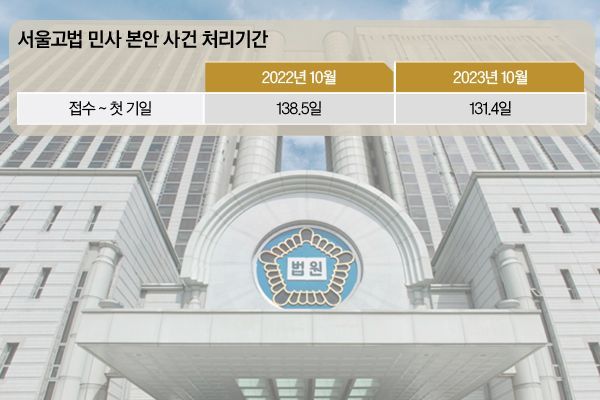
According to the Seoul High Court on the 24th, the time taken from receipt to conclusion of civil substantive cases filed at the Seoul High Court was reduced by about 68 days, from 369.3 days as of October last year to 301.6 days as of October this year. Compared to the nationwide high courts, where the period from receipt to final result decreased from 359.4 days to 345.9 days during the same period, the case processing at the Seoul High Court is even faster.
Considering that the nationwide high courts shortened their processing period by about 14 days during the same period, the reduction in processing time at the Seoul High Court is significant even compared to other high courts nationwide.
The period from receipt to the scheduling of the first hearing has also shortened. It was reduced by about one week, from 138.5 days as of October last year to 131.4 days as of October this year. Nationwide high courts, however, saw an increase in the period from receipt to first hearing scheduling, from 148.9 days last October to 151.8 days this October.
A lawyer who is a former chief judge said, “The shortening of the period from receipt to the first hearing being scheduled can be interpreted as the court quickly reviewing and understanding the case records,” adding, “This can be seen as a result of the court’s focused trial.”
In family cases as well, the processing period has become faster. It took 221.3 days from receipt to judgment as of October last year, but this was reduced to 188.3 days as of October this year. For family cases filed at the Seoul High Court, the period from receipt to the scheduling of the first hearing was also shortened by about a month, from 140 days to 108.2 days during the same period.
Although the case processing period has shortened, the number of cases filed has actually increased. As of October last year, 462 civil substantive cases were filed at the Seoul High Court, but this number rose to 615 as of October this year.
Notably, the Seoul High Court abolished one civil (substantive) trial division in March this year due to the appointment of Kim Hyung-doo as a Constitutional Court Justice and Seo Kyung-hwan as a Supreme Court Justice in June, redistributing cases to other divisions. It is understood that the allocation ratio was adjusted and cases were fairly reassigned. Despite this, the overall processing period for civil substantive cases at the Seoul High Court has shortened.
Earlier, Yoon Joon (62, Judicial Research and Training Institute class 16), President of the Seoul High Court, emphasized the importance of speedy trials in his inauguration speech in February this year.
President Yoon stated, “Even in appellate trials, the principle of speedy trials cannot be an exception,” and emphasized, “It is the appellate trials that hold the key to alleviating the public’s suffering in receiving justice, even if only a little.”
He continued, “The Tokyo High Court’s civil substantive appellate trial period averages within six months, which reportedly played a decisive role in drastically reducing the overall processing period of civil cases in Japan. This holds implications for us who are gathering wisdom to solve the problem of trial delays,” adding, “I envision a future where the status of the Seoul High Court is further solidified through fair and speedy trials, and accordingly, the status and pride of the judges and staff of the Seoul High Court rise greatly.”
Another lawyer, a former chief judge, said, “Support from judicial researchers and other trial assistance staff likely played a part,” adding, “The average age of judges is probably higher than in other courts, so such support should increase not only at the Seoul High Court but also at courts nationwide in the future.”
Han Su-hyun, Legal Times Reporter
※This article is based on content supplied by Law Times.
© The Asia Business Daily(www.asiae.co.kr). All rights reserved.

















