Democratic Party Executive Committee Approves Plan to Strengthen Proportion of Party Members' Votes
Proportion of Party Members' Votes Increased... Vote Value Tripled from Current
Lee: "Institutions Require Understanding, Not Just Agreement"
The Democratic Party of Korea held a party affairs committee meeting on the 27th and passed a revision to the party constitution and regulations to increase the proportion of 'party members with voting rights' in the party convention that elects the party leader and supreme council members. Amid criticism from the non-Myeong faction that this is a 'foothold by the pro-Myeong (pro-Lee Jae-myung) faction to seize the next party leadership,' this revision is expected to further escalate factional conflicts within the party.
Senior Spokesperson Kwon Chil-seung told reporters after the party affairs committee meeting held at the National Assembly that morning that they passed a revision to the party regulations adjusting the proportion of delegates and party members with voting rights to 70% in the final candidate selection rules for the party convention, with the reflection ratio adjusted to less than 20 to 1. The agenda will be submitted to the Central Committee for approval on the 7th of next month, and if confirmed as is, it will be applied starting from the party convention in August next year.
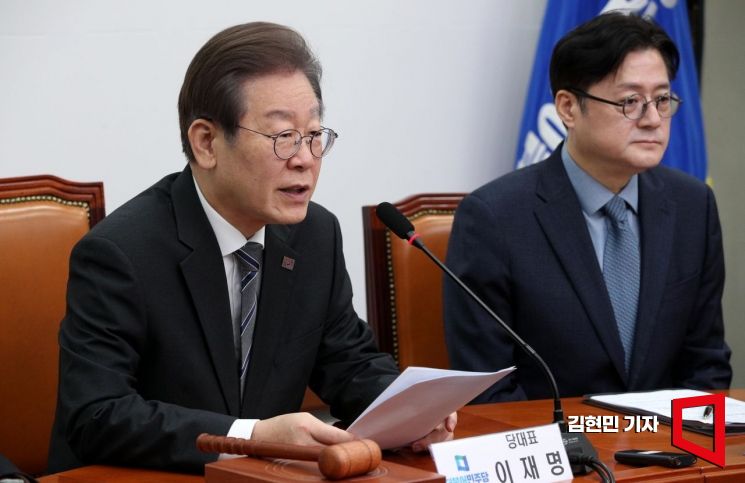 Lee Jae-myung, leader of the Democratic Party of Korea, is speaking at the Supreme Council meeting held at the National Assembly on the 27th. Photo by Kim Hyun-min kimhyun81@
Under the current rules, the Democratic Party's party convention voting is conducted at the ratio of 'delegates 30%, party members with voting rights 40%, general public 25%, general party members 5%'. Considering that 60 votes from party members with voting rights correspond to one delegate vote, the proposed adjustment will increase the value of party members with voting rights' votes by more than three times.
So far, hardline party members, including the pro-Myeong faction, have advocated expanding the proportion of party members with voting rights from the perspective of 'vote equivalence.' The Democratic Party had already revised the rules once during the August 28 party convention last year. At that time, the reflection rule was changed from 'delegates 45%, party members with voting rights 40%, general public 10%, general party members 5%' to the current one, which also reduced the proportion of delegate votes to relatively increase the value of party members with voting rights' votes.
Some within the party expect factional conflicts to intensify as controversy arises over the 'nullification of the delegate system.' In particular, the non-Myeong faction is voicing opposition, calling it a 'de facto abolition of the delegate system' and a 'trick for Gaeddal.' Representative Cho Eung-cheon said in a KBS radio interview that "Since the influence of the hardline support base has been continuously expanded, I do not expect a sudden U-turn now." This criticism carries suspicion that the revision is a foothold to further strengthen the 'influence' of party members with voting rights, where Lee Jae-myung's hardline supporters are the majority, in next year's party convention.
Party leader Lee Jae-myung said to reporters at the National Assembly that day, "It is true that there is a strong desire for one person, one vote between delegates and party members with voting rights," adding, "We should move in that direction, but it is a difficult wall to overcome at once, so I hope people understand that it will be changed gradually." He continued, "There are various opinions within the party, and a system is not something everyone agrees on but something that requires mutual understanding, so we will gather opinions through sufficient consultation."
Senior Spokesperson Kwon also said in response to questions about 'criticism within the party,' "I judge that a ratio of about 20 to 1 is still within the range of consensus within the party."
Meanwhile, the Democratic Party also passed an agenda at the party affairs committee to increase the deduction rate of primary election votes for incumbent lawmakers who rank in the bottom 10% in the 'evaluation of elected officials' in next year's general election from the current 20% to 30%.
© The Asia Business Daily(www.asiae.co.kr). All rights reserved.

















