The Supreme Court overturned the guilty verdict against a police officer who wrote an investigative report stating that a suspect was 'on the run,' thereby obtaining an arrest warrant, despite the suspect having expressed willingness to voluntarily appear through an acquaintance but had postponed the appearance due to personal circumstances.
Although it is true that some important details related to the reasons for the arrest were omitted in the investigative report, since the officer could not contact the suspect at the time of writing the report, it cannot be considered that false information was recorded. Furthermore, the prosecutor's evidence was insufficient to prove the officer's intent, even implicitly, to create a false official document.
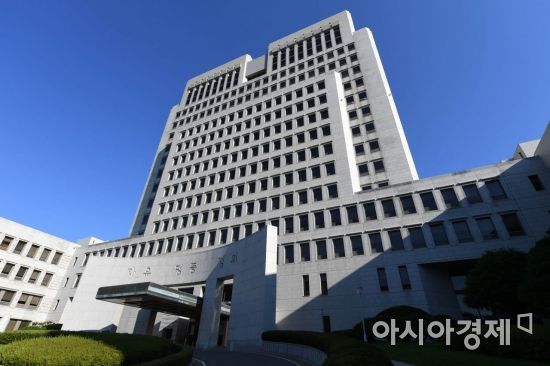
On the 27th, according to the legal community, the Supreme Court's First Division (Presiding Justice Seo Kyunghwan) overturned the original ruling that sentenced Choi, who was indicted on charges of abuse of authority in arrest, false official document creation, and use of false official documents, to eight months in prison with a two-year probation and a one-year disqualification, and remanded the case to the Busan District Court.
The court stated, "The original court erred in its legal interpretation regarding the establishment and intent of the crime of false official document creation and the establishment of the crime of abuse of authority in arrest, which affected the judgment," as the reason for the reversal and remand.
Choi, a police officer with 25 years of experience who worked at a police station in Busan, was assigned on June 19, 2020, to investigate a special injury case involving suspect A at a foreign construction worker dormitory located in Dongnae-gu, Busan. A, a Vietnamese national, had inflicted injuries requiring two weeks of medical treatment on a victim, also of Vietnamese nationality, and was at large.
On the day of the incident, Choi gave A's phone number to B, a Korean interpreter of Vietnamese descent, asking B to encourage A to voluntarily appear. However, during a call with B, A said, "I have a lot of debt in Vietnam. Since I am an undocumented immigrant, I could be deported if I make a mistake. If deported, what will happen to my debts in Vietnam?" Contact was maintained until June 23, 2020, but after that, no contact was made until July 6 of the same year.
Meanwhile, C, the site manager at A's workplace, maintained contact with A and encouraged him to voluntarily appear. On July 6, 2020, they agreed to appear together for police questioning. Around 9 a.m. on the scheduled date, A called B, the interpreter he had spoken to earlier, saying, "I am on my way to the police station," and B, unaware of this plan, replied, "Go and cooperate with the investigation."
Shortly after, C, who met with A, called Choi around 11:20 a.m. the same day, saying, "I am with A now, and we will go for the investigation." However, Choi, who was out on another case investigation at the time, postponed the appearance, saying it was difficult to conduct the investigation that day due to being out in the field and asked them to come another time. Afterward, A maintained contact with C via a KakaoTalk chat room, waiting for Choi to summon him until his arrest.
Choi, who postponed A's appearance, told interpreter B, "I received a call from A. He said he would come for the investigation. However, I told him not to come because I had an urgent case to handle. Please tell A that I will contact him later about the investigation schedule."
B contacted A as requested by Choi, but A did not answer the phone, so they could not talk. Upon hearing this, Choi said, "Okay, I will talk to C, so don't worry about it anymore. Do not contact A anymore."
On the afternoon of the same day and the next day, July 7, 2020, when Choi spoke with C, C never mentioned that contact with A had been lost. However, on the afternoon of July 7, 2020, Choi wrote an investigative report stating that "A is currently on the run and unreachable." Based on this, on July 8, 2020, Choi requested a review for an arrest warrant for A, applied for the warrant on July 9, and obtained it, arresting A on July 10.
The prosecution judged that Choi's act of hiding the fact that he himself had postponed A's voluntary appearance and writing the investigative report as if A was on the run and unreachable constituted false official document creation, and that arresting A based on this was an abuse of authority in arrest, thus indicting Choi.
The first trial court acquitted Choi.
The court ruled, "Although there may be misunderstandings due to not including circumstances favorable to A, the facts were recorded and cannot be considered false."
The court considered ▲ A fled toward Jochiwon immediately after the crime as an undocumented immigrant and turned off the power of the burner phone he used ▲ only favorable circumstances for A were omitted, not falsely recorded ▲ Choi did not know A's whereabouts at the time of writing the investigative report ▲ it seemed unlikely that A, fearing forced deportation, would voluntarily appear to the investigation agency, and concluded that even if some favorable circumstances (such as A's willingness to voluntarily appear) were recorded, it could not be definitively said that the arrest warrant would not have been issued.
However, the second trial court overturned the first trial's acquittal and sentenced Choi to eight months in prison with a two-year probation and a one-year disqualification.
The second trial court judged, "Choi omitted details about A's voluntary appearance intention and the circumstances of postponement when writing the investigative report, and falsely stated that A was on the run or unreachable, which does not correspond to the truth."
It also found Choi guilty of abuse of authority in arrest, stating, "It is recognized that Choi wrote the investigative report falsely and deceived police officers, prosecutors, and judges who were unaware of these facts to obtain an arrest warrant and arrested A based on that warrant."
However, the Supreme Court's judgment was different.
The court cited circumstances similar to those of the first trial and stated, "Although it is acknowledged that the defendant did not detail the reasons for A's arrest in the investigative report, it is difficult to conclude that there is no reasonable doubt that the report contains falsehoods or that the defendant had definite or even conditional intent to create a false official document."
The court referred to Supreme Court precedents stating, "Even if the intent or purpose of creating an official document was improper, if the contents recorded are not false, the crime of false official document creation cannot be established."
Furthermore, the court judged, "Since it is difficult to recognize the intent or conditional intent to create a false official document, it is also difficult to conclude that the prosecution's facts regarding abuse of authority in arrest based on that are proven beyond reasonable doubt."
© The Asia Business Daily(www.asiae.co.kr). All rights reserved.

















