Budget Shortage but Settlement Village Funding Forced
Gantz Hints at Possible Withdrawal from Coalition
As a truce for a hostage exchange between Israel and the Palestinian armed faction Hamas continues, the Israeli cabinet, currently formed as a wartime coalition government, is showing signs of division over budget issues, sparking controversy. Despite drafting a deficit budget due to insufficient war funds, Prime Minister Benjamin Netanyahu has refused to give up the budget for Palestinian settlement construction, leading to growing opposition from the opposition parties. As discord within the coalition deepens, there is a possibility that the cabinet could collapse amid the war, potentially leading to political instability with new elections being held again.
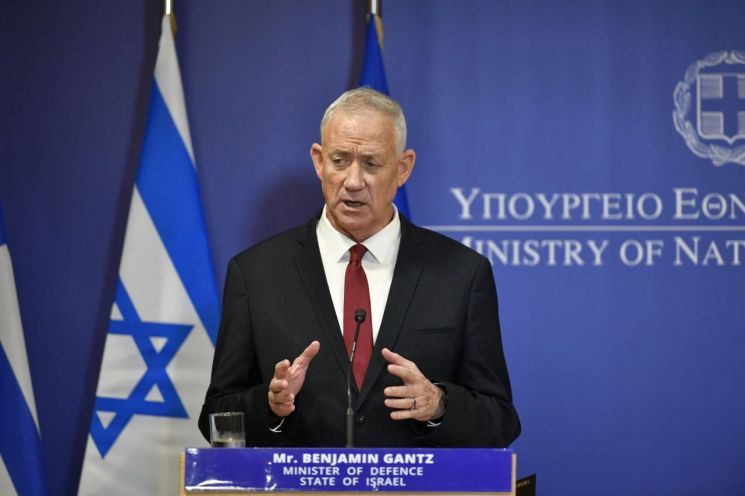
According to the Times of Israel on the 26th (local time), Benny Gantz, leader of Israel's National Unity Party, warned at a press conference that "if the current cabinet does not divert all available resources to war expenses, the National Unity Party will vote against the cabinet's war budget," adding, "We may have to consider the next steps." The phrase "next steps" has been interpreted as a possible withdrawal from the coalition, raising concerns about the potential collapse of the coalition both inside and outside Israeli politics, the Times of Israel reported.
The reason for Gantz's strong remarks is understood to be that the Netanyahu cabinet included budgets for settlement development and Jewish identity projects, such as the expansion of settlements in Palestinian areas, in part of the war budget. Previously, the Netanyahu cabinet allocated a large sum of 1 billion shekels (approximately 356 billion KRW) for settlement development costs amid drafting a deficit budget due to current war expenses and recovery of damaged areas, and even issuing large-scale government bonds, which sparked controversy.
In a letter directly sent to Prime Minister Netanyahu, Gantz emphasized, "Allocating huge amounts to controversial items unrelated to the war will harm national resilience and Israeli social integration," adding, "Now, the entire Israeli society must share the burden, and the citizens know this, and the government must act accordingly. All available funds should be used for war expenses and for the victims."
However, the Israeli Prime Minister's Office immediately rebutted with a statement. The Prime Minister's Office claimed, "The newly drafted war budget is an unprecedented 30 billion shekels, which meets all the demands of the Israel Defense Forces (IDF) and will be sufficient to care for hostages, the injured, the fallen, the families of victims, and to stimulate the Israeli economy," adding, "Many budgets have already been cut, and compared to other large budgets, the 1 billion shekels expenditure is a small amount."
Nevertheless, the Bank of Israel has also expressed opposition to the Netanyahu cabinet's settlement budget, further intensifying the controversy. In a statement, the Bank of Israel pointed out, "The budget cuts proposed by the Ministry of Finance earlier this month are insufficient to cover all costs, including war expenses," and warned, "As public debt levels and costs rise, defense spending and interest payments will permanently increase, and the government must prepare for the possibility of higher government expenditures."
As political conflicts within the Israeli coalition continue over the new war budget, there is a possibility that the coalition could be severely shaken or even collapse. Given the significant responsibility attributed to the Netanyahu cabinet for the war, if the wartime coalition falls apart, Israel may enter a new general election phase, raising concerns about ongoing political instability amid the war.
© The Asia Business Daily(www.asiae.co.kr). All rights reserved.
![Clutching a Stolen Dior Bag, Saying "I Hate Being Poor but Real"... The Grotesque Con of a "Human Knockoff" [Slate]](https://cwcontent.asiae.co.kr/asiaresize/183/2026021902243444107_1771435474.jpg)
















