Regulatory Relaxation Distribution Industry Development Act
Pending in National Assembly for Over 3 Years
Need for Shift to Online-Centered Services Like Large Mart Dawn Delivery
The distribution and delivery system has become more segmented through the COVID-19 pandemic, but there are criticisms that laws and social mechanisms have not kept pace with reality. Within the industry, there are even remarks such as, "In a situation where competition in delivery logistics is becoming increasingly fierce, the standards established in the past have long lost their effectiveness."
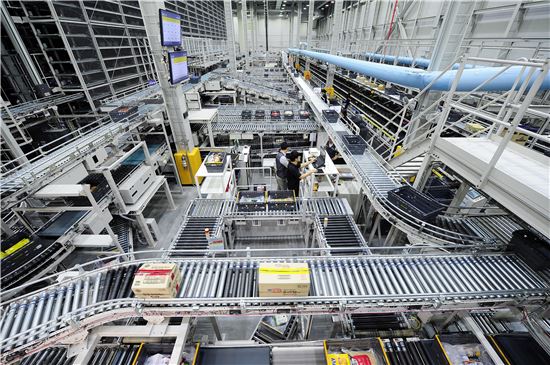 In Bojeong-dong, Giheung-gu, Yongin-si, Gyeonggi-do, the conveyor belt with delivery boxes is busily running at the ambient temperature product picking (sorting) worksite of the Emart Mall logistics center.
 [Photo by Asia Economy DB]
The 'Law' Needed by the Distribution Industry
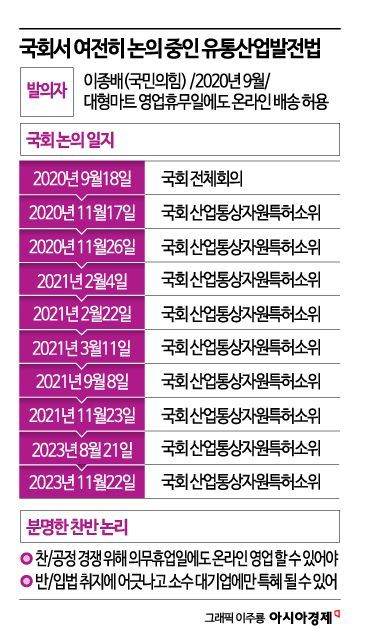
According to the industry on the 27th, an amendment to the Distribution Industry Development Act, which allows large supermarkets to permit online delivery even on mandatory closure days or restricted business hours, thereby easing regulations on dawn delivery, has been pending in the National Assembly for over three years. Discussions were held on the 22nd at a subcommittee of the National Assembly's Industry, Trade, Energy, Small and Medium Enterprises Committee, but no conclusion was reached. This amendment has been submitted to the National Assembly since September 2020 and has been discussed 10 times in total, but differences in opinion between the ruling and opposition parties remain.
The industry emphasizes the necessity of the amendment, which has been pending for over three years. Since the distribution environment has been reorganized around online channels after COVID-19, it is necessary to rationalize regulations on large supermarket operations. An industry official stated, "The regulations on large supermarkets, implemented in 2012 to protect small business owners and traditional markets, have lost their original purpose and, through COVID-19, have resulted in the expansion of the online shopping market," adding, "For fair competition, large supermarkets should be allowed to operate online on mandatory closure days and during restricted business hours."
The fact that a significant number of consumers are excluded from the current delivery system also strengthens the justification for the amendment. In particular, dawn delivery, which has become common in e-commerce, is provided only in the densely populated metropolitan area and six major cities (Busan, Daegu, Incheon, Gwangju, Daejeon, Ulsan) and some nearby areas, considering the establishment of dedicated logistics centers and delivery efficiency. This means that in small and medium-sized cities outside these areas, even if consumers want dawn delivery, the environment does not allow it. For this reason, a recent survey by the Korea Chamber of Commerce and Industry confirmed that nine out of ten consumers in small and medium-sized cities said they would be willing to use dawn delivery if it were provided using large supermarket stores near their homes.
"No Late-Night or Dawn Delivery"... Strong Skepticism
Inside and outside the industry, it is expected that the amendment will not easily pass the National Assembly. The opposition party, which holds the majority of seats in the National Assembly, is reportedly negative about lifting restrictions on online delivery by large supermarkets. They argue that the amendment contradicts the legislative intent of the Distribution Industry Development Act (to protect small business owners and traditional markets) and could be a special privilege for a few large corporations. The fact that large supermarkets already provide online delivery services outside business hours through logistics centers rather than stores also serves as a factor denying the need for the amendment.
Moreover, if the law is amended, dawn delivery would be legalized even at large supermarket stores, but the opposition party holds a strong negative stance toward dawn delivery itself. This sentiment was confirmed during last month's National Assembly audit. At the National Assembly Environment and Labor Committee audit, opposition lawmakers raised their voices over the death of a 60-year-old delivery worker who died at a delivery site that month, saying, "Dawn delivery causes death from overwork." They urged the primary contractor of the delivery worker to participate in the 'social agreement' established in 2021 by the delivery industry labor-management council to prevent overwork deaths among delivery workers. The social agreement stipulates that late-night delivery is allowed until 9 p.m., and if unavoidable, until 10 p.m.
The industry points out that such views from the opposition party "fail to keep up with rapidly changing delivery trends." Especially regarding dawn delivery, which was previously a service provided only by companies like Coupang and Kurly, it has expanded comprehensively through the COVID-19 pandemic. An industry official said, "Delivery services have become more segmented and developed, including evening and same-day delivery," adding, "Dawn delivery now involves more participants, and it is time for fundamental discussions beyond structure and working hours."
© The Asia Business Daily(www.asiae.co.kr). All rights reserved.

















