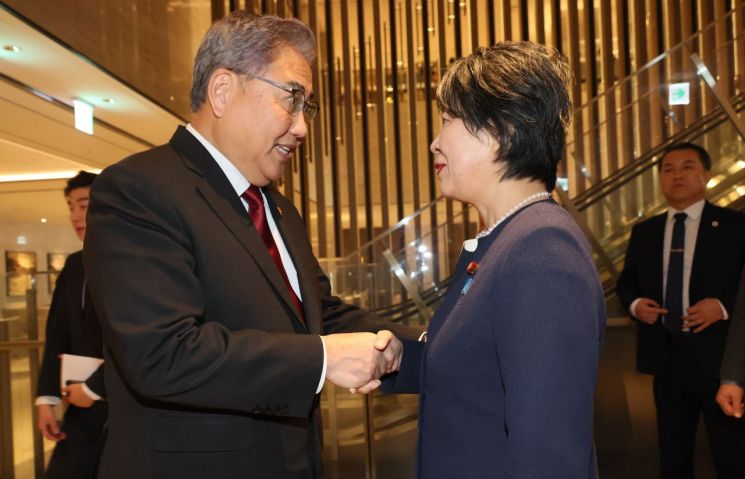
On the 26th, the foreign ministers of South Korea and Japan held talks in Busan and discussed bilateral issues, including the appellate court ruling in favor of the Japanese military comfort women victims in their compensation lawsuit.
Foreign Minister Park Jin held a meeting for about 85 minutes with Japanese Foreign Minister Kamikawa Yoko at a hotel in Busan in the morning, who was visiting South Korea to attend the Korea-China-Japan foreign ministers' meeting.
The two ministers exchanged views on the appellate court ruling by the Seoul High Court in favor of the Japanese military comfort women victims in their compensation lawsuit against the Japanese government. The Japanese government strongly protested and demanded that the South Korean government take appropriate measures to rectify the violation of international law. Foreign Minister Kamikawa conveyed this Japanese position again to Minister Park. Minister Park reaffirmed the South Korean government's stance that "the 2015 Korea-Japan comfort women agreement is respected as an official agreement between the two countries."
A Foreign Ministry official explained to reporters after the meeting, "(Minister Park) said that as stated in the agreement, both countries should strive to restore the honor and dignity of the victims, and in this context, both countries should continue efforts to seek a constructive and future-oriented relationship."
The South Korean and Japanese governments have announced that the 2015 agreement, which included Japan's apology and the allocation of 1 billion yen from the Japanese government budget, resolved the Japanese military comfort women issue "finally and irreversibly."
Japan claims that the issue was resolved through the 1965 Korea-Japan Claims Agreement and the 2015 agreement, and argues that South Korean judicial rulings that contradict this are violations of international law. However, as seen in this ruling, controversy continues over whether the victims' individual claims remain valid.
When asked whether they believe the victims have no legal right to receive compensation, a Foreign Ministry official said, "The most important thing is that both countries strive to restore the honor and dignity of the victims," adding, "It means continuing communication between the two countries on this issue."
On the same day, foreign media also reported that the Japanese government has decided to support the South Korean government's bid to host the 2030 World Expo in Busan. It is known that this position was also expressed during the Korea-Japan foreign ministers' meeting as part of this context.
Furthermore, the two ministers agreed to promote cooperation in advanced technology sectors between Korea-Japan and Korea-US-Japan, as well as cooperation between consular authorities of Korea and Japan, and discussed continuing communication so that both countries can speak with one voice on multilateral stages such as the United Nations.
The two ministers also strongly condemned North Korea's so-called military reconnaissance satellite launch and agreed to continue close cooperation among Korea-Japan and Korea-US-Japan in responding to North Korean issues such as North Korea-Russia arms transactions. With the Korea-China-Japan foreign ministers' meeting resuming after four years, they agreed to further activate trilateral cooperation processes and continue cooperating to hold a trilateral summit at an early date.
© The Asia Business Daily(www.asiae.co.kr). All rights reserved.

















