Wide-banded Sea Snake and Bamsuji Cockscomb Discovered
Sea Temperature Rise Due to Global Warming Is the Cause
Wide-banded Sea Snake Has Venom 20 Times Stronger Than Poisonous Snakes
In Dadohaehaesang National Park, the highly venomous 'Neolbeunddikkeunbadam' (Broad-banded Sea Snake) and the coral species 'Bamsuji Maendrami' (Night Spike Cockscomb) were discovered for the first time. Both are tropical and subtropical marine organisms, and this discovery serves as evidence that the domestic seas are gradually warming due to climate change.
On the 26th, the Korea National Park Service under the Ministry of Environment announced that they had confirmed the presence of the Broad-banded Sea Snake, which mainly inhabits tropical seas, and the coral Bamsuji Maendrami around the uninhabited island Sogan-yeo and the waters near Geomun-do in Dadohaehaesang National Park for the first time.
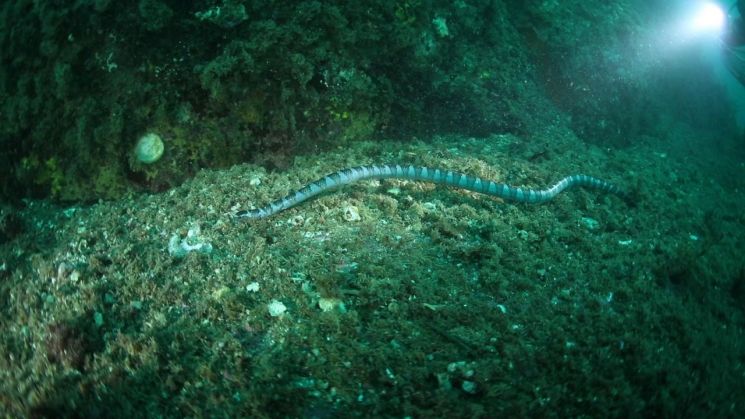 Wide-banded sea snake discovered in Dadohaehaesang National Park.
 [Photo by Korea National Park Service, Yonhap News]
The Broad-banded Sea Snake, belonging to the cobra family, primarily inhabits warm waters of the western Pacific such as the Philippines, Taiwan, and Okinawa, Japan. This snake lives underwater but has the unique characteristic of breeding, laying eggs, and shedding skin on land. It is a highly venomous marine reptile with venom 20 times stronger than that of common venomous snakes, so extreme caution is necessary as bites can be fatal.
In Korea, a live Broad-banded Sea Snake was first captured in August 2015 in Seogwipo, Jeju. However, subsequent research revealed that a 'Meokdaegari Badam' (a type of sea snake) caught in 1995 in Suyeong-gu, Busan, was actually a Broad-banded Sea Snake. So far, the presence of Broad-banded Sea Snakes has been confirmed in Jeju, Busan, Tongyeong in Gyeongnam, and Yeosu in Jeonnam. It is presumed that the Broad-banded Sea Snakes found along the Korean coast mostly came from populations in Taiwan or Japan, carried by ocean currents.
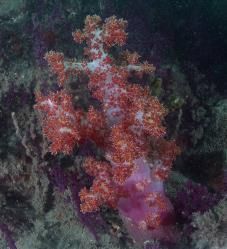 Bamsuji cockscomb discovered in Dadohaehaesang National Park.
 [Photo by Korea National Park Service, Yonhap News]
The Bamsuji Maendrami, discovered alongside, is classified as a second-class endangered wild species and is sensitive to water temperature, making it an important organism for studying changes in marine ecosystems due to climate change. The Bamsuji Maendrami is a coral resembling a chestnut burr, living at depths of 5 to 25 meters in areas with strong currents. It is mainly distributed in Tanabe Bay, Japan, and the Indian Ocean, and in Korea, it primarily inhabits the waters around Jeju.
Meanwhile, as sea surface temperatures rise due to warming, the occurrence of tropical and subtropical species in Korean waters is becoming increasingly frequent.
The National Institute of Biological Resources reported on the 21st that among 131 fish species observed around Ulleungdo over the past three years, 76 species were tropical and subtropical, accounting for 58.5% of the total. Tropical fish and subtropical fish numbered 49 and 27 species respectively, which combined is 1.5 times the number of temperate fish species (48 species, 36.9%).
According to the National Institute of Fisheries Science, from late August to early September this year, the surface water temperature around the Korean Peninsula reached 26 degrees Celsius, the highest since satellite-based surface temperature observations began in 1990.
© The Asia Business Daily(www.asiae.co.kr). All rights reserved.

















