Metropolitan Area Universities "Can Increase Enrollment with Spare Quotas"
Provincial Areas Face Poor Educational Conditions Like 'Mini Medical Schools'
Thousands of Billions in Budget Needed Even for New Medical Schools
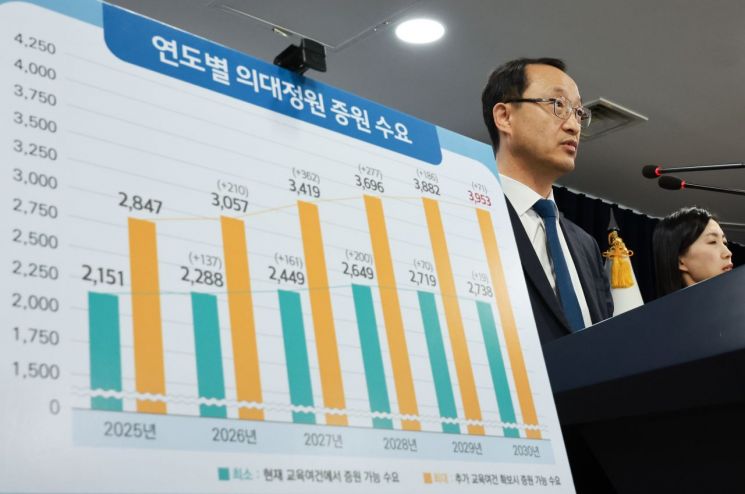
As the government moves forward with plans to expand medical school quotas to increase the number of doctors, reactions from medical associations, the education sector, and other groups are divided. The Ministry of Health and Welfare states that nearly 4,000 additional students can be admitted across 40 medical schools nationwide by 2030, but the medical community strongly opposes this, arguing that due to the nature of medical education, a significant increase in quotas would compromise the quality of education. We have examined the conditions that need to be considered if medical school expansion is pursued.
◆Net Increase Possible for Medical Schools in the Capital Area= Currently, universities located in the capital area are subject to restrictions under the Capital Region Readjustment Planning Act. To prevent population concentration in the capital area, the total admission quotas for universities in this region cannot be increased. Last year, the government attempted to increase quotas for advanced departments in capital area universities to foster semiconductor talent. At that time, discussions were held on applying special exceptions to the enforcement decree of the Capital Region Readjustment Planning Act and on amending the law, but these discussions were scrapped in the National Assembly due to opposition from opposition parties and educational organizations.
However, without amending the law, there is some flexibility within the total admission quota. According to the Capital Region Readjustment Planning Act, the total admission quota for universities in the capital area is 117,145 students, and the Ministry of Education estimates that about 6,000 slots remain available this year. In the demand survey announced by the Ministry of Health and Welfare on the 21st, the demand for medical school quota increases nationwide was between 2,000 and 3,000 students. If the expansion proceeds at the level indicated by the survey, capital area universities are expected to be able to increase quotas within the available margin. A Ministry of Land, Infrastructure and Transport official explained, "Even if additional increases are necessary, the Ministry of Land can adjust the total quota through deliberation by the Capital Region Readjustment Committee."
◆Basic Faculty Must Be Secured at Regional Medical Schools= Once the scale of medical school expansion is decided, each university must prepare conditions to accommodate additional students. The key is to prevent a decline in the quality of medical education by focusing on four essential requirements: university campus land, buildings and faculty, and revenue-generating basic assets. The core issue is securing medical school faculty and expanding training facilities. Currently, many medical school professors spend an excessive amount of time on patient care rather than student education. Without increasing faculty, simply increasing student numbers will make it more difficult for educators to teach the latest medical knowledge and train excellent doctors. The medical community fears that education will become more like "academy-style" lectures aimed only at passing the medical licensing exam, which would lower the quality of newly graduated doctors.
An admissions officer at a Seoul-area university stated, "Along with securing faculty, it is important to have an environment where medical students can be properly taught. The affiliated hospital must be large enough to provide additional practical training for the increased number of students."
The problem lies with regional medical schools. Since the government emphasizes preventing the collapse of essential regional medical services and is pushing for medical school expansion, discussions are likely to focus on regional medical schools. However, regional medical schools currently face a shortage of faculty to teach basic medical sciences, and recruiting additional faculty is even more difficult. Some small medical schools with fewer than 50 students have poor training hospital conditions. In such cases, the medical community points out that without direct additional government support, realistic expansion capacity is lacking.
◆Concerns Over Deterioration with ‘Mini Medical Schools’= Another method being discussed to increase the number of doctors is the establishment of new regional medical schools, and competition among regions to attract medical schools is already intense. The controversy over establishing public medical schools, which had subsided, is showing signs of revival. On the 21st, Jeon Byeong-wang, head of the Medical Education Inspection Team, said at a Ministry of Health and Welfare briefing, "We will first focus on expanding existing medical schools, but the establishment of public medical schools or regional medical schools will continue to be reviewed based on demand."
According to data submitted by the Ministry of Education to Rep. Lee Eun-ju of the Justice Party, 11 universities nationwide have requested the establishment of new medical schools. However, establishing a medical school requires astronomical costs. When a regional national university establishes a medical school, related laws require the establishment of a university hospital or its branch for clinical training. Establishing both a medical school and a hospital requires a budget in the hundreds of billions of won.
Those concerned about establishing regional medical schools cite the 2018 closure of Seonam University in Namwon, Jeonbuk. Seonam University’s medical school was a small-scale medical school with 49 students, training doctors at small affiliated hospitals without a university hospital, and it failed to provide proper medical education. After its closure, students were absorbed into Jeonbuk National University’s medical school. If small regional medical schools with inadequate educational and training environments like Seonam University are newly established, smooth operation may be difficult.
Meanwhile, once the scale of medical school expansion is determined, the Ministry of Education will allocate detailed quotas to each university. To apply this to the 2025 academic year admissions, the Ministry of Health and Welfare must finalize the total expansion scale by March next year at the latest. Each university must announce its university admission plan by April of the previous year.
© The Asia Business Daily(www.asiae.co.kr). All rights reserved.


















