With just four days left until the selection of the host city for the '2030 World Expo,' a global festival, expectations are rising that South Korea could generate an economic impact worth 60 trillion won if it succeeds in hosting the Expo. All previous Expo host countries have succeeded in driving both quantitative and qualitative development, including economic growth, technological advancement, and infrastructure improvement, leading to the analysis that the Expo could significantly contribute as a growth engine for South Korea's future development.
According to the government on the 24th, the International Bureau of Expositions (BIE) will decide the host city for the 2030 Expo through a secret ballot among 182 member countries at its 173rd General Assembly to be held in Paris, France, on the 28th. South Korea is competing against Riyadh, Saudi Arabia, and Rome, Italy. If Busan Expo is finally selected as the host city, the grand event will commence from May 1 to October 31, 2030, spanning six months.
The World Expo is considered one of the world's three major festivals alongside the World Cup and the Olympics. The Expos recognized by the International Bureau of Expositions include Registered Expos, Recognized Expos, and Triennials, with the World Expo being the largest and most representative Registered Expo among them.
Economic Impact of 60 Trillion Won, Employment of 500,000
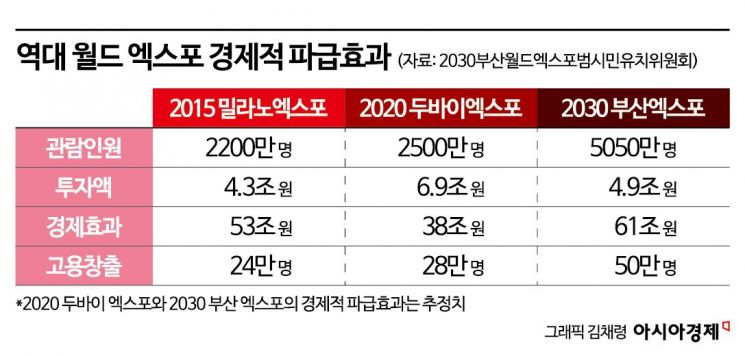
According to analyses by the Korea Development Institute (KDI) and the Korea Chamber of Commerce and Industry, if South Korea hosts the Busan Expo, it is estimated to generate an economic ripple effect worth 61 trillion won and create 500,000 jobs. Over six months, more than 50.5 million visitors from over 200 countries worldwide are expected to attend, generating a production inducement effect of 43 trillion won and a value-added effect of 18 trillion won. This is 2.1 times and 3.6 times higher than the economic ripple effect of 29 trillion won during the 2018 Pyeongchang Winter Olympics and the 17 trillion won economic value added from hosting the 2002 Korea-Japan World Cup, respectively. The World Expo is a platform where not only the host country but also participating countries showcase their comprehensive commercial capabilities to the world, which explains its greater economic profitability.
Countries that previously hosted the World Expo also reaped tens of trillions of won in economic benefits. According to the Korea Trade-Investment Promotion Agency (KOTRA), the 2010 Shanghai Expo attracted 74 million visitors over six months from 192 countries and 50 international organizations, achieving an economic impact of 110 trillion won. Of this, tourism revenue alone reached 52.7 trillion won, and employment creation totaled 630,000 people. The 2015 Milan Expo, with an investment of 4.3 trillion won, generated an economic effect of 53 trillion won and created 240,000 new jobs. Despite the adverse effects of COVID-19, the 2020 Dubai Expo is estimated to have produced a production inducement effect worth 38 trillion won.
The capital invested and infrastructure expanded for hosting the Expo can also serve as valuable resources for the long-term development of the city. It can revitalize underdeveloped or neglected suburban areas, expanding the urban perimeter and giving the host city a new identity. France is a prime example. By reconstructing the city through the Expo grounds connecting central Paris, the Eiffel Tower, and the Seine River, it elevated its status as a global city. Austria's Vienna, which connected the Expo site with the old city outskirts to create a new downtown area, is also cited as a major success story among Expo host countries.
Busan, the Hub of the East Sea and Pacific Region...Expectations for Economic Vitality
Since most cities that have hosted Expos possess commercial competitiveness, South Korea's hosting of the Expo is seen as an opportunity to enhance its status as a host of large-scale events and raise Busan's international recognition. Busan, as the starting and ending point of the Eurasian railway network (T0R, TCR) connecting China, Russia, and Europe, is expected to strengthen its position as the hub of the East Sea and Pacific region. Ji-Young Park, Senior Researcher at the Free Enterprise Institute, explained in 'Implications and Challenges of the 2030 Busan World Expo' that "Hosting the Busan World Expo is an opportunity to promote and publicize South Korea's economic stature as a country with one of the world's top 10 economies."
Above all, hosting the World Expo is expected to provide a new foundation for the long-standing national goal of balanced regional development in South Korea. It is anticipated to invigorate the southern economic zone, including Busan, Ulsan, and Gyeongnam, and particularly promote regional development through the revitalization of Busan's commercial districts. The establishment of a metropolitan transportation network connecting the region for the Expo and the influx of innovative companies into Busan through the Expo could activate local commerce.
Previously, the 1993 Daejeon Expo led to improvements in residential environments such as the expansion of lanes on the Gyeongbu Expressway, construction of the Daejeon-Sintanjin expressway, and development along Gapcheon, transforming Daejeon into the central city of the central economic zone. The 2012 Yeosu Expo contributed to Yeosu's growth as a major marine tourism city through the establishment of the Jeolla Line KTX and construction of various expressways. Researcher Park diagnosed that "Investment activation in SOC sectors, including transportation and regional development infrastructure, and overall economic revitalization can enhance economic vitality."
© The Asia Business Daily(www.asiae.co.kr). All rights reserved.



















