Continuing for 14 Years in Inhaman... 96% of Franchise Stores Receive Preferential Treatment
Legal Maximum Interest Rate Must Be Adjusted to Market Conditions
There have been calls to realistically improve the card merchant fee rates, which are close to 0% and even raise concerns about 'reverse margin.' This is because various simple payment service providers operate similar businesses but are not subject to merchant fee rate regulations, potentially leading to unfair competition. There were also arguments that different statutory maximum interest rates should be applied to banks and secondary financial institutions to better include middle- and low-credit borrowers within the formal financial system.
The Korea Credit Card Association held the 'KOCAS Conference 2023' on the 23rd at a hotel in Jung-gu, Seoul, under the theme of 'Business Strategies for Future Revenue Generation and Cost Reduction of Card Companies.'
Professor Kim Sang-bong of Hansung University’s Department of Economics pointed out the issue of card companies' merchant fee rates during the second topic presentation that day. Merchant fee rates have been lowered 14 times since 2007. The preferential fee rates applied to small merchants have also been expanded more than eight times since 2012, and currently, 96% of all merchants are subject to these rates. The preferential fee rates are categorized based on annual sales as follows: ▲0.5% for up to 300 million KRW ▲1.1% for over 300 million KRW up to 500 million KRW ▲1.25% for over 500 million KRW up to 1 billion KRW ▲1.5% for over 1 billion KRW up to 3 billion KRW.
Professor Kim explained, "Merchant fee rates are currently almost 0%. Merchants benefit from tax deductions during year-end tax settlements if they have card terminals, so card payments actually generate profits for them. Meanwhile, card companies continue to incur losses in the fee segment as transactions increase. IT companies providing simple payment services, such as Apple Pay, apply higher fee rates despite offering essentially the same services."
There were also calls to abolish the 'qualified cost system,' under which the Financial Services Commission recalculates merchant fees every three years. The current system fails to reflect the high-interest-rate environment and effectively serves only as a justification for fee reductions. 'Qualified costs' refer to a type of operating cost for card companies, including ▲funding costs ▲risk management costs ▲general administrative costs ▲authorization and settlement costs ▲marketing costs.
Professor Kim criticized, "When the qualified cost system was established, interest rates were declining, but now we are in a high-interest-rate era, and the current system does not reflect the increased funding costs of card companies. The qualified cost system should be abolished or the recalculation cycle adjusted to reflect economic fluctuations."
He also argued that the current statutory maximum interest rate of 20% should be changed. Without a flexible maximum interest rate policy, middle- and low-credit borrowers struggling with high interest rates may turn to illegal private loans instead of financial institutions. Therefore, he proposed a variable maximum interest rate system that flexibly adjusts according to market conditions. For example, as bond yields or base rates in the funding market rise, the statutory maximum interest rate should also change, or flexible restrictions should be applied by product or industry sector.
Professor Kim explained, "Twenty-one European Union (EU) member countries, including France and Italy, have adopted variable maximum interest rate systems or do not impose limits on statutory maximum interest rates. France sets its statutory maximum interest rate at 133% of the average market interest rate for similar loans in the previous quarter, as announced quarterly by the central bank, while Italy distinguishes maximum interest rates in detail by product."
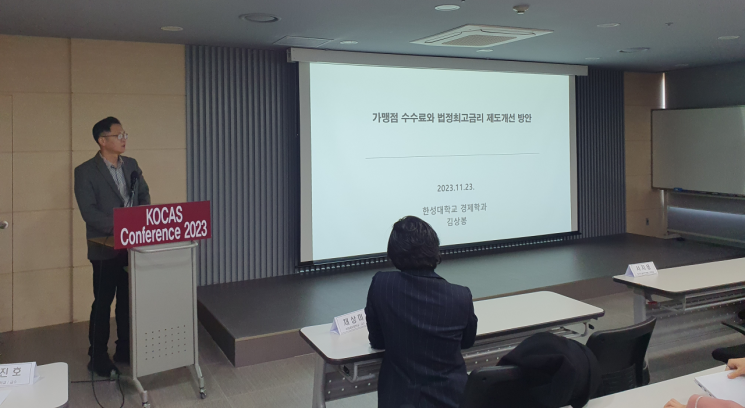 Professor Kim Sang-bong of the Department of Economics at Hansung University is giving a keynote presentation at the 'KOCAS Conference 2023' hosted by the Korea Credit Card Association at a hotel in Jung-gu, Seoul on the 23rd.
© The Asia Business Daily(www.asiae.co.kr). All rights reserved.
![Clutching a Stolen Dior Bag, Saying "I Hate Being Poor but Real"... The Grotesque Con of a "Human Knockoff" [Slate]](https://cwcontent.asiae.co.kr/asiaresize/183/2026021902243444107_1771435474.jpg)
















