One in Eight Korean Companies "Will Withdraw in 5 Years"
Causes: Intensified Competition, US-China Disputes, Rising Production Costs
69% Target Southeast Asia for Relocation
A survey revealed that over 40% of Korean semiconductor companies operating in China are unable to operate even 60% of their facilities. Related companies, which had generally planned to maintain their businesses until last year, are now actively considering long-term withdrawal or downsizing.
On the 23rd, Kim Jae-deok, head of the Beijing branch of the Korea Institute for Industrial Economics & Trade, announced this at the Beijing Morning Forum hosted by the Chinese Korean Chamber of Commerce and the Korea Chamber of Commerce and Industry Beijing Office at the Hilton Hotel in Beijing, China. He presented on the topic of "Recent Management Status of Korean Companies in China and the 2024 Korea-China Economic Outlook." The survey was conducted from June to August targeting 508 member companies operating in China.

Unusually Low Operating Rates in the Semiconductor Sector
China is Eager to Attract Investment... One in Eight Korean Companies Plans Withdrawal in 5 Years
Semiconductor Companies More Actively Considering Withdrawal
Looking at the operating rates of respondent companies confirmed through the survey, half (50.5%) reported operating at 60% or higher, which is considered a slight improvement compared to last year (48.0% at 60% or higher). Companies operating at 80% or more accounted for 22.4%.
However, in the semiconductor sector, only 23.5% of companies reported operating at 80% or higher, with the largest share (35.3%) reporting operating rates between 60% and 80%. Operating rates between 40% and 60% accounted for 29.4%, and 20% to 40% reached 11.8%. In last year’s survey, 85.7% of semiconductor companies reported operating rates between 60% and 80%, and the remaining 14.3% reported 40% to 60%. Kim explained, "Since the first survey in 2020, the operating rate in the semiconductor sector has been unusually low."
For mobile phones and home appliances, 32.3% reported operating at 80% or higher, 35.5% between 60% and 80%, and 19.4% between 40% and 60%. Companies reporting 20% to 40% and below 20% accounted for 6.5% each. In the textile and apparel sector, the largest share reported operating rates between 40% and 60% (28.6%), followed by 80% or higher (25.7%) and 60% to 80% (22.9%). By industry, 51.7% of manufacturers reported operating rates of 60% or higher, while service industries recorded 49.1%.
In this survey, one out of eight Korean companies operating locally said they are considering withdrawal within five years, drawing attention. The reasons cited for consideration included intensified market competition, the US-China dispute, and rising production costs.
Regarding future business prospects, 12.4% of respondents viewed their business outlook in China negatively after five years and said they are considering withdrawal. Particularly, the display sector among manufacturers had the highest withdrawal response rate at 26.7% across all industries. While a significant portion of service industries (41.3%) expected to maintain operations, 15.6% considered withdrawal. Other sectors with relatively high withdrawal outlooks included excavators and ships (20.2%), transportation equipment (15.9%), automotive and parts (15.1%), and manufacturing (11.2%).
Semiconductor companies whose operating rates significantly worsened compared to last year mostly planned to maintain operations (71.4%) and only some (28.6%) expected withdrawal until last year. However, this year’s survey showed a decrease in maintenance responses to 52.9%, with increases in withdrawal (29.4%) and downsizing (17.6%).
The proportion of companies planning to expand their business within the next 2-3 years was 13.6% for manufacturing and 15.6% for services. The most optimistic sectors for short-term business expansion were automotive and parts (22.6%) and other manufacturing (21.2%), while withdrawal responses were prominent in excavators and ships (20.0%) and display (13.3%).
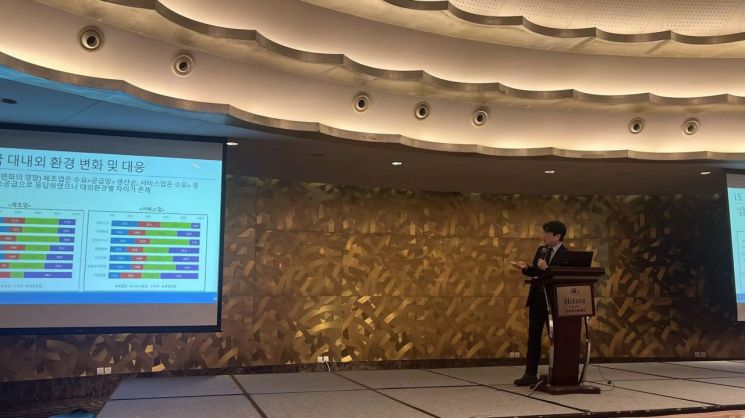 Kim Jae-deok, Head of the Beijing Office at the Korea Institute for Industrial Economics and Trade, is giving a presentation on "Recent Business Conditions of Korean Companies in China and the 2024 Korea-China Economic Outlook" at the Beijing Morning Forum hosted by the Chinese Korean Chamber of Commerce and the Beijing Office of the Korea Chamber of Commerce and Industry at the Hilton Hotel in Beijing, China, on the 23rd. (Photo by Kim Hyun-jung)
Biggest Issues Are Intensified Competition and US-China Dispute
69% Identify Southeast Asia as Alternative Countries
The most representative reasons cited by companies considering withdrawal or relocation were intensified competition (33.28%), the US-China dispute (26.22%), and rising production costs in China (15.13%). The dominant relocation target region was Southeast Asia (69.16%), followed by South Asia (13.3%) and Korea (2.9%).
Overall expectations for current business performance have improved compared to last year during the zero-COVID period, but the outlook for sales increase (28.4%) was far outweighed by expectations of sales decline (42.3%). Similarly, profits were more often expected to decrease (42.2%) than increase (27.6%).
The main cause of expected sales decline was weak local demand (47.9%, based on first priority). Other factors included intensified local competition (17.3%), weak export demand (15.4%), and COVID-19 disruptions (6.8%). Conversely, reasons for expecting sales growth included increased local demand (33.1%), product quality (19.7%), and business diversification (18.7%). Additionally, operational difficulties in China cited included intensified competition, weak local demand, and labor shortages. The most sensitive regulatory issues mentioned were environmental, labor, fire safety, and licensing regulations.
The survey also showed that Korean companies have accepted worsening internal and external conditions in the Chinese market (such as lockdown policies due to COVID-19 spread and strengthened environmental policies by the Chinese government). Environmental factors with relatively high joint response rates with affiliates included changes in demand markets (17.2%), rising production costs (16.7%), and unfair competition (14.6%).
The most sensitive external environmental issues (based on first priority) were the Korean Peninsula issue (31.5%), the US-China dispute (31.5%), and COVID-19 (22.8%). By company size, medium and large companies were sensitive to the Korean Peninsula issue, while small companies were sensitive to COVID-19 and the US-China dispute.
Meanwhile, this survey has been conducted by the Korea Institute for Industrial Economics & Trade since 2020, jointly organized by the Korea Chamber of Commerce and Industry Beijing Office, with the Chinese Korean Chamber of Commerce handling the survey operations.
© The Asia Business Daily(www.asiae.co.kr). All rights reserved.
![User Who Sold Erroneously Deposited Bitcoins to Repay Debt and Fund Entertainment... What Did the Supreme Court Decide in 2021? [Legal Issue Check]](https://cwcontent.asiae.co.kr/asiaresize/183/2026020910431234020_1770601391.png)
















