OpenAI Staff Party Right After Altman’s Return
'Precious Talent' AI Developers Earn Up to 1 Billion Won Annually
"AI Developers Are the Product... Difficult Training Makes Retention Crucial"
As 'the father of ChatGPT' Sam Altman returns as CEO of OpenAI, attention is focused on the AI developers who supported him and even issued warnings of mass resignation. Given the scarcity of developers in the AI industry, their support acted as a powerful force pressuring the board, ultimately helping Altman’s reinstatement.
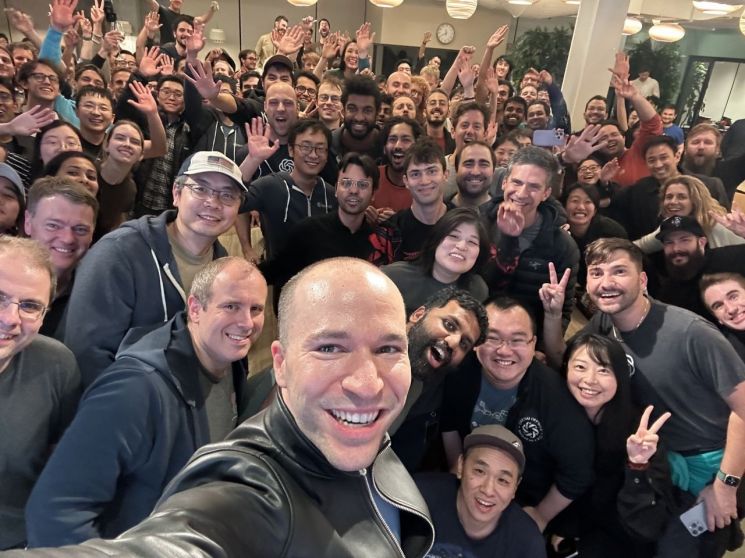 Greg Brockman, co-founder of OpenAI, taking photos while partying with employees at the headquarters on the 22nd (local time), shortly after CEO Sam Altman's return. (Photo by Greg Brockman SNS)
On the 22nd (local time), according to Bloomberg and Business Insider, Greg Brockman, co-founder who resigned alongside Altman immediately after his dismissal but returned on the same day, posted on his X (formerly Twitter) account a photo of a party with employees at OpenAI headquarters, along with the message "We are back." In the photo, OpenAI employees are smiling brightly, making peace signs or waving at the camera.
When the OpenAI board suddenly decided to dismiss Altman on the 17th, OpenAI employees expressed their opposition through social media.
After the first round of negotiations for Altman’s return failed, on the 20th, more than 700 out of 770 employees signed a petition stating they would resign if Altman did not come back. Shortly after, when news spread that Altman might move to Microsoft (MS), employees even expressed willingness to follow him, solidifying their position as his strong support base.
This prompted the board to begin discussing Altman and his return once again.
OpenAI, the company behind the globally impactful generative AI 'ChatGPT,' has many skilled AI developers. The support of these AI developers played a significant role in Altman’s return. The fact that over 90% of the company’s employees threatened to resign is a critical issue for the company’s survival, but in an AI company where technology is key, losing the AI developers who create that technology shakes the company’s foundation.
In the AI industry, developers are truly considered 'precious assets.' Developers experienced in the new technology of AI are so rare that companies often raise their salaries as they demand. Even when trying to increase salaries, it is difficult to find suitable talent.
Bloomberg cited data released in May by Levels.fyi, an IT company salary data analysis platform, reporting that AI developers earn 8 to 12.5% more than developers in non-AI fields.
In terms of amounts, the average salary for general developers ranges from $200,000 to $370,000 (approximately 260 million to 480 million KRW), but specialized AI developers can earn up to $450,000 (about 590 million KRW). This does not include bonuses or stock options, which can raise total compensation to as much as $800,000 (about 1.04 billion KRW).
Julia Pollak, senior economist at the online job matching service ZipRecruiter, explained, "For new technologies like AI, developers with experience are extremely rare," adding, "They are both the product and the company." She emphasized, "Supply constraints for AI developers are very real and binding problems," and "It is difficult to train new developers or hire experienced ones, so retaining current talent is most important."
Pollak also noted that even among AI developers, there is a significant gap between those who have learned the company’s existing code and technology and those who have not, adding, "One internal AI developer is worth as much as three external AI developers."
Large IT companies such as Google and Salesforce, which have been experiencing difficulties recruiting AI developers, actively moved to attract developers leaving OpenAI immediately after news of Altman’s dismissal broke. However, most reportedly stayed at OpenAI, closely watching the possibility of Altman’s return.
Microsoft, where the possibility of Altman and OpenAI developers moving increased, was also spotted preparing offices and Apple MacBook laptops at its subsidiary LinkedIn headquarters so that employees could start working immediately.
© The Asia Business Daily(www.asiae.co.kr). All rights reserved.


















