Delinquency Increased 2.5 Times in One Year
Seoul Has the Highest Average Loan Amount
The loan balance of self-employed multiple debtors facing repayment crises due to blocked additional loans has approached 744 trillion won. This figure has increased 6.2 times in one year.
According to the 'Status of Loans for Self-Employed Multiple Debtors by Province' data submitted by the Bank of Korea (BOK) to Yang Kyung-sook, a member of the National Assembly's Planning and Finance Committee from the Democratic Party of Korea, as of the end of the second quarter this year, the total loan balance of self-employed multiple debtors nationwide stood at 743.9 trillion won.
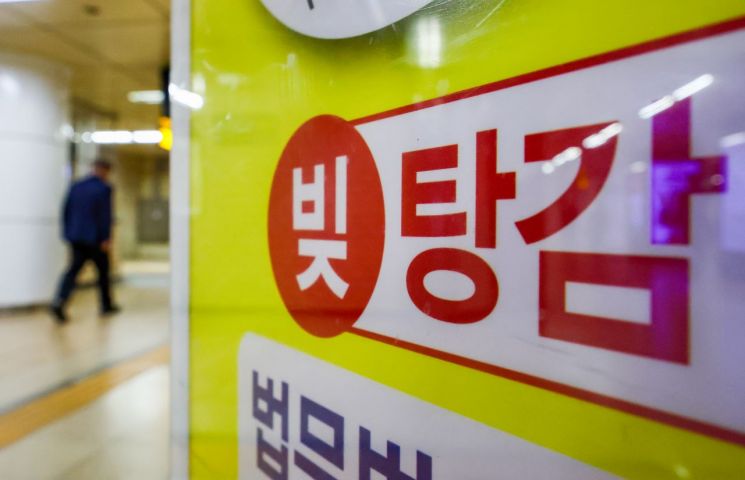 According to data from the Bank of Korea, the number of self-employed multiple debtors with a combined total of three or more household loan institutions and individual business loan products increased by 3.2% compared to last year, reaching a record high of 1,778,000.
 [Photo by Yonhap News]
The BOK considered individual business loan holders as self-employed by utilizing its household debt database (panel data of about 1 million borrowers) and estimated the total self-employed loan amount by combining their household loans and individual business loans.
Among them, multiple debtors are defined as those whose total number of household loan institutions and individual business loan products is three or more. The 743.9 trillion won is not only the highest ever recorded but also 6.2% higher than the 700.6 trillion won recorded at the end of the second quarter last year.
Number of Self-Employed Multiple Debtors Increases 3.2% to Record High
 As of the second quarter of this year, the outstanding loan balance and delinquent amount for self-employed individuals have each reached record highs, with loan flyers posted on the streets of Myeongdong, Seoul.
 [Photo by Yonhap News]
The number of self-employed multiple debtors, which increased by 3.2%, also reached a record high of 1.778 million people.
Over the past year, the delinquent amount (13.2 trillion won) and delinquency rate (1.78%) rose even more sharply, also setting record highs. In this data, the BOK considered the delinquent amount as the total loan amount of self-employed multiple debtors who failed to repay principal and interest for more than one month. Given the nature of multiple debtors who are practically unable to roll over their debts, the analysis regarded all loans held by these borrowers as the potential maximum delinquent amount.
The delinquency rate is the ratio of the delinquent amount to the total loans of self-employed multiple debtors. The delinquent amount in the third quarter was about 2.5 times the 5.2 trillion won recorded at the end of the second quarter last year. During the same period, the delinquency rate also surged 2.4 times from 0.75%. The average loan amount per self-employed multiple debtor nationwide was 418 million won, the highest in 3 years and 3 months since the first quarter of 2020 (430 million won).
Among provinces nationwide, Seoul had the highest average loan amount per self-employed multiple debtor at 603 million won. Daegu (491 million won), Gyeonggi (428 million won), Busan (427 million won), and Jeju (427 million won) also exceeded the national average (418 million won).
The largest increases were seen in Chungbuk (7.9%: 293 million won → 316 million won), Seoul (6.1%: 568 million won → 603 million won), Gwangju (5.9%: 338 million won → 358 million won), Jeju (5.8%: 404 million won → 427 million won), and Gangwon (4.5%: 270 million won → 282 million won). The region with the largest increase in total loan balance of self-employed multiple debtors over one year was Sejong (44%: 5.6 trillion won → 8 trillion won), which also ranked first in borrower growth rate (53.5%: 13,000 → 20,000 people).
Since both the total and per capita loan balances of self-employed multiple debtors are at record highs, their interest burden inevitably surges as interest rates rise. Based on the self-employed multiple debtor loan scale (743.9 trillion won at the end of the second quarter) and the estimated variable interest rate ratio (64.5%), the BOK analyzed that every 0.25 percentage point (p) increase in interest rates raises the total interest amount by 1.3 trillion won.
The average increase in interest burden per person is about 730,000 won annually. If interest rates rise by 1.0%p, the total and per capita average interest payments would surge by 5.2 trillion won and 2.91 million won, respectively.
Financial Authorities Strongly Demand Interest Reductions from Banks
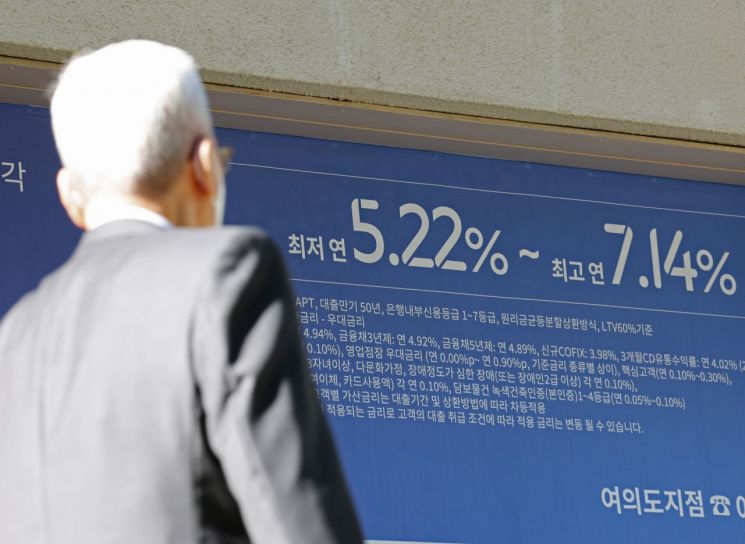 Household loan balances at the five major banks increased at the fastest rate in two years.
 [Photo by Yonhap News]
Meanwhile, financial authorities are emphasizing the financial burden on self-employed individuals in the high-interest era and are strongly demanding direct interest reductions for self-employed and small business owners from the banking sector.
Separately, according to the 'Household Credit (Preliminary) for the Third Quarter' announced by the BOK the day before, the household credit balance as of the end of September increased by 14.3 trillion won from the previous quarter to 1,875.6 trillion won.
This surpassed the record high of 1,871.1 trillion won at the end of September last year. The BOK evaluates that household debt is being managed at an appropriate level since the increase is not large, but concerns remain significant.
In particular, despite the government's household debt suppression measures being in effect, the household debt scale is growing, and indicators showing deterioration in debt quality are emerging in various areas, raising increasing criticism and warning signals.
© The Asia Business Daily(www.asiae.co.kr). All rights reserved.
![Clutching a Stolen Dior Bag, Saying "I Hate Being Poor but Real"... The Grotesque Con of a "Human Knockoff" [Slate]](https://cwcontent.asiae.co.kr/asiaresize/183/2026021902243444107_1771435474.jpg)


















