The government will apply tariff quotas to 76 items including sugar, chicken, and liquefied natural gas (LNG) to stabilize prices.
On the 22nd, the Ministry of Economy and Finance announced that it will give a one-week legislative notice starting today on the "2024 Tariff Quota Operation Plan," which contains detailed plans for the regular tariff quota operation for next year. Tariff quotas include tariff-rate quotas (0%), adjustment tariffs, increased market access volumes, and special emergency tariffs.
First, next year's tariff quotas will apply reduced tariffs to 76 items, prioritizing industrial competitiveness enhancement and price stabilization by comprehensively considering price trends and the utilization of free trade agreements (FTAs). The tariff quota system is a flexible tariff that adjusts the basic tariff rate within a range of 40 percentage points to strengthen industrial competitiveness, stabilize prices, and resolve tariff rate imbalances.
The fields subject to tariff quotas include new growth industry materials and raw materials such as quartz glass substrates (semiconductors) and lithium nickel cobalt manganese oxide (secondary batteries), as well as raw materials for traditional key industries such as aluminum alloys (automobiles) and nickel ingots (steel). Items related to vulnerable industries such as dispersible dyes (textiles) and feed corn (feed) are also supported.
For price stabilization, food and food raw materials such as food-grade potato modified starch, sugar, processed peanuts, chicken, and processed egg products, as well as industries and power generation raw materials vulnerable to supply and demand instability due to international oil price fluctuations, including LNG, LPG (butane, propane), and crude oil (for naphtha, LPG), are included. However, for oil products such as LNG, LPG, and naphtha, the support scale will be decided first in the first half of next year, and the extension of support in the second half will be reviewed and decided in the first half of next year.
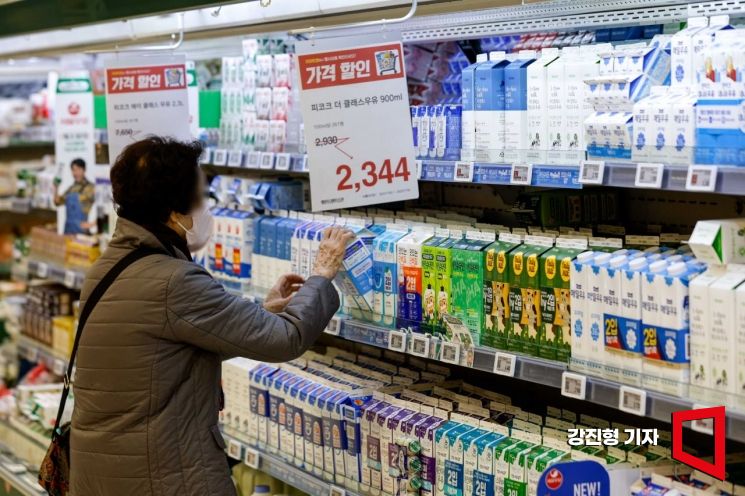 Last month, the price of milk rose by 14.3%, reaching the highest level in 14 years, as major food prices closely monitored by the government showed a significant increase compared to last year. On the 14th, a citizen visiting a large supermarket in Seoul is selecting milk. Photo by Jinhyung Kang aymsdream@
The adjustment tariff applies to 13 items including gochujang, live tilefish, salted shrimp, frozen pollock, and squid to protect domestic industries. The same tariff rates as this year will be applied to these items next year. Adjustment tariffs are flexible tariffs that can increase the basic tariff rate by up to 100 percentage points when the import increase of certain goods disrupts the domestic market or threatens the collapse of the industrial base.
Market access volume (TRQ) increases will support 13 items such as sesame, soybeans, and malt, with a slight increase in volume compared to this year. Processed peanuts, which were supported by increased market access volume this year, will be excluded from next year's market access volume increase targets as support will be expanded through tariff quotas due to recent sharp price rises.
Special emergency tariffs for agricultural and livestock products will be applied to 40 items including rice, glutinous rice, and rice flour, the same as this year. Special emergency tariffs are additionally imposed when imports of agricultural products liberalized under the Uruguay Round negotiations surge or import prices fall, meeting certain criteria. However, reflecting the recent trend of market expansion, the volume of grains is expected to be adjusted upward from 464,422 tons to 654,995 tons.
The government stated, "The operation plan was prepared through prior consultations and tariff review committee deliberations based on the demands of related ministries and stakeholders, and after legislative notice and related procedures, it is planned to be implemented from January 1 next year."
© The Asia Business Daily(www.asiae.co.kr). All rights reserved.

















