Religious Second-Generation Defense Team Announces Investigation Results
Forced to Refuse Blood Transfusions Due to Parents' Religion
In Japan, following the shooting incident involving former Prime Minister Shinzo Abe and the ensuing controversy over so-called 'second-generation religious followers' in the former Unification Church, a report on the actual conditions of Jehovah's Witnesses has been released, sparking further debate. As allegations have surfaced that children of members of this religion were forced to refuse blood transfusions and suffered child abuse, the issue is causing ripples once again in Japanese society.
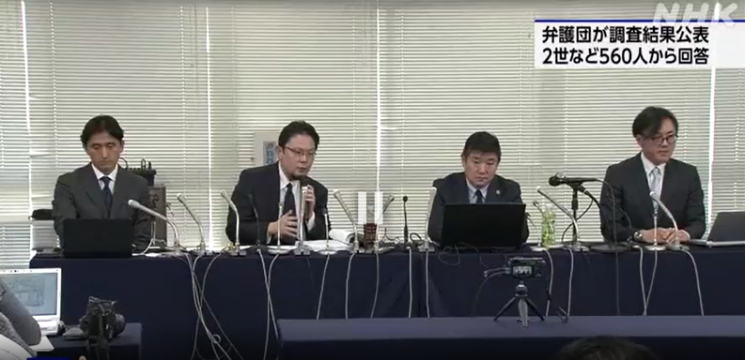 Jehovah's Witnesses second-generation religious defense team presenting the investigation results. (Photo by NHK)
On the 21st, Asahi Shimbun reported that a legal team addressing the Jehovah's Witnesses issue announced a survey report on the abuse of second-generation religious followers the previous day. The legal team conducted a survey of 581 second-generation Jehovah's Witnesses, and 487 responded that despite their parents being believers, they themselves 'do not have faith.'
Additionally, more than 90%, or 514 respondents, reported having been physically punished with bare hands, rulers, belts, or similar means. The most common period when the punishment began was 'from birth to around age 3,' with 241 respondents indicating this.
Furthermore, over 80%, or 451 respondents, possessed blood transfusion refusal cards. Jehovah's Witnesses prohibit blood transfusions according to their doctrine. Regarding why second-generation members carried these refusal cards, 337 said it was 'because they heard it from their guardians,' 218 said 'because they believed in the doctrine that blood transfusions are forbidden,' and 153 said 'because they heard it from fellow believers around them.'
When asked if they had ever been unable to participate in certain classes or school events due to religious doctrine, more than 90%, or 537 respondents, answered 'yes.' Similarly, 522 respondents, also over 90%, reported having experienced restrictions in friendships, romantic relationships, or marriage due to being believers.
In addition, 437 people reported feeling negative emotions such as loneliness, alienation, and lack of self-esteem due to religious issues, while 343 reported feeling or having been diagnosed with mental health conditions such as PTSD or alcoholism.
The legal team demanded the establishment of an investigative committee including third parties and an apology from the religious organization to second-generation members who have suffered child abuse.
At a press conference the previous day, the legal team pointed out, "Abuse has been reported for decades across various regions," and stated, "Second-generation religious followers have suffered human rights violations for decades, and in some cases, for their entire lives." The legal team also submitted this survey report to the Child and Family Agency.
However, the Jehovah's Witnesses responded to Asahi's inquiry by stating, "We do not force religion on children. We do not tolerate child abuse."
The Japanese government is actively working to resolve the second-generation religious follower issue, including filing a dissolution order against the former Unification Church. On the 7th, Tomihiro Tanaka, head of the Japan Church, held a press conference and officially apologized, saying, "We sincerely apologize from the bottom of our hearts to the second-generation religious followers and the public who have had difficult experiences due to our shortcomings."
© The Asia Business Daily(www.asiae.co.kr). All rights reserved.
!["The Woman Who Threw Herself into the Water Clutching a Stolen Dior Bag"...A Grotesque Success Story That Shakes the Korean Psyche [Slate]](https://cwcontent.asiae.co.kr/asiaresize/183/2026021902243444107_1771435474.jpg)
















