Differences Between Public and Private Sectors Over 'Completion Deadline Extension'
Ministry of Land Holds Mediation Committee Meeting to Seek Agreement
CJ Side: "If Mediation Fails, Project Cannot Proceed"
The 'CJ Live City' project, the largest private development project in the northern Gyeonggi region with nearly 700 billion won already invested and an estimated economic effect reaching 30 trillion won, is at risk of falling apart. This is because Gyeonggi Province is firmly maintaining its stance that it cannot allow an extension of the completion deadline, which is the biggest issue. It has been confirmed that CJ Live City, a subsidiary of CJ Group and the project implementer, is seriously considering completely scrapping the project if mediation fails at the 'PF (Project Financing) Adjustment Committee' reoperated by the Ministry of Land, Infrastructure and Transport after 10 years. Recently, even Deputy Prime Minister for Economy Choo Kyung-ho stepped in, stating, “We will support the prompt resumption of construction and completion in 2026 based on a reasonable adjustment plan and consultations between both parties by November,” mentioning project normalization, but in reality, the project is on the verge of collapse.
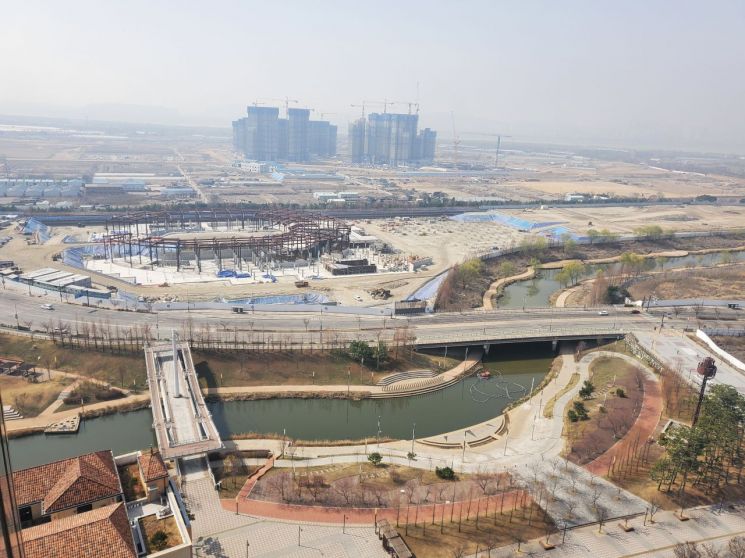 The CJ LiveCity construction site facing the risk of project cancellation. Construction has been halted since April [Photo provided by CJ LiveCity]
The PF Adjustment Committee is a system operated by the Ministry of Land, Infrastructure and Transport to prevent insolvency as conditions for several public-private PF projects have worsened recently. It targets development projects where public institutions provide land and private entities invest capital. The CJ Live City project, for which Gyeonggi Province provided the site, is also included in the adjustment targets. The committee notifies the public and private parties of the agreed adjustment plan. However, the adjustment plan has no legal binding force. Ultimately, it depends on the will of the local government.
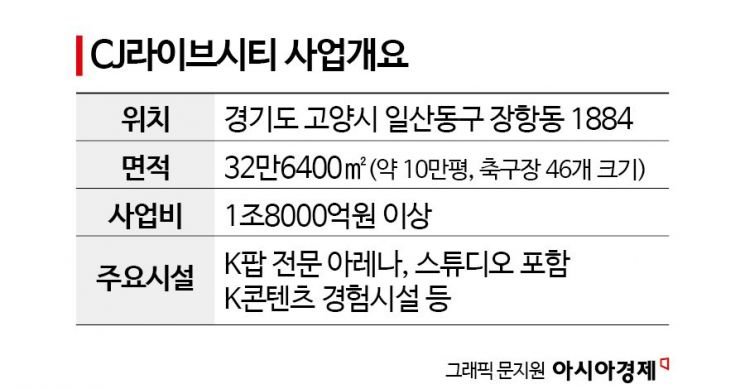
Launched in 2016, the CJ Live City project involves constructing a K-pop specialized arena (a large-scale concert hall optimized for music performances) on a 326,400 ㎡ site (equivalent to 46 soccer fields) in Janghang-dong, Goyang Special City, Gyeonggi Province, with a total project cost of 1.8 trillion won. The indoor seating capacity alone is 20,000, and including outdoor areas, it can accommodate up to 60,000 spectators. The original completion target was 2020. However, the project faced difficulties due to three changes in the project plan and delays in permits and approvals by Gyeonggi Province. Construction began in October 2021 but was halted in April at a progress rate of about 17%.
US Company: "We Cannot Understand Korean Administration"
The core reason for the construction halt is financial issues. Due to rising material and labor costs, it became difficult to continue construction with the existing contract with the construction company. Compared to three years ago, the original completion target time, construction costs have increased by more than 30%. As the project period extended, the total project cost, initially 1.2 trillion won, swelled to 1.8 trillion won. CJ Live City has tried to continue construction by issuing long-term CP (commercial paper) worth 275 billion won but has reached its limit. The parent company, CJ ENM, is also in a situation with no financial capacity, having accumulated losses of 73.3 billion won by the third quarter.
To smoothly raise funds, an extension of the 'completion deadline' is necessary first. The completion deadline was December 2020, which has already passed by nearly three years. This was the completion period agreed upon by Gyeonggi Province, the project sponsor, and CJ. If the project is not completed within the period, delay compensation must be paid. The longer the delay, the higher the compensation. The compensation amount already exceeds 100 billion won. AEG, a key American partner in the project, is reportedly considering withdrawing from the project if the completion deadline extension is not granted. AEG owns and operates more than 300 arenas and stadiums worldwide and is known as the 'Midas touch' in the performance industry. It is promoting a joint venture with CJ Live City, investing half the shares each to plan and promote performances.
A CJ Live City official said, "If the extension of the completion deadline is not allowed, even if we want to continue the project, we cannot," adding, "AEG reacts that it cannot understand Korean administration treating a private project with no tax benefits so poorly." The business environment is very different from other countries that provide tax benefits or long-term loans. The only benefit CJ Live City has received from the government is the land provided on a 'paid lease' basis.
Gyeonggi Province: "Completion Deadline Extension Not Possible"
CJ Live City hopes the 'PF Adjustment Committee' will resolve the issue of extending the completion deadline. However, if Gyeonggi Province, which does not allow the extension, does not change its position, it is meaningless. In fact, the Gyeonggi Province Content Business Department, the project’s main department, told Asia Economy in a phone interview, "The clear cause of the delay lies with CJ," and "Currently, there is no intention to extend the completion deadline." They stated that if delay compensation is not paid despite missing the deadline, it could be seen as preferential treatment or breach of duty, so it cannot be allowed. They also expressed reluctance, saying the project might be audited by the Board of Audit and Inspection in the future.
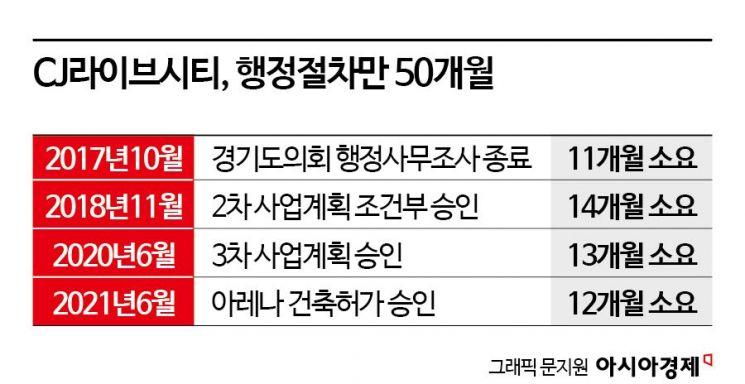
Of course, the primary cause of the project delay was the three changes in the project plan. However, it is difficult to place all responsibility on CJ. The administrative procedures alone took nearly 50 months. CJ was investigated by the Gyeonggi Provincial Council for 11 months in 2016 due to involvement in the political scandal but was eventually cleared of charges. Only suspicion of 'preferential treatment' caused delays and wasted time. The second and third plan approvals took 14 and 13 months respectively. The arena construction permit also took 12 months. Moreover, since this adjustment committee explicitly allows pre-consultation with the Board of Audit and Inspection before deciding the adjustment plan, CJ believes it can be free from suspicion of preferential treatment. The pre-consultation system is a system where the Board of Audit and Inspection provides opinions when decision-making is difficult while promoting proactive administration.
Other local governments besides Gyeonggi Province have granted extensions of completion deadlines in many cases. For example, in Yeongjongdo, Incheon, the Inspire Arena project had its deadline extended twice by Incheon City by a total of 39 months. The reasons for extension were changes in investment plans and project plans. The project sponsor is the American resort company Mohegan. This 15,000-seat venue is scheduled to open this month. The American company thus will obtain the title of the first 'K-pop arena' instead of CJ Live City.
'Even if BTS Returns as a Complete Group, There Is No Venue to Perform'
If CJ gives up, there is no major company suitable to take over this project. More than 1 trillion won in funds will be needed going forward. From a profitability perspective, there is no reason to jump in. The main revenue source, 'rental fees,' is not as large as expected. Generally, rental fees account for less than 10% of concert revenue. The rest mostly goes to production companies and agencies. Last year, the total rental fee income from four facilities around Olympic Park, including KSPO Dome, was 14 billion won. Considering CJ Live City is about three times larger, it would take 100 years to recover the project cost (1.8 trillion won) from rental fees. Even putting the project cost in a bank and receiving interest would yield more than rental income.
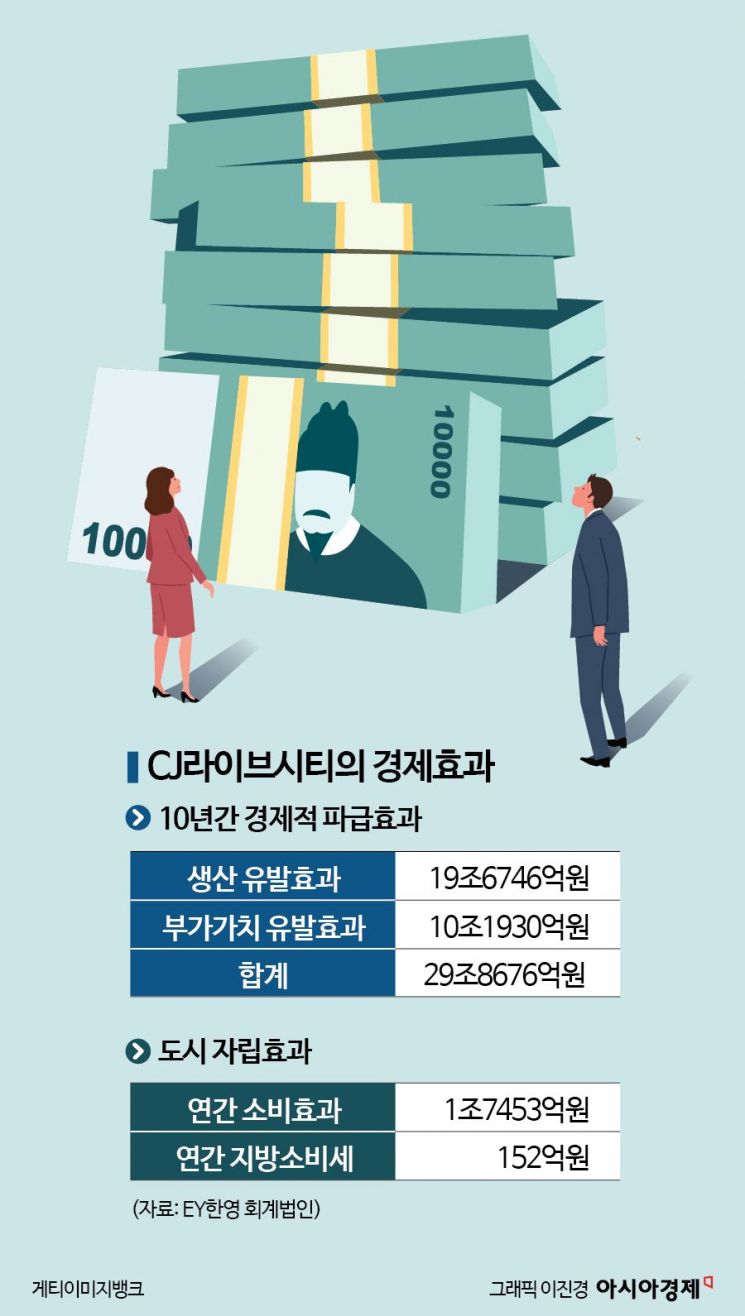
This project was possible because CJ Group pursues 'Cultural Patriotism (Munhwa Boguk).' If the project collapses, the '30 trillion won economic effect' will be lost. According to data investigated by EY Han Young Accounting Firm in 2019, if the project operates, the economic ripple effect over 10 years would reach 29.8676 trillion won, and employment inducement would be 200,000 people. It is expected to generate 1.7453 trillion won in annual consumption effects, and local consumption tax revenue for Goyang Special City would reach 15.2 billion won annually.
Even if construction resumes, completion will only be possible by 2026. The entertainment industry eagerly awaits the normalization of the CJ Live City project. In Korea, venues that can accommodate 60,000 people are limited to Jamsil Olympic Main Stadium and Seoul World Cup Stadium. Football stadiums are practically unavailable for rental, and the Olympic Main Stadium is undergoing remodeling until 2026. This means that even if BTS resumes activities as a complete group in 2025, there will be no large-scale venue suitable for proper performances. The largest current venue, KSPO Dome (with a maximum capacity of about 15,000 seats), has already fully booked rental reservations for this year in the first half, and there are even cases of paying premiums to secure rentals. It is time for the central government, local governments, and political circles to play some role for the development of K-pop and revitalization of local economies.
© The Asia Business Daily(www.asiae.co.kr). All rights reserved.



















