Korean Studies Advancement Center "Deep Gratitude for Donation Without Compensation"
On the 21st, the Korea Institute of Korean Studies announced that it received a donation of five epitaph stones (jiseok) of Yakbong Kim Geuk-il (1522?1585), repatriated from Japan, from Jeon Yunsu, director of the China Art Research Institute, last month. Jiseok are engraved stones or slabs buried to record personal information or the location of a grave. They include details such as clan origin, name, ancestral lineage, birth date, death date, life traces, and family relationships, and are buried in front of or beside the grave.
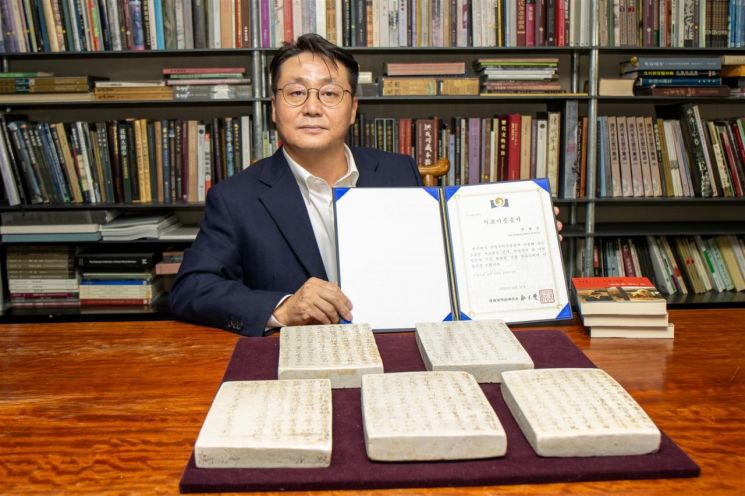 Jeon Yunsu, Director of the Chinese Art Research Institute, who donated the inscription of Yakbong Kim Geuk-il
Kim Geuk-il was a descendant of a prestigious family in Andong, Gyeongbuk, and the eldest son of Cheonggye Kim Jin (1500?1580). He passed the civil service examination in the first year of King Myeongjong’s reign (1546) and served as Left Assistant Minister of the Ministry of Personnel, Governor of Gyeongsang Province, County Magistrate of Pyeonghae, County Magistrate of Yecheon, Magistrate of Seongju, and Chief Inspector of the Saheonbu. The epitaph stones were written by Miam Lee Jae (1657?1730) in the fourth year of King Yeongjo’s reign (1728). They were looted during the Japanese colonial period and taken to Japan but were able to return thanks to Director Jeon’s efforts.
Director Jeon said, “I heard a rumor that they were in an antique shop in Japan, so I went there myself and purchased them. Their preservation condition was good,” adding, “Since they were excavated from ancestral graves, it is only right to return them.” He has also donated other items such as the white porcelain epitaph of Lady Sim of Geumneung County and the white porcelain epitaph of Jeon Manchu (both at the National Palace Museum), and the epitaph stone of Jeollado Governor Hong Jungha (at the National Gwangju Museum).
Jung Jongseop, president of the Korea Institute of Korean Studies, said, “We deeply appreciate the donation of important overseas repatriated cultural assets without any compensation,” and added, “It is even more meaningful that they will be managed together with about 3,000 Korean studies materials from the Cheonggye Kim Jin family, which are currently held in trust.”
© The Asia Business Daily(www.asiae.co.kr). All rights reserved.

















