Collapsed at the immigration office, treated at Inha University Hospital
"The best cardiologist... moved by the sincerity"
A mayor from a Japanese local government who collapsed due to cardiac arrest at the Incheon International Airport arrival hall has recovered and returned home.
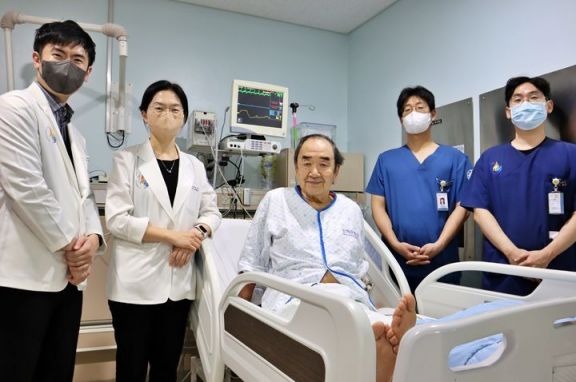 Iwakura Hirofumi, the 73-year-old mayor of Tomakomai City in the southwest of Hokkaido, Japan, is taking a commemorative photo with officials one day before being discharged from Inha University Hospital.
 [Photo by Inha University Hospital]
On the 21st, Inha University Hospital announced that Hirofumi Iwakura, the 73-year-old mayor of Tomakomai City, located southwest of Hokkaido, Japan, had completed treatment and was discharged.
Earlier, on the 7th, Mayor Iwakura boarded a flight to Korea for a business trip. However, while waiting at the immigration checkpoint in Terminal 2 of Incheon Airport, he collapsed due to cardiac arrest.
Staff from the Incheon Airport Immigration Office and the airport ambulance team, who were working nearby, immediately performed cardiopulmonary resuscitation (CPR) and emergency treatment. Mayor Iwakura was then transferred to the Incheon Airport International Medical Center at Inha University Hospital for treatment.
Afterward, Mayor Iwakura’s consciousness gradually began to return only after the medical staff at the Incheon Airport International Medical Center performed intubation and other procedures.
The center decided to transfer him to the main hospital, Inha University Hospital, for intensive care. Crossing the Yeongjongdo Bridge, he was transported to Inha University Hospital, where he was admitted to the cardiovascular intensive care unit after passing through the emergency medical center.
During this process, Professor Choi Seong-hwan accurately diagnosed cardiogenic shock caused by heart failure and set the treatment direction. Professors Jang Ji-hoon, who is fluent in Japanese, and Shin Sung-hee adhered to global standards for treating critically ill patients after cardiogenic shock and responded appropriately to each situation.
Following the professors’ advice, Mayor Iwakura decided to return to his home country to receive an implantable cardioverter defibrillator (ICD).
Mayor Iwakura said, "My family in Japan was worried when they heard about my condition, but I reassured them not to worry because I was receiving treatment from Korea’s top heart specialists. I was deeply moved by the high-quality medical service and the sincere care for patients at Inha University Hospital."
Chief physician Professor Jang Ji-hoon stated, "I hope this case serves as an opportunity for heart failure patients, their families, and those around them to recognize the importance of early emergency measures such as CPR, consistent medication for prevention, and the implantation of cardioverter defibrillators."
○ When a cardiac arrest patient occurs
- If there is a problem with heartbeat or breathing, start cardiopulmonary resuscitation (CPR).
- After calling 119, perform strong, deep, and fast chest compressions continuously (more than 100 times per minute).
- CPR involves repeating 30 chest compressions and 2 rescue breaths. Rescue breaths should not exceed 10 seconds.
- Performing CPR alone can save lives in cases of cardiac arrest caused by trauma, myocardial infarction, arrhythmia, or other risks.
© The Asia Business Daily(www.asiae.co.kr). All rights reserved.
!["The Woman Who Threw Herself into the Water Clutching a Stolen Dior Bag"...A Grotesque Success Story That Shakes the Korean Psyche [Slate]](https://cwcontent.asiae.co.kr/asiaresize/183/2026021902243444107_1771435474.jpg)
















