International Joint Research Including KAIST
Measuring Economic Development in Underdeveloped Countries
According to the United Nations (UN), the number of people living in absolute poverty on less than $2 a day reaches 700 million. However, accurately assessing the state of poverty is not easy. Over the past 15 years, 53 countries worldwide have failed to conduct agricultural surveys, and 17 countries have not even carried out population censuses. To overcome this data shortage, technology that estimates economic indicators using satellite images accessible to anyone on the web is gaining attention.
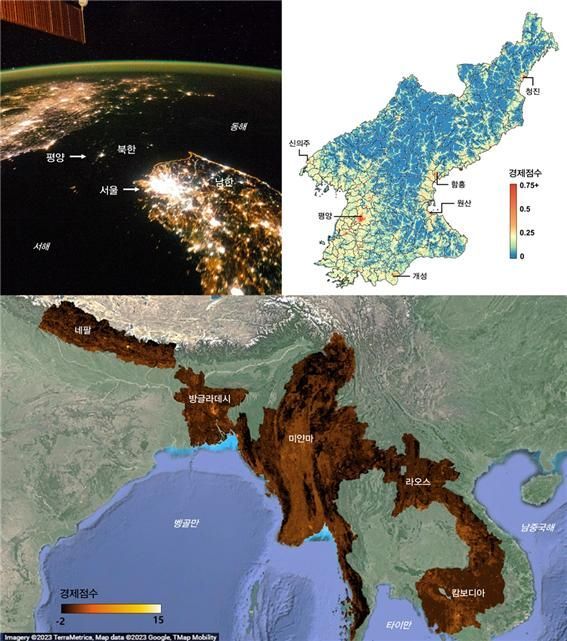 Nighttime light imagery, primarily used for economic scale prediction (top left: background photo provided by NASA Earth Observatory). Compared to South Korea, where lights are bright, North Korea appears dark except for Pyongyang due to lack of electricity supply. The model developed by the research team shows more detailed economic prediction results for North Korea (top right) and five Asian countries (bottom: background photo from Google Earth). [Source=KAIST]
A research team led by Professors Cha Mi-young and Kim Ji-hee at KAIST announced on the 21st that they have developed a new artificial intelligence (AI) method to analyze economic conditions using weekly satellite images through joint research with the Institute for Basic Science, Sogang University, Hong Kong University of Science and Technology, and the National University of Singapore.
The research team utilized Sentinel-2 satellite images operated and freely provided by the European Space Agency (ESA). First, they finely divided the satellite images into small areas of about 6 km². Then, based on visual information such as buildings, roads, and greenery in each area, they quantified economic indicators using AI techniques.
Through this study, the team expanded the scope of economic analysis to regions lacking existing statistical data and applied the same technology to North Korea and five Asian countries (Nepal, Laos, Myanmar, Bangladesh, Cambodia). The team stated, "The economic indicators presented in this study showed a high correlation with existing socioeconomic indicators such as population density, employment numbers, and the number of businesses, confirming its applicability to underdeveloped countries with insufficient data."
A strength of this model is its ability to detect annual changes in economic activity. In the case of North Korea, three trends in the economy were identified between 2016 and 2019, a period when economic sanctions intensified.
First, North Korea's economic development became more concentrated in Pyongyang and major cities, deepening the gap between urban and rural areas. Second, in tourism economic development zones established to overcome sanctions and a shortage of dollar foreign exchange, changes such as new building constructions were observed. Third, traditional industrial and export economic development zones showed minimal changes.
 Main Research Participants. No. 1 Andonghyun, Ph.D. candidate, Department of Computer Science, KAIST; Jaeseok Yang, Ph.D. candidate, Department of Geography, National University of Singapore; Miyoung Cha, Professor, KAIST / IBS CI; Jihee Kim, Professor, KAIST; Sangyoon Park, Professor, Hong Kong University of Science and Technology; Hyunju Yang, Professor, Sogang University.
The research team expressed hope that "this work will help reduce the data gap between developed and developing countries and contribute to achieving the United Nations and international community’s shared goal of sustainable development."
The research results were published on the 26th of last month in the international academic journal Nature Communications by Dr. Andonghyun, a doctoral candidate in the Department of Computer Science at KAIST, and Dr. Yang Jaeseok, a doctoral candidate at the National University of Singapore, as co-first authors.
© The Asia Business Daily(www.asiae.co.kr). All rights reserved.


















