The Ministry of Employment and Labor is reportedly set to decide this week whether to request President Yoon Suk-yeol to exercise his veto power over the "Partial Amendment to the Labor Union and Labor Relations Adjustment Act," commonly known as the "Yellow Envelope Act."
Labor organizations argue that this law is essential to effectively guarantee the constitutionally protected "three labor rights" and are demanding its immediate promulgation and enforcement. However, the business community strongly urges the president to exercise his veto, claiming it would lead to a deterioration of labor conditions by promoting an all-powerful strike culture.
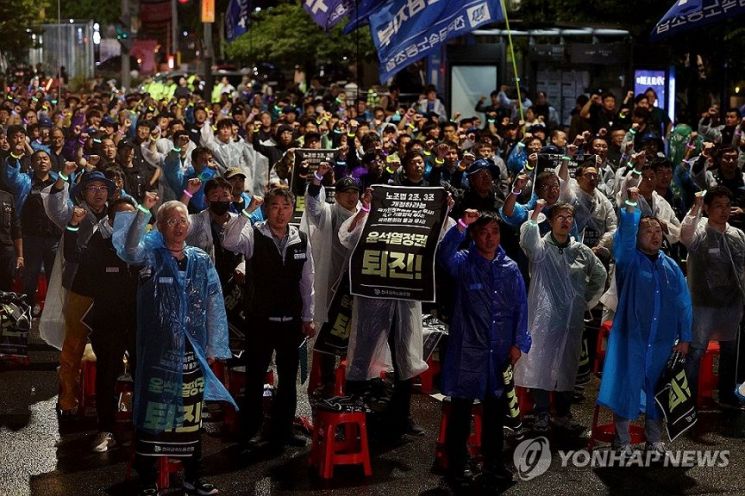 On September 20th, members of the Metalworkers' Union held a protest rally in front of the National Assembly, urging the passage of the amendment to Articles 2 and 3 of the Labor Union Act (Yellow Envelope Act) in the plenary session and blocking the veto.
The core of the Yellow Envelope Act (amendment to the Labor Union Act) is to expand the concepts of employer and labor disputes, significantly broadening the circumstances under which workers can engage in industrial action, while limiting the union's liability for damages arising from illegal labor disputes.
This means that workers will receive stronger protection of their three labor rights, but employers will inevitably face much greater burdens. Supporters of the Yellow Envelope Act claim that the contents of the amendment reflect recent trends in Supreme Court and some lower court rulings. Conversely, opponents argue that the amendment violates the principle of legality and clarity under criminal law and conflicts with civil law and Supreme Court precedents that recognize joint and several liability among co-offenders (bearing joint responsibility for the entire damage to the creditor regardless of fault ratio).
Origin of the Yellow Envelope Act
The name "Yellow Envelope Act" originates from 2014 when Ms. Bae Chun-hwan sent a donation of 47,000 KRW in a yellow envelope?the color of past salary envelopes?to a media outlet to support Ssangyong Motor workers who had been ordered by the court to pay 4.7 billion KRW in damages following a strike.
At that time, Ms. Bae sent the donation along with a letter stating, "If 100,000 people donate 47,000 KRW each, we can raise 4.7 billion KRW." Subsequently, the "Yellow Envelope Campaign" continued, with about 47,000 citizens participating and raising approximately 1.46 billion KRW. Recently, Ms. Bae also sent a letter to President Yoon urging him not to exercise the veto power.
This campaign led to discussions on amending the Labor Union Act, with bills introduced in the 19th and 20th National Assemblies but failing to be fully debated and eventually discarded. The issue resurfaced last July when subcontracted workers at Daewoo Shipbuilding & Marine Engineering (now Hanwha Ocean) faced a lawsuit seeking about 48 billion KRW in damages after a strike, prompting opposition lawmakers in the 21st National Assembly to introduce related bills.
On the 9th, the National Assembly plenary session passed a committee alternative proposed by the Environment and Labor Committee, integrating 11 bills and one petition submitted between June 2020 and November 2022, with opposition party members voting alone.
Subcontracted unions demand collective bargaining from primary employers
The key points of the Yellow Envelope Act are ▲expansion of the employer concept ▲expansion of the labor dispute concept ▲limitation of union liability for damages.
First, the amendment changes the definition of "employer" in Article 2(2) of the Labor Union Act.
Under the current Labor Union Act, an employer is defined as "the business owner, the person in charge of business management, or a person acting on behalf of the business owner regarding matters related to the workers of that business."
However, the amendment adds the clause: "In this case, even if not a party to the labor contract, a person who is in a position to substantially and specifically control or determine the working conditions of the workers shall be regarded as an employer within the scope."
In other words, the scope is expanded from "parties to the labor contract" to include those with substantial and specific authority over working conditions.
Practically, this means that in subcontracting relationships widely used in industries such as automobile manufacturing and construction, subcontracted unions can demand collective bargaining from primary employers who do not have direct contractual relationships with subcontracted workers.
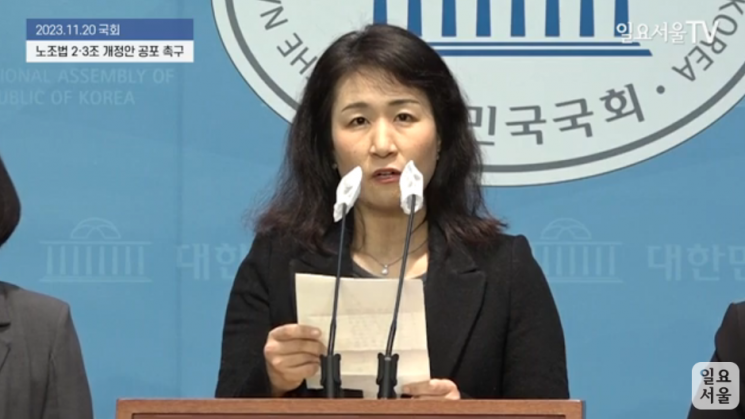 Bae Chun-hwan, who initiated the Yellow Envelope Campaign, is seen speaking about the Yellow Envelope Act at a press conference held at the National Assembly on the 20th. Photo by Ilyo Seoul YouTube broadcast capture
"Those with substantial control and decision-making authority over working conditions should be regarded as employers"… Recent judicial trends
The rationale for the bill states, "Recent precedents interpret employers to include not only those who have explicit or implicit labor contracts with workers but also those in positions to substantially and specifically control or determine working conditions. Therefore, reflecting this in the law is necessary to allow subcontracted and indirectly employed workers to engage in collective bargaining with primary employers, thereby guaranteeing their three labor rights."
In March 2010, the Supreme Court ruled in an unfair labor practice case involving Hyundai Heavy Industries that "a person in a position to substantially and specifically control or determine the basic working conditions of workers who interferes with or controls the organization or operation of the workers' union is considered an employer subject to remedial orders for unfair labor practices."
At that time, the Supreme Court stated, "If the primary employer has a position to substantially and specifically control or determine the basic working conditions of workers belonging to an in-house subcontractor to the extent that it shares authority and responsibility with the subcontractor as the employing business owner, and induces the closure of the subcontractor's business thereby suppressing or infringing on the activities of the subcontractor's labor union, the primary employer is considered an employer subject to remedial orders for unfair labor practices."
In January this year, the Seoul Administrative Court, citing the above Supreme Court precedent, ruled in the CJ Logistics case that the Central Labor Relations Commission's retrial decision that CJ Logistics' refusal to engage in collective bargaining with the subcontracted delivery drivers' union was an unfair labor practice was valid.
The court stated, "A person in a position to substantially and specifically control or determine basic working conditions to the extent of sharing authority and responsibility as an employer is included as an employer. CJ Logistics' claim that it is not an employer under the Labor Union Act cannot justify refusal of collective bargaining, and such refusal constitutes an unfair labor practice." This ruling was completely opposite to the first and second instance rulings in a similar lawsuit filed by the Metal Workers' Union against Hyundai Heavy Industries in 2018.
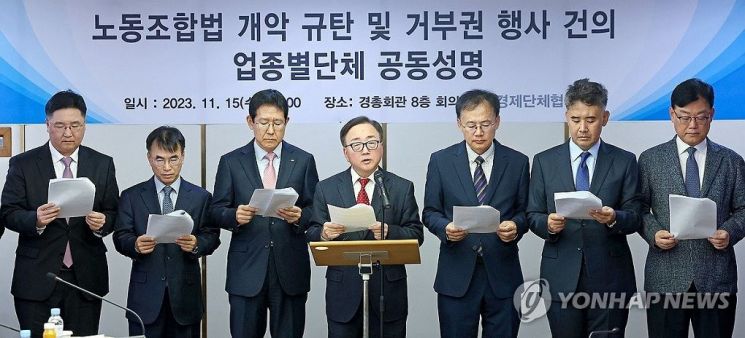 On the 15th, Lee Dong-geun, Executive Vice Chairman of the Korea Employers Federation (center), held a press conference at the Federation Hall in Mapo-gu, Seoul, titled "Joint Statement by Industry Associations Condemning the Deterioration of the Labor Union Act and Requesting the Exercise of Veto Power."
Concerns over violation of the principle of legality and erosion of subcontracting system
Meanwhile, the business and legal communities express concerns that the expansion of the employer concept does not accurately reflect the reality of subcontracting relationships and raises several legal issues.
First, the employer concept under the Labor Union Act directly defines the subject of unfair labor practices punishable by criminal sanctions, such as refusal of collective bargaining. Vaguely defining the scope of employers violates the principle of legality and clarity in criminal law.
Article 81(1)(3) of the Labor Union Act prohibits employers from unjustifiably refusing or neglecting collective bargaining or agreements with union representatives or authorized persons, and violators can be punished with imprisonment of up to two years or a fine of up to 20 million KRW under Article 90 of the same law.
According to the amendment, whether a primary employer is subject to criminal punishment for violating the Labor Union Act depends on the interpretation of "a position to substantially and specifically control or determine the working conditions of workers." This could result in numerous economic actors being unpredictably subject to criminal penalties for violating employer obligations under the Labor Union Act, undermining predictability of punishment.
Second, if collective bargaining between primary employers and subcontracted unions becomes possible as per the amendment, it could infringe on the management rights and independence of subcontracted employers, effectively nullifying the current subcontracting system and damaging the ecosystem of partner companies.
Currently, in subcontracting relationships, subcontracted employers have direct labor contracts with subcontracted workers and exercise independent authority over work instructions. However, if subcontracted workers can directly demand collective bargaining from primary employers and the latter must respond, the subcontracting system could become meaningless, the business community warns. For example, if a collective agreement is concluded between the primary and subcontracted unions, the subcontracted company, despite being an independent employer, may be forced to apply a collective agreement it did not sign.
The main reason for using subcontracting is to secure employment flexibility and respond flexibly to economic conditions. Allowing bargaining between primary and subcontracted parties could increase inefficiencies in workforce management and reduce corporate competitiveness, according to the Federation of Korean Industries and other business groups.
Furthermore, the business community argues that if the primary employer presents specific opinions during negotiations on wages, working hours, or work content with subcontracted workers, it could be seen as exercising work instructions and personnel authority over subcontracted workers, potentially constituting illegal dispatch. This would increase the burden of using subcontracting and could stifle the activities of small and medium enterprises that receive outsourced work from large corporations.
Previously, in 2015, the Supreme Court ruled that if a primary employer exercises personnel authority such as work instructions and attendance management over subcontracted workers, it is regarded as a de facto dispatch relationship. The primary employer then bears obligations under the Worker Dispatch Act, and violations constitute illegal dispatch.
The Supreme Court stated, "Whether the legal relationship constitutes worker dispatch subject to the Worker Dispatch Act should be judged based on the substance of the labor relationship, not the contract name or form designated by the parties."
Ultimately, if the amendment is enacted, subcontracted unions will increasingly claim that primary employers substantially and specifically control their working conditions and request direct negotiations with primary employers. Given the high use of subcontracting in domestic industries, this is expected to cause significant confusion and disputes. Especially in industries like shipbuilding and construction, where large corporations have contracts with many subcontractors or use multiple subcontracting layers, continuous disputes over bargaining obligations and union unification are anticipated due to frequent union demands.
According to the "2021 August Supplementary Survey on Employment Types" released by the Ministry of Employment and Labor in August last year, the proportion of workers employed outside their affiliated companies, such as through subcontracting or dispatch, was 17.9% in companies with 300 or more employees, 62.3% in shipbuilding, 47.3% in construction, and 18.8% in manufacturing industries.
© The Asia Business Daily(www.asiae.co.kr). All rights reserved.



















