Austrian Government Began Construction Last Month
Local Residents Protest, Calling It an Act Erasing Historical Significance
The Austrian government has decided to convert the birthplace of war criminal Adolf Hitler, who instigated World War II, into a police station, but controversy surrounding this decision continues unabated.
On the 19th (local time), the American daily The New York Times (NYT) reported that among the residents of Braunau am Inn, the town where Hitler's birthplace is located, voices are emerging that the site should be used not as a police station but as a museum or similar venue that reflects on history and provides lessons.
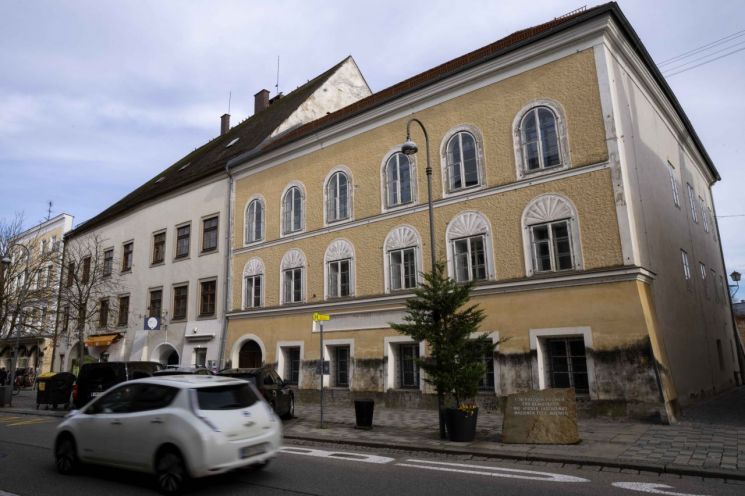
Previously, the Austrian government purchased the building of Hitler's birthplace, located in Upper Austria near the German border, in 2017 for 812,000 euros (approximately 1.1 billion KRW).
Since then, the government formed the "Committee for the Historically Appropriate Handling of Adolf Hitler's Birthplace" and has been considering various options for years, including demolishing the building or establishing a museum or research institute. After much deliberation, the government ultimately decided in 2019 to convert the house into a police station.
At that time, the committee opposed demolishing the building, arguing that "Austria must not deny the history associated with this site." However, they expressed concern that converting it into a museum or other historically significant venue might continue to evoke Hitler. Therefore, they proposed that "sufficient architectural redesign is necessary to eliminate the building's recognition and symbolic power."
Accordingly, the government announced plans to convert Hitler's birthplace into a local police station and to construct two new buildings to serve as a human rights education center for police officers. Although renovation work began in earnest last month, some residents criticize this as an act that erases the historical significance of the site.
Anette Pommer (32), a history teacher, told the NYT that she and many other residents hoped the building would become a museum or exhibition space exploring Austria's role in Nazi activities. She said, "This place should have been a space about how a person like Hitler could come to be," adding, "It was not the devil's house, just the home where a child was born. But explaining what that child later became is the right thing to do."
Some also argue that the building's previous use as a welfare center for people with disabilities should be revived. In 1972, when the building was privately owned, the Austrian government leased it directly from the owner to prevent it from being exploited as a base by neo-Nazi followers. Subsequently, from 1977 to 2011, the building was used as a government-managed welfare facility for people with disabilities.
Local historian Florian Kotanko told the NYT, "Many residents prefer that the building be used again as a place for disability welfare organizations," arguing that "this would be contrary to Hitler's intentions, who persecuted disabled people." He also expressed concern that converting it into a police station could backfire, as Hitler and neo-Nazi followers might take pride in being arrested for illegal activities nearby and spending time inside the police station.
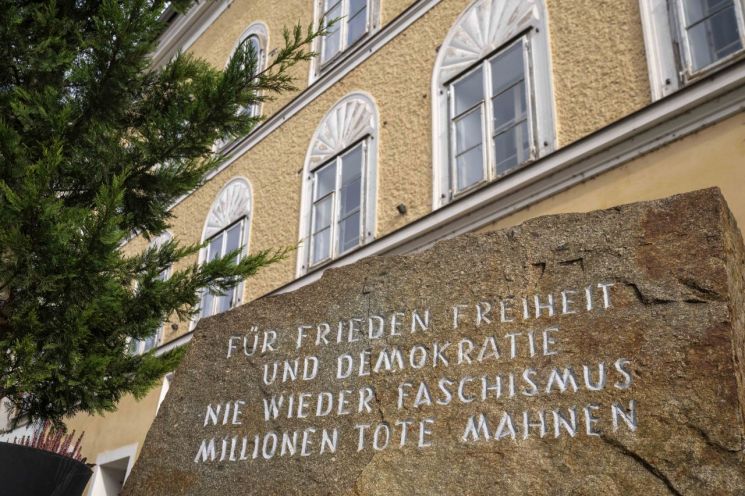 A monument installed in front of Hitler's birthplace. It is inscribed with the phrase, "For peace, freedom, and democracy. To prevent the return of fascism. The deaths of millions are the warning." Photo by AP Yonhap News.
Adolf Hitler was born in the top floor of this building in 1889. Shortly afterward, the Hitler family moved to Linz on the banks of the Danube River in Germany, so Hitler actually spent little time here, but since then, the birthplace has become a kind of shrine and tourist attraction.
Currently, in front of Hitler's birthplace stands a monument erected in 1989 by the mayor of Braunau am Inn, inscribed with the words: "For peace, freedom, and democracy. So that fascism never returns. The deaths of millions are the warning."
This monument is made from stones taken from the Mauthausen concentration camp site. The NYT reported that while the site is mainly visited by tourists, neo-Nazi followers also come on Hitler's birthday and place candles or wreaths there.
© The Asia Business Daily(www.asiae.co.kr). All rights reserved.


















