It has been revealed that most specialized construction companies have failed to respond to the Serious Accidents Punishment Act. Since small specialized construction companies could not cope with the enforcement of the law due to limitations in capital and manpower, there are calls for at least a 2 to 3-year grace period and amendments to the law.
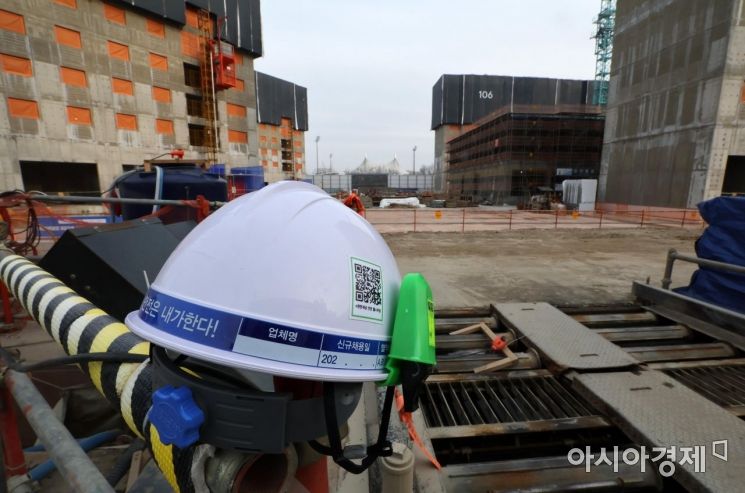 On the first day of the Serious Accidents Punishment Act enforcement, which allows for the punishment of management officials when serious accidents such as worker fatalities occur, a construction site of an apartment in Gyeonggi-do on the 27th./Photo by Kim Hyun-min kimhyun81@
On the 20th, the Korea Construction Policy Institute conducted a survey of 781 specialized construction companies in cooperation with the Korea Specialty Contractors Association to assess their response to the Serious Accidents Punishment Act. As a result, only 3.6% of companies had taken measures such as establishing safety management systems and allocating personnel and budgets. In contrast, 96.8% of respondents answered that they were "maintaining the status quo without any special measures."
The Serious Accidents Punishment Act will apply to workplaces with 5 or more regular workers but fewer than 50 (construction projects under 5 billion KRW) starting January 27 next year, after a two-year grace period. Although the law’s enforcement is imminent, the reasons for the insufficient preparation by specialized construction companies were identified as "the vast safety and health obligations and their ambiguous content (67.2%)," "cost burden (24.4%)," and "lack of specialized personnel (8.4%)."
Accordingly, specialized construction companies responded that for workplaces with 5 or more regular workers but fewer than 50 (construction projects under 5 billion KRW), "exclusion from the application of the Serious Accidents Punishment Act (51.5%)" or "a 3-year grace period (26.5%)" is necessary.
They also answered that legal amendments such as "relaxing the serious accident criteria to two or more deaths (51.2%)" or "reducing safety and health obligations (34.4%)" are needed to enable accident prevention through compliance with the law.
In particular, they responded that it is necessary to supplement the employer’s safety and health obligations to fit the circumstances of small companies, such as "establishing and operating a dedicated safety and health organization (32.3%)," "establishing and implementing measures to prevent recurrence of accidents (24.8%)," and "budgeting and executing safety and health expenses (12.4%)."
Kim Hee-su, president of the Korea Construction Policy Institute, said, “The Serious Accidents Punishment Act contains many ambiguous provisions, and it is difficult for specialized construction companies to fulfill their obligations with only short-term external support, so the application of the law should be deferred for at least 2 to 3 years.” He added, “It is necessary to seek various support measures to build safety capabilities and to amend the law to suit the circumstances of small companies.”
© The Asia Business Daily(www.asiae.co.kr). All rights reserved.

















