SNS 'Hot Place' Shops Receive Backlash Over English Menus
Alien Language Menus Filled with Spelling and Typographical Errors
"Mistaken Belief That Using English Gives a Sophisticated Impression"
Famous stores known as 'hot places' on social networking services (SNS) are causing controversy by presenting menus written only in English without any Korean notation. Not only do customers find it difficult to understand the menu, but there were also cases with spelling errors in English.
 This photo is for reference to help understand the article and is not directly related to the content. [Image source=Pixabay]
On the 20th, a post titled "The cafe I went to this time left me speechless" was uploaded on social media platform X (formerly Twitter). The author, Mr. A, revealed the menu of the cafe he visited, which was all written in English cursive, and the menu descriptions were entirely in English as well.
Mr. A said, "I don't know if they're saying not to order if you don't know English or if they're mocking those who can't read it," adding, "Moreover, it was written in cursive, not in print, so it was even harder to read."
Another visitor, Mr. B, also revealed that he visited the same cafe, saying, "I went with my elderly mother, but she couldn't read the menu at all. Feeling sorry, I asked if there was a Korean menu, but they said there was only an English menu." He added, "All the menus were written in English, but the notice 'one menu per person' was written only in Korean, which was funny."
Netizens who saw the photos reacted with comments such as "Are they saying elderly people shouldn't even order?", "If it had been written in print, it might have been recognizable," and "What are they doing in Korea?"
Professor Park Chi-wook of Purdue University College of Pharmacy: "Cursive is hard to read"
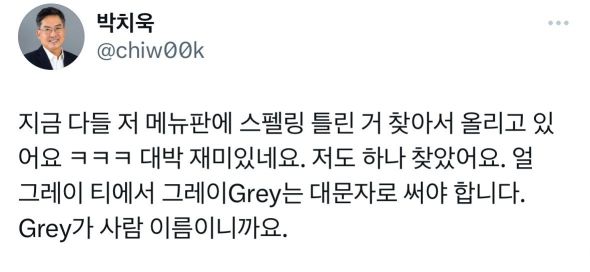 Professor Park Chi-wook of Purdue University College of Pharmacy made a sharp remark by quoting the 'English menu' that has been causing controversy on social media.
 [Photo by X (formerly Twitter) capture]
In response, Professor Park Chi-wook of Purdue University College of Pharmacy cited the issue, saying, "It's hard to recognize because they can't write English cursive properly."
He continued, "Everyone is posting about spelling mistakes on the menu. I found one too. In Earl Grey tea, 'Grey' should be capitalized because Grey is a person's name," he pointed out.
Earl Grey tea is associated with Lord Grey, a British nobleman. In English, when writing a person's name, the first letter is capitalized, so it should be 'Earl Grey' or 'earl Grey,' but the cafe's menu was written as 'Earlgrey.'
There were other spelling mistakes as well. 'Fantasy' was written as 'fantage,' Americano as 'Americcano,' and Caffe latte as 'cafe latte.'
Some menus were written in English but followed Korean orthography. This is called 'Hangul alien language.' For example, decaffeinated (Decaffeinated·Decaf·caffeine-free), meaning low caffeine, was written as 'Dicaffeine' following Korean spelling rules, and chocolate was written as 'Choco.'
Mixed Korean-English alien language menu may lead to an 'exclusion' culture
The so-called 'English alien language menu,' which goes beyond the misuse of unknown Korean and English, is pointed out to possibly lead to a culture of 'exclusion,' where only those who understand can enjoy it.
Geonbeom Lee, representative of the Hangul Cultural Solidarity, said, "There is a tendency to use foreign languages, especially English, because it gives a sense of high culture and sophistication," adding, "Whether in cafes or public places, overusing English can lead to the alienation or discrimination of the elderly, so it is preferable to use our language, which everyone can easily understand."
© The Asia Business Daily(www.asiae.co.kr). All rights reserved.


















