Rapid Increase in Installation of Committees on the Court by Kim Myung-su
Although the Judicial Administration Advisory Council, which has eight subcommittees, was launched under the pretext of decentralizing judicial administrative authority during the "Kim Myung-soo Court," there are criticisms that the criteria for deciding judicial policies have become ambiguous, and the responsibility for problems that arise has become unclear. The number of various committees established under the Court Administration Office increased from 43 in 2016 to 51 as of the end of December last year, raising concerns that "only authority is being decentralized while no one takes responsibility, causing repeated side effects."
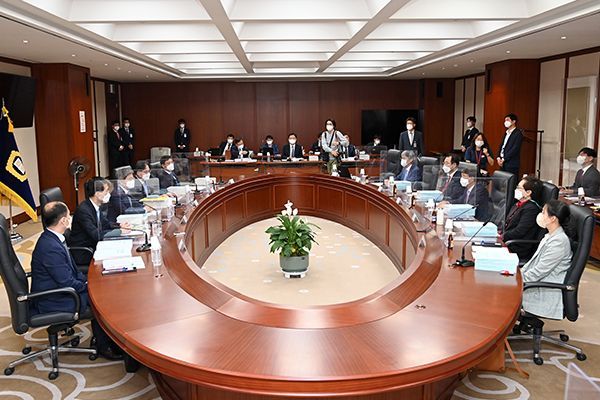
The Judicial Administration Advisory Council was launched in September 2019. It was established to enhance the transparency and democracy of judicial administration, which had been monopolized and conducted in a closed manner by the Chief Justice and the Court Administration Office. The Chief Justice serves as the chairperson, and the council consists of five judges and four external experts as members. Two judges recommended by the National Conference of Court Presidents, three judges recommended by the National Conference of Judges’ Representatives, and four non-judges participate. Currently, the position of Chief Justice is vacant, so the chairperson position of the Judicial Administration Advisory Council is also vacant.
Within the Judicial Administration Advisory Council, there are eight subcommittees: the Finance and Facilities Subcommittee, the Trial System Subcommittee, the Judicial Policy Subcommittee, the Judge Personnel Subcommittee, the Special Committee on the Appellate System, the Court Staff Personnel System Improvement Subcommittee, the Special Committee on the Judge Evaluation System, and the Unified Legal Profession System Subcommittee. These eight subcommittees advise on matters referred by the Chief Justice, such as the enactment and revision of Supreme Court regulations, opinions submitted by the Chief Justice to the National Assembly, budget requests, expenditure of contingency funds, settlement of accounts, and judges’ assignments.
The council is only a body for discussion and consultation, not a decision-making entity. However, criticism has arisen that the responsibility for major judicial policies has become unclear as matters that should be decided by the Chief Justice or the head of the Court Administration Office are discussed by the subcommittees, and their conclusions are generally followed.
A presiding judge stated, “Under the Kim Myung-soo Chief Justice system, too many committees have been created that exercise authority but do not take responsibility. Committees have been formed not only on matters limited to the internal society of judges but also on judicial systems and trials directly related to the judiciary. Rather than democratic opinion gathering, the reality is that conclusions are reached with no one taking responsibility.” He added, “The term ‘committee specialist judge’ has emerged because some judges devote themselves to committees, receiving preferential treatment in work assignments and even being transferred to policy departments for their involvement in judicial administration.” He further criticized, “Creating advisory committees to shift responsibility while promoting the non-judge staffing of the Court Administration Office is not the attitude of an institutional head.”
Han Su-hyun & Park Su-yeon, Legal Times Reporters
※This article is based on content supplied by Law Times.
© The Asia Business Daily(www.asiae.co.kr). All rights reserved.

















