Statistics Korea, Regional Economic Trends for Q3 and Q4 2023
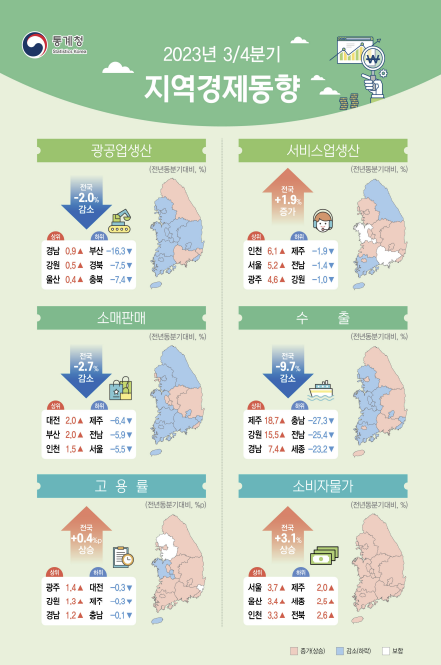
In the third and fourth quarters of this year, manufacturing production decreased in 14 out of 17 cities and provinces nationwide. However, semiconductor production only declined by 1.1% compared to the same period last year, showing a moderation in the downturn compared to the previous quarter.
According to the "Regional Economic Trends for the 3rd and 4th Quarters" released by Statistics Korea on the 21st, nationwide manufacturing production fell by 2.0% compared to the same period last year. This marks the fourth consecutive quarter of decline following the fourth quarter of last year.
By region, production decreased in 14 cities and provinces including Busan (-16.3%), Gyeongbuk (-7.5%), and Chungbuk (-7.4%). The contraction in manufacturing production was largely influenced by other machinery equipment and medical precision sectors. By item, other machinery equipment (-12.2%) and medical and precision (-15.0%) saw significant production decreases. Semiconductor and electronic parts production, which had decreased by 19.0% in the second quarter, only declined by 1.1%.
Exports continued to struggle due to semiconductor weakness. In the third and fourth quarters, exports of memory semiconductors (-28.4%), diesel (-33.0%), and processors/controllers (-21.3%) decreased, resulting in a 9.7% drop compared to the same period last year.
By region, exports shrank in 11 cities and provinces including Chungnam (-27.3%), Jeonnam (-25.4%), and Sejong (-23.3%), mainly centered on memory semiconductors, steel plates, and printed circuits. On the other hand, three regions?Jeju (18.1%), Gangwon (15.5%), and Gyeongnam (7.4%)?saw export increases due to strong performance in semiconductors, components, and electrical and electronic products.
Imports decreased in 16 cities and provinces nationwide in the third and fourth quarters due to reduced imports of crude oil, gas, and coal.
Retail sales, which indicate consumption trends, fell by 0.3% compared to the same period last year as sales at duty-free shops and specialty stores declined.
The decline in retail sales has continued for six consecutive quarters since the second quarter of last year. Sales at specialty stores and duty-free shops decreased by 2.7% compared to the same period last year. In particular, Jeju (-6.4%), which was hit hard by a drop in tourists, experienced the largest decrease.
Prices rose in all cities and provinces. Nationwide, prices increased by an average of 3.1% compared to the same period last year. Due to increases in public utility charges such as electricity, gas, and water, as well as rising dining-out prices, Seoul (3.7%), Ulsan (3.4%), and Incheon (3.3%) saw price increases higher than the national average. Jeju (2.0%) and Sejong (2.5%) had the lowest increases compared to the national average.
© The Asia Business Daily(www.asiae.co.kr). All rights reserved.
![Clutching a Stolen Dior Bag, Saying "I Hate Being Poor but Real"... The Grotesque Con of a "Human Knockoff" [Slate]](https://cwcontent.asiae.co.kr/asiaresize/183/2026021902243444107_1771435474.jpg)
















