The government's efforts to legislate fiscal rules to strengthen national fiscal soundness are becoming increasingly unlikely to be introduced within this year. Although the government submitted a revision bill to the National Finance Act containing fiscal rules to the National Assembly in September last year for stable fiscal management, discussions have been delayed for 1 year and 2 months due to failure to reach consensus with opposition parties. If the revision bill is not passed by next month when the regular session of the National Assembly ends, it is expected that the bill's passage will be practically difficult until the second half of next year when the next National Assembly begins.
On the 20th, the International Monetary Fund (IMF) pointed out in the '2023 Korea Article IV Consultation Report' that if the legislation of fiscal rules is not preceded, central government debt could rapidly increase starting with a sharp rise in the old-age dependency ratio due to population aging. Considering Korea's low-growth trend, economic structural reforms and safeguards for fiscal expenditure are urgently needed.
The IMF positively evaluated the Korean government's efforts such as the formulation of next year's budget and the introduction of fiscal rules for fiscal normalization, but also warned that if the current pension system continues, central government debt could soar to about 200% of the Gross Domestic Product (GDP) by 2075. In an unavoidable situation of rapid aging, reforms to delay the start age of National Pension benefits to 65 from 2033, along with the legislation of fiscal rules to support this, must be implemented together.
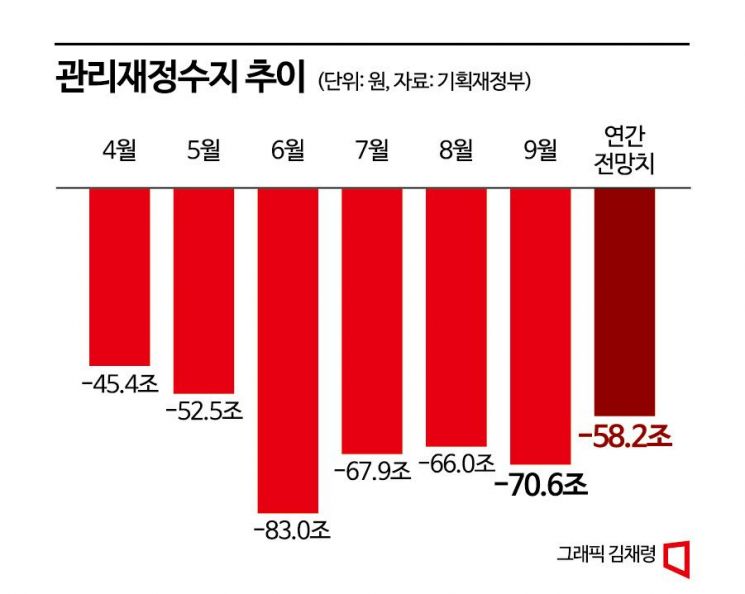
The core of the fiscal rules contained in the National Finance Act revision bill is to mandatorily manage the deficit ratio of the management fiscal balance within 3% of GDP. If the national debt ratio exceeds 60% of GDP, the deficit ratio of the management fiscal balance is limited to within 2%. By legislating such fiscal rules, the government can efficiently prevent reckless supplementary budget formulations and other expenditures. During the Moon Jae-in administration in 2020, the management fiscal balance deficit was 112 trillion won, which was criticized as excessive even considering the COVID-19 situation. The cumulative management fiscal balance deficit from January to September this year was 70.6 trillion won, which is 40 trillion won less than three years ago, but it exceeded the government's annual deficit forecast (-58.2 trillion won) by about 12 trillion won.
The problem is that amid significant global external uncertainties, there are concerns that next year's national tax revenue may decrease more than the government's forecast, worsening fiscal conditions. Recently, the National Assembly's Budget and Accounts Committee recommended reviewing the appropriateness of next year's national tax revenue forecast in the '2024 Budget and Fund Operation Plan Review Report.' This is because international organizations including the IMF have downgraded Korea's economic growth rate four months after the government announced next year's budget at the end of August, raising concerns that tax revenue collection may fall short of expectations. Previously, the government projected next year's national tax revenue at 367.375 trillion won, a decrease of 33.082 trillion won (8.3%) compared to this year's main budget (400.457 trillion won).
If tax revenue shortages and a low-growth phase become full-fledged, demands for fiscal expansion by the government may gain more support, especially from the major opposition parties. This is because the opposition parties are still requesting supplementary budgets for economic stimulus before the legislation of fiscal rules. If the National Finance Act revision bill is not passed by May 29 next year when the 21st National Assembly ends, the bill will be automatically discarded. A government official said, "We are making efforts for cooperation between the ruling and opposition parties so that the related law amendments for fiscal rules can be passed in the regular session next month, but the situation is not easy."
© The Asia Business Daily(www.asiae.co.kr). All rights reserved.


















