"Exceeding the Global Plastic Production Growth Rate"
Diversified from 2 Types in 1971 to 20 Types in 2018
The level of microplastic pollution in the sediments of Masan Bay and Jinhae Bay is increasing, and since the 2000s, the rate of pollution increase has been confirmed to be higher than the global plastic production growth rate.
The Korea Institute of Ocean Science and Technology (KIOST) announced on the 20th that the research team led by Dr. Shim Won-jun and Dr. Hong Sang-hee at the South Sea Research Institute measured the level of microplastic pollution in the sediments of Masan Bay and Jinhae Bay along the southern coast of Korea.
The research team used dated sediment cores from Masan Bay and Jinhae Bay in the South Sea to identify the increasing trend of past microplastic pollution from the 1970s to the late 2010s, and published their findings in the international journal Marine Pollution Bulletin.
According to the research results, the concentration of microplastics in the sediments showed a continuous increasing trend over time.
Starting from the 2000s, the annual average growth rate of microplastic concentration changed sharply: in Masan Bay, it increased threefold from 5% to 15%, and in Jinhae Bay, it more than doubled from 4% to 10%. These figures exceed the global annual plastic production growth rate of 8%.
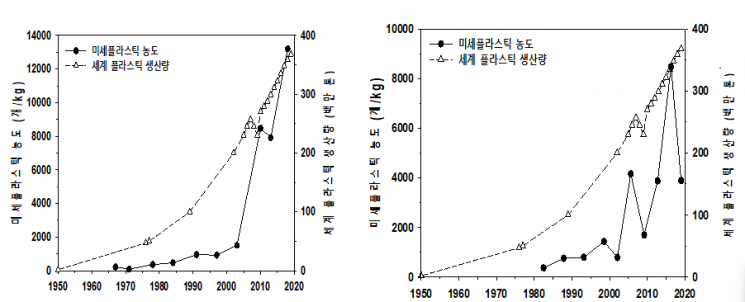 Comparison table of microplastic concentrations in Masan Bay (left) and Jinhae Bay and global plastic production.
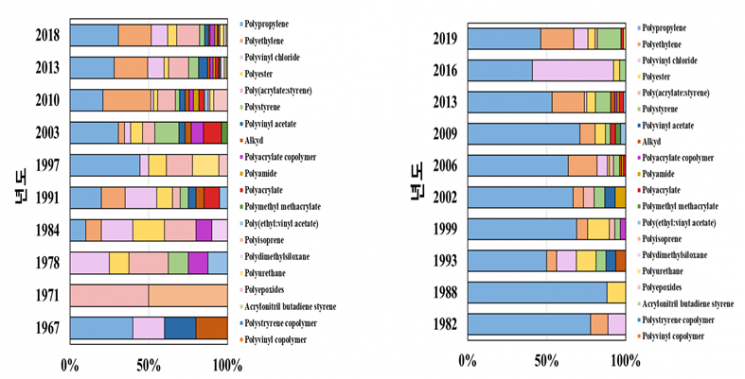
The variety of plastic types was also confirmed to be increasing.
In Masan Bay, only two types of microplastics, poly(acrylate:styrene) and polyisoprene, were found in 1971, but by 2018, 20 types of plastics including polypropylene and polyethylene were detected.
In Jinhae Bay, the number of plastic types increased from two microplastics, polypropylene and polyester, in 1988 to ten types in 2013.
The types of plastics detected in Masan Bay, an urban area, were more diverse than those in Jinhae Bay. In Jinhae Bay, which has many aquaculture farms, polypropylene and polystyrene?materials used in aquaculture ropes and buoys?were relatively more frequently detected.
Marine microplastic pollution due to increased plastic consumption has become a global environmental issue. Accordingly, related international organizations, including the United Nations Environment Programme (UNEP), have continuously urged actions to address microplastic pollution issues, such as risk assessments related to microplastic contamination.
Director Kang Do-hyung stated, “KIOST is leading global research in the analysis of marine microplastics and plastic-containing hazardous substances, microplastic fragmentation, and environmental behavior, and scientifically presents the necessity of microplastic management through environmental risk assessments of marine microplastics.”
He added, “This research will raise awareness of the impact of marine plastics on marine ecosystems and serve as an opportunity to emphasize the importance of the marine environment.”
The research team led by Dr. Shim Won-jun and Dr. Hong Sang-hee has been studying microplastics since 2012 and has been conducting the project “Research on Marine Microplastic Inflow, Generation, and Environmental Behavior” under the Ministry of Oceans and Fisheries’ national research and development program since 2022 to quantitatively assess the risk levels of microplastics on marine ecosystems.
© The Asia Business Daily(www.asiae.co.kr). All rights reserved.


















