Medical AI company Lunit announced on the 20th that it will present eight research results utilizing its AI imaging analysis solution, 'Lunit INSIGHT,' at the '2023 Radiological Society of North America (RSNA 2023)' conference held in Chicago, USA, from the 26th to the 30th. Lunit has been continuously demonstrating the clinical value of AI-based imaging analysis technology by reflecting the actual demand in medical fields through ongoing research presentations on the diagnosis of major cancers such as lung cancer and breast cancer.
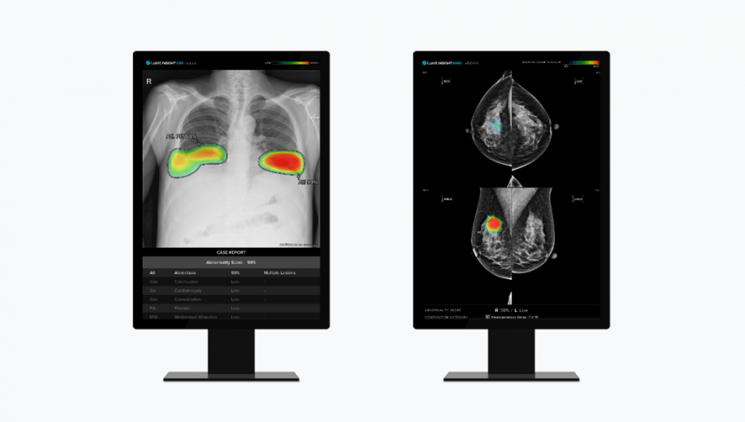 Lunit's chest X-ray AI imaging analysis solution 'Lunit Insight CXR' (left) and mammography AI imaging analysis solution 'Lunit Insight MMG'. [Photo by Lunit]
At this conference, Lunit will give an oral presentation on research that establishes a safety net using a dual AI algorithm for chest X-ray image interpretation, maximizing the efficiency of interpreting the majority of normal chest images encountered in clinical settings and preventing the omission of abnormal cases.
The research team developed an autonomous algorithm called the 'NF model' that first analyzes X-ray images and then performs additional analysis using the commercial chest X-ray AI imaging analysis solution, 'Lunit INSIGHT CXR.' They analyzed X-rays of a total of 8,029 patients with the NF model, and when applying a threshold that judged half (1,765) of the 3,531 normal X-rays as normal, the sensitivity for accurately diagnosing abnormalities averaged 97.8%. Subsequently, through additional analysis by Lunit INSIGHT CXR, 4 out of 24 abnormal cases missed by the NF model (16.7%) were additionally detected.
This means that algorithms like the NF model, which autonomously determine normal and abnormal findings, support rapid interpretation of a large volume of normal chest images, and applying Lunit's AI solutions in a dual manner can also prevent omission of abnormal cases. Lunit plans to include the NF model used in this study in its AI solution products in the future.
Lunit will also present research results on its self-developed AI model that tracks temporal changes in mammography images to predict future breast cancer risk. The research team developed Model A, which learned from mammography images at a single past time point before diagnosis, and Model B, which learned from two different time points of the same patient to consider temporal changes, using 16,113 digital mammography images.
As a result, the C-index, an accuracy metric for prediction models, was higher for Model B at an average of 0.73 compared to 0.68 for Model A. Similar results were observed in dense breasts, which are common among East Asian women. This indicates that adding temporal change learning can improve accuracy in AI-based breast cancer risk prediction.

Follow-up research to a prospective study published in September by researchers at the Karolinska Institutet in Sweden in the world-renowned medical journal 'Lancet Digital Health' will also be presented, comparing AI and radiologists in mammography interpretation. The study analyzed the relationship between patient recall accuracy based on independent readings by two specialists and the mammography AI imaging analysis solution 'Lunit INSIGHT MMG' for 55,581 women.
As a result, among 3,014 cases recalled by AI for suspicious findings, the positive predictive value (PPV) was 29%, whereas among 2,501 cases recalled only by specialists as potentially abnormal, the PPV was 3.4%. This confirms the accurate interpretive ability of AI while suggesting caution due to potential bias in the specialists' final interpretation of AI results.
Seobum Seok, CEO of Lunit, said, "We continuously demonstrate the technological capabilities of Lunit AI solutions and present high-quality research results annually at the RSNA conference to introduce our products to the industry. Through this conference, we will further solidify our global leadership in AI-based cancer diagnosis and continue efforts to provide practical benefits to medical professionals and patients."
At the Lunit booth at RSNA 2023, a 'Global INSIGHTS' session will be held, inviting world-renowned medical professionals to share their experiences using Lunit AI. This three-day event from the 26th to the 28th will feature speakers such as Dr. Karin Dembrower from Sweden's Saint G?ran Hospital and Dr. David Gruen, former Chief Medical Officer (CMO) at IBM Watson Health, who will discuss the importance of Lunit AI imaging analysis solutions and their practical utility in medical settings.
© The Asia Business Daily(www.asiae.co.kr). All rights reserved.


















