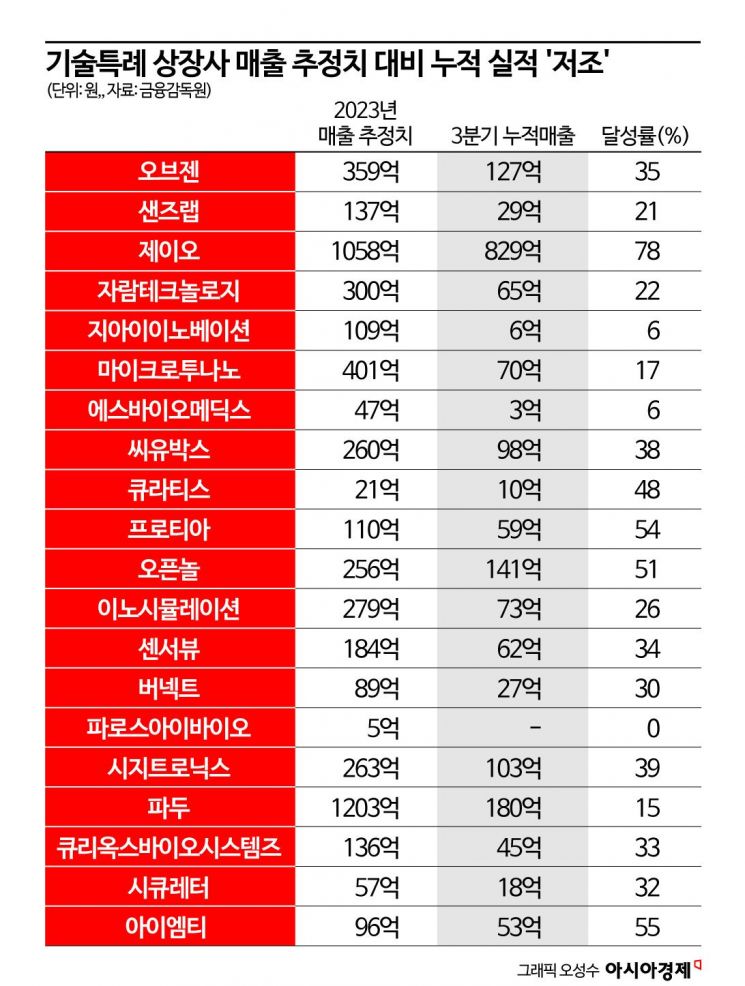
Analysis of Cumulative Sales Compared to Estimates for 20 out of 32 Specially Listed Companies This Year
Only 4 Specially Listed Companies Achieve Over 50% of Sales Target
Issuers and Underwriters Benefit from Higher IPO Prices... Temptation to Inflate Performance
Need for Institutional Improvements to Protect Investors and Promote Listings
As financial authorities work to improve the technology special listing system with the goal of implementing changes in the first half of next year, controversy has erupted over Pado's 'performance inflation.' Not only Pado but also the majority of newly listed companies that entered the stock market through technology special listings this year are projected to have difficulty achieving their estimated performance. Although the aim was to broaden access for excellent innovative companies to enter the capital market, concerns are growing that the momentum for deregulation may be lost. Some in the financial investment industry argue that performance inflation to raise the public offering price is not limited to technology special listings and call for strengthening the responsibilities of underwriters across the entire initial public offering (IPO) market.

Pado's Performance Achievement Rate Stands at 15%
Among the 32 companies listed this year through technology special listings, the average achievement rate of 20 companies whose estimated performance can be compared with cumulative results up to the third quarter was 32%. Pado presented an estimated sales revenue of 120.3 billion KRW for this year but recorded only 18 billion KRW up to the third quarter, resulting in an achievement rate of just 15%. Three bio companies?GI Innovation, S-Biomedics, and Pharos I Bio?had lower achievement rates than Pado. Their cumulative sales up to the third quarter were 600 million KRW for GI Innovation and 300 million KRW for S-Biomedics, showing a significant gap from the estimated figures of 10.9 billion KRW and 4.7 billion KRW presented at the time of the public offering.
Among the 20 companies, only four?JO, IMT, Protia, and Opennol?exceeded a 50% achievement rate. The company with the highest achievement rate was JO, a developer of carbon nanotubes for secondary battery anode materials, which recorded cumulative sales of 82.9 billion KRW in the third quarter. This corresponds to 78% of the estimated sales revenue of 105.8 billion KRW presented in the investment prospectus submitted for the IPO.
Pado, which was listed at a public offering price of 31,000 KRW, saw its stock price fall by 36.2% to 19,770 KRW. S-Biomedics and Pharos I Bio also dropped by 58.3% and 19.7%, respectively, compared to their public offering prices.
The technology special listing system lowers the listing review standards to allow innovative companies with high future growth potential but currently low profitability to list. It was introduced in 2005. Companies recognized for the innovativeness of their technology or corporate growth potential are allowed to apply for preliminary listing review with only minimum financial requirements. In the early days of the system, only bio companies, which had excellent technology and growth potential but could not show stable financial performance required for general listings, were allowed to enter through technology special listings, considering the nature of new drug development that requires steady funding. In the mid-2000s, the number of companies listing through technology special listings was not large, totaling only 15 from 2005 to 2014.
Authorities abolished industry restrictions on technology special listings in 2014 to provide opportunities for various growth companies. They relaxed the requirements for innovative companies to enter the stock market through measures such as the Tesla requirements in 2017 and the unicorn special listing in 2021. This is why technology special listings began to become active from 2015. This year alone, 32 companies have listed through technology special listings.
The majority of companies preparing to list through technology special listings conduct their public offerings without making profits. Underwriters estimate future profits to calculate an appropriate corporate value. They present estimated performance considering the company's business plan and industry characteristics. The structure involves verifying the underwriters' proposed public offering price range through a demand forecasting process.
When technology special listings were limited to bio companies, the number of companies was small, and due to the nature of new drug development, the accuracy of estimated performance was not high. Even if there was a large gap between estimates and actual performance, the impact on stock prices was relatively small. Investors were more interested in the progress of clinical trials.
Concerns Over Public Offering Price Bubble Grow After Industry Restrictions Lifted
With the removal of industry restrictions and the entry of companies with high growth expectations into the stock market through technology special listings, concerns about bubbles in public offering prices have increased. A financial investment industry insider said, "It is important to ensure that the Pado incident does not lead to a contraction of the technology special listing system," adding, "Concerns about performance inflation are not limited to technology special listings, so improvements are needed throughout the IPO process."
Actions to increase sales or raise forecasts just before listing to boost the public offering price have been ongoing. There are also cases where future sales are brought forward to maximize profits in the year immediately before listing. The 'second-year jinx,' where sales and profits decline in the year following listing, can be easily found not only in the KOSDAQ market but also in the KOSPI market.
Companies pursuing listing tend to prefer securities firms that propose high corporate values when selecting underwriters for IPOs. The higher the public offering price, the larger the amount of funds raised. In the case of technology special listings, there are more variables in calculating the public offering price range. The scale of the offering can vary greatly depending on estimated performance. For issuers that do not make profits but incur high research and development (R&D) costs, a high public offering price is crucial. Pado's public offering price range was 26,000 to 31,000 KRW. The offering size differed by more than 30 billion KRW, ranging from 162.5 billion KRW to 193.8 billion KRW.
Underwriters Collect Fees Proportional to Offering Size
IPO underwriters collect fees proportional to the offering size. When the public offering price is high and the offering size is large, both the issuer and the underwriter benefit. The fee rate for technology special listings is higher than for general listings. Seok-Hoon Lee, Senior Research Fellow at the Korea Capital Market Institute, explained, "The underwriting fees for special listing companies are on average 0.8 percentage points higher than those for general listing companies," adding, "Underwriters need to make greater efforts to attract investors for IPO companies that find it difficult to attract investors."
NH Investment & Securities and Korea Investment & Securities, which underwrote Pado's IPO, collected underwriting fees amounting to 5.8 billion KRW. This compares to 4.2 billion KRW in underwriting fees for Doosan Robotics, considered the largest IPO this year. Pado signed the lead underwriting contract on November 4, 2021. The underwriters provided services for one year and ten months until Pado's listing in August this year. Despite the long effort, if the issuer's management delays or withdraws the listing, the underwriters receive no fees.
Underwriters' Subjective Judgment Involved in Selecting Estimated Performance Figures
Authorities have established various safeguards to protect investors. The 'Technology Special Listing System Improvement Plan' announced in July this year, just before Pado's listing, included improvements for investor protection. The Financial Services Commission explained that while the system improvement would broaden listing opportunities, necessary regulations for robust investor protection would be maintained or strengthened separately.
The most critical stage in determining the public offering price during the IPO process is demand forecasting. If institutional investors participating in demand forecasting do not accept the proposed public offering price range, the public offering price inevitably falls. The most widely used method to calculate appropriate corporate value is comparing with existing listed companies. Underwriters' subjective judgment intervenes in selecting comparable companies and presenting estimated performance figures. There have been cases where companies were criticized for selecting overseas listed companies with more favorable valuations than the domestic stock market as comparables. For example, Naracella included French luxury brand Louis Vuitton (LVMH) as a comparable company at the time of listing but faced criticism for overvaluation and subsequently reorganized its comparable company group.
Even institutional investors who apply strict standards to comparable companies tend to be relatively lenient regarding estimated performance. They accept the estimates as the best-case scenario, understanding the nature of growth companies. An IPO industry insider said, "There needs to be an incentive for institutional investors participating in demand forecasting to actively verify appropriate public offering prices," adding, "Investors who commit to long-term investment are more sensitive to the public offering price."
This is why regulators aim to introduce pre-demand surveys and cornerstone investor systems to facilitate reasonable public offering price calculations. It is expected to help set a reasonable public offering price range by reflecting pre-demand survey results before submitting the securities registration statement. Institutions designated as cornerstone investors can negotiate with underwriters to be allocated a certain amount of shares at the public offering price determined later, before the securities registration statement is submitted. Because prices are proposed within a range coordinated in advance with reputable institutions, this increases market trust in the public offering price range.
Balancing Investor Protection and Market Vitalization
The Korea Exchange's proposed 'Amendments to KOSDAQ Market Listing Regulations and Enforcement Rules' announced on the 17th is also part of measures to implement improvements to the technology special listing system. First, it plans to strengthen accountability mechanisms for listing underwriters. If a technology special listing (innovative technology/business model) company underwritten by the same underwriter within the past three years experiences early failure, additional conditions such as put-back options will be imposed on the underwriter for future technology special listings. A put-back option allows general investors who were allocated shares through the public offering subscription to sell the shares back to the underwriter if the stock price falls below 90% of the public offering price within a certain period after listing.
IPO departments at securities firms must raise the public offering price to survive, so strengthening only underwriters' responsibilities will not fundamentally solve the problem. During LG Energy Solution's demand forecasting, issues with fictitious subscriptions were revealed, and regulators required underwriters to verify institutional investors' payment capabilities. Although the demand forecasting competition rate decreased, the rate of finalizing the public offering price above the upper limit of the proposed price range increased.
Seok-Hoon Lee, Senior Research Fellow at the Korea Capital Market Institute, emphasized, "It is necessary to develop disclosure systems related to technological achievements and strengthen monitoring of disclosure violations or unfair trading by special listing companies," adding, "If the capabilities of technology evaluations required for special listings and investor protection related to special listing companies are enhanced, the special listing system will become a more important listing method in the KOSDAQ market."
© The Asia Business Daily(www.asiae.co.kr). All rights reserved.


















