International Institute of Finance (IIF) 'Global Debt Report'
Despite the high interest rate trend, domestic corporate debt in South Korea has been recorded as the second fastest growing in the world. Following already world-leading household debt levels, the rapid increase in corporate debt is raising concerns.
According to the latest global debt report by the Institute of International Finance (IIF) on the 19th, as of the third quarter of this year, South Korea ranked third in the ratio of non-financial corporate debt to Gross Domestic Product (GDP) among 34 countries worldwide (with the Eurozone counted as a single statistic), at 126.1%, following Hong Kong (267.9%) and China (166.9%).
South Korea's corporate debt-to-GDP ratio rose by 5.2 percentage points from 120.9% in the second quarter, surpassing Singapore to climb to third place within three months. This increase rate was the second highest globally, following Malaysia.
Compared to the third quarter of last year (120.4%), it also rose by 5.7 percentage points, making the annual growth rate the third fastest after Russia and China.
Additionally, the IIF compared the increase rates of corporate defaults up to October this year among 17 major countries including South Korea, the United States, the United Kingdom, France, Germany, the Netherlands, and Finland. South Korea ranked second with about a 40% increase (year-on-year), following the Netherlands at approximately 60%.
Regarding household debt, South Korea's ratio to GDP was 100.2% as of the third quarter, the highest among the 34 countries surveyed. It has held the top position for nearly four years since the onset of the COVID-19 pandemic in 2020. Notably, South Korea was the only country among those surveyed where household debt exceeded the total economic size (GDP).
However, South Korea's household debt ratio decreased by 1.5 percentage points from 101.7% in the second quarter and by 4.6 percentage points from 104.8% in the third quarter of last year.
The Bank of Korea recently stated in a report, "In situations where the household credit ratio exceeds 100%, as in South Korea, the negative spillover effects of household debt on the macroeconomy are likely to be greater," and emphasized, "It is important to reduce household debt so that this ratio approaches 80%." Only three countries had ratios exceeding 80%: South Korea, Hong Kong (95.2%), and Thailand (91.5%).
South Korea's government sector debt-to-GDP ratio (48.9%) ranked 22nd, placing it in the mid-lower tier. Japan had the highest government debt relative to economic size at 239.9%, followed by Singapore (170.8%), the United States (117.6%), and Hong Kong (103.4%).
However, the pace of increase in South Korea's government debt was relatively fast globally. Compared to a year ago in the third quarter of last year (44.2%), the increase of 4.7 percentage points was the fourth largest after Hong Kong (23.3 percentage points), Argentina (8.1 percentage points), and China (7.1 percentage points).
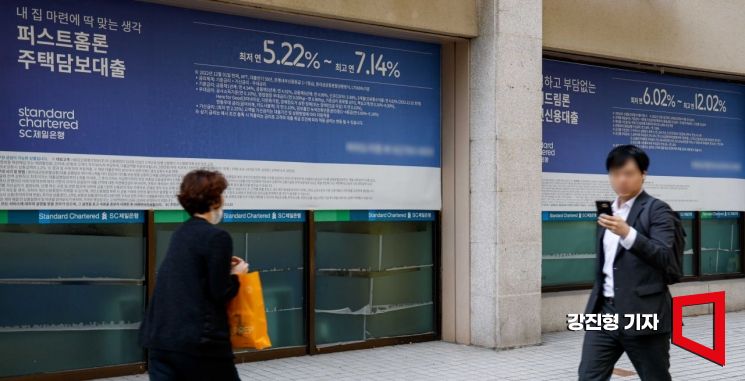
The scale of private sector (household + corporate) debt in South Korea, which greatly exceeds the size of the economy, continues to grow in the fourth quarter. In October, household loans in the banking sector surged by 6.8 trillion KRW compared to the end of September, mainly driven by mortgage loans, and total loans across the entire financial sector, including secondary financial institutions, increased by 6.3 trillion KRW.
In November, the increase in household and corporate loans has not slowed. As of the 16th of this month, the outstanding household loans at the five major banks (KB Kookmin, Shinhan, Hana, Woori, NH Nonghyup) totaled 689.5581 trillion KRW, a sharp increase of approximately 3.5462 trillion KRW in about half a month compared to the end of October (686.0119 trillion KRW).
Not only did mortgage loans increase by 3.4175 trillion KRW (from 521.2264 trillion KRW to 524.6439 trillion KRW), but credit loans also rose by 310.6 billion KRW (from 107.9424 trillion KRW to 108.2531 trillion KRW).
The outstanding corporate loans (including large corporations and small businesses) currently stand at 766.3856 trillion KRW, an increase of 2.0696 trillion KRW compared to the end of last month. Compared to the end of last year (703.7268 trillion KRW), corporate loans at the five major banks have surged by 62.6587 trillion KRW this year alone.
© The Asia Business Daily(www.asiae.co.kr). All rights reserved.
![Clutching a Stolen Dior Bag, Saying "I Hate Being Poor but Real"... The Grotesque Con of a "Human Knockoff" [Slate]](https://cwcontent.asiae.co.kr/asiaresize/183/2026021902243444107_1771435474.jpg)
















