'Yubotonghap' Government Organization Act Amendment, National Assembly Public Hearing
155 Floral Tributes Including Kindergarten Teachers in Front of the National Assembly
Government Criticized Over 'Lack of Financial Plan'
"'Sincerely praying for the repose of early childhood education"
On the 17th, a line of wreaths bearing this phrase was displayed in front of the National Assembly. These were sent by public kindergarten teachers from various regions ahead of the public hearing on the government organization law amendment bill centered on the integration of early childhood education and care (Yubo Integration) held at the National Assembly that day. About 155 wreaths lined up approximately 120 meters to the right of the main gate of the National Assembly.
The public hearing was jointly hosted by the National Assembly's Education Committee, the Public Administration and Security Committee, and the Health and Welfare Committee, with attendance from lawmakers including Kim Cheol-min, Chair of the Education Committee from the Democratic Party, Kim Gyo-heung, Chair of the Public Administration and Security Committee, and Deputy Minister Jang Sang-yoon of the Ministry of Education.
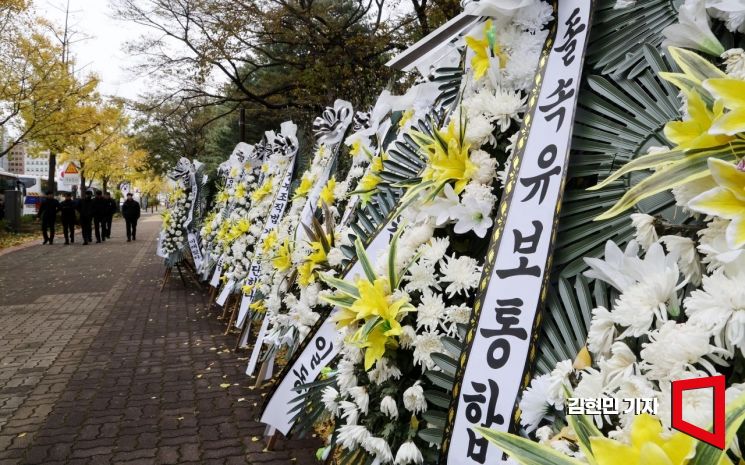 On the 17th, wreaths urging the government to halt the promotion of the reserved integration (integration of early childhood education and care) were placed in front of the National Assembly. Photo by Hyunmin Kim kimhyun81@
Yubo Integration aims to unify kindergartens managed by the Ministry of Education (and local education offices) and daycare centers managed by the Ministry of Health and Welfare (and local governments) into a single system under the Ministry of Education. Discussions on this have been ongoing since the Kim Young-sam administration, and both major party candidates proposed Yubo Integration pledges during the last presidential election, indicating a broad consensus across political lines. The challenge lies in narrowing differences among related ministries and various sectors regarding the integration method and procedures. Specifically, budget and personnel, curriculum changes, and issues concerning qualifications and treatment of teachers are key points of contention.
Deputy Minister Jang Sang-yoon of the Ministry of Education stated, "Our country faces a serious crisis due to population decline caused by low birth rates," adding, "Raising each child as a valuable talent for the future society is a national task, and the government intends to make this year the inaugural year of educational reform." He further said, "In particular, Yubo Integration is a core task to overcome the low birthrate crisis and guarantee equality of starting points and opportunities for children," and expressed hope that "the government organization law amendment bills, respectively proposed by lawmakers Lee Tae-gyu and Kang Byung-won, will be swiftly passed and that educational and childcare inequalities will be resolved."
The Ministry of Education announced plans to fully promote Yubo Integration starting in July this year, proposing a 'three-step' integration plan. First, this year, the central agency in charge will be unified from the Ministry of Health and Welfare to the Ministry of Education; in 2024, local agencies will be transferred to metropolitan and provincial offices of education; and in 2025, the 'integration model' will be finally applied. The first step necessary for this transfer of duties is legal amendment. Specifically, the government organization law will transfer 'early childhood care' from the Ministry of Health and Welfare to the Ministry of Education, and the Early Childhood Education and Care Act will change the responsible authority from the Minister of Health and Welfare to the Minister of Education.
However, this policy faces opposition, especially from the education sector. Critics point out that proceeding with ministry unification without accompanying financial plans is likely to shift the financial burden onto metropolitan and provincial offices of education, potentially causing adverse effects similar to the past 'Nuri Curriculum incident,' ultimately harming children.
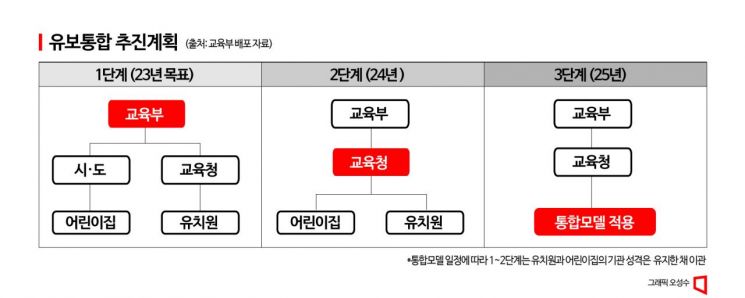
First Step of Yubo Integration... Government Criticized Over 'Financial Insufficiency'
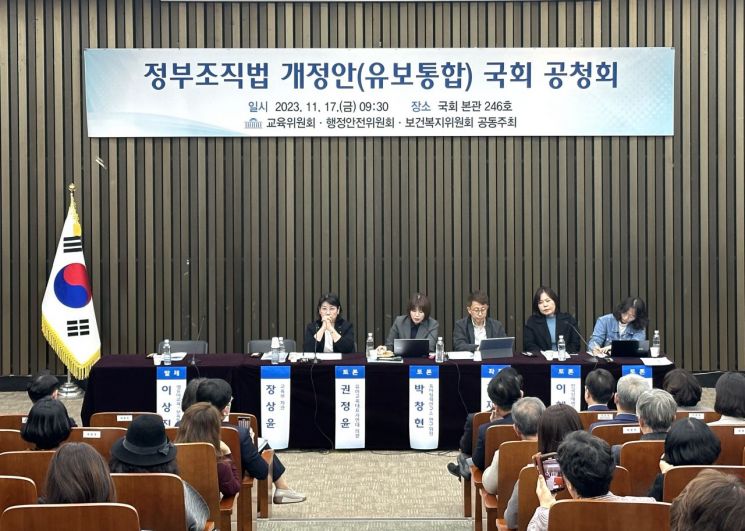 On the morning of the 17th, the "Public Hearing on the Government Organization Act Amendment Bill (Integration of Childcare and Education)" jointly hosted by the Education Committee, the Public Administration and Security Committee, and the Health and Welfare Committee was held at the National Assembly. Photo by Jang Hee-jun junh@
At the public hearing that day, criticism continued regarding the government's lack of preparation for Yubo Integration. The government plans to transfer early childhood care duties, previously managed by the Ministry of Health and Welfare and local governments, to the Ministry of Education within the year, but critics argue that pushing organizational integration without establishing financial plans predicts negative consequences.
The discussion was chaired by Professor Jeong Jae-hoon of the Department of Social Welfare at Seoul Women's University, with participants including Park Da-som, Chair of the National Public Kindergarten Teachers' Union; Lee Hye-yeon, Advisor of the National Parents' Association for Children with Disabilities; Park Chang-hyun, Research Fellow at the Childcare Policy Research Institute; and Kwon Jeong-yoon, Chair of the Early Childhood Education Representatives Coalition (Professor at Sungshin Women's University).
▶Opposition: Establish Financial Plans First = Park Da-som, Chair of the National Public Kindergarten Teachers' Union, expressed regret over the public hearing being rushed like "roasting beans in a lightning flash" just before the government organization law amendment, questioning, "Didn't members of the Education, Public Administration, and Welfare Committees fail to attend?" She criticized, "Even when raising objections to the Ministry of Education's proposals and demanding communication because they differ from field opinions, only formal procedures have been conducted," and added, "There is still no proper plan on how to improve the quality of care and education after Yubo Integration."
Park particularly warned, "(If it proceeds as is) Yubo Integration will rather cause enormous educational disparities by region," strongly criticizing the legal amendment that pushes organizational integration without budget considerations. She raised concerns including ▲financial collapse due to insufficient financial planning ▲disruptions in elementary, middle, and high school education and new childcare duties due to financial issues ▲work paralysis due to insufficient personnel and wage plans ▲negative impacts on treatment improvements for daycare centers and private teachers, questioning, "Is it possible to improve treatment without plans for increased personnel costs after Yubo Integration?"
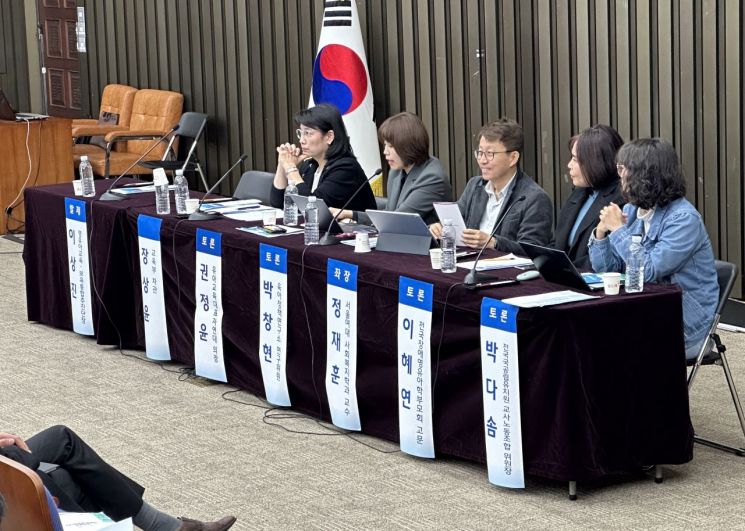 On the morning of the 17th, a public hearing on the "Government Organization Act Amendment Bill (Integration of Childcare and Education)" jointly hosted by the Education Committee, the Public Administration and Security Committee, and the Health and Welfare Committee was held at the National Assembly. Photo by Heejun Jang junh@
▶Support: Stop Shifting Responsibility, Prioritize Central Ministry Unification = Lee Hye-yeon, Advisor of the National Parents' Association for Children with Disabilities, shared her experience of her elementary school child's disability diagnosis, lamenting, "Although the Special Education Act was enacted in 2007, for 16 years, disabled young children have not been assigned special education teachers because they attend daycare centers under the Ministry of Health and Welfare." She pointed out, "Kindergartens receive hundreds of thousands of won per class for teaching materials and various educational supports through special education support, but daycare centers do not receive such support."
Lee strongly criticized the government for 'shifting responsibility' due to the dual system between the Ministry of Education and the Ministry of Health and Welfare during the process of urging countermeasures, emphasizing, "The government organization law amendment must first remove the barriers of discrimination." She represented the perspective of parents of disabled young children, stating, "People ask why not just move to kindergartens to receive better benefits, but in the metropolitan area, most nearby institutions are already overcrowded. In small and medium-sized cities in provinces, it is difficult to find kindergartens that disabled young children can attend, and in towns and townships, kindergartens are mostly nonexistent."
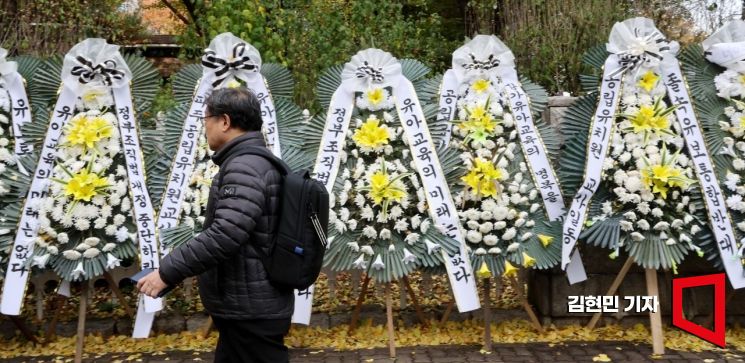 On the 17th, wreaths urging the government to halt the promotion of reserved integration (integration of early childhood education and care) were placed in front of the National Assembly. Photo by Hyunmin Kim kimhyun81@
▶Alternative: Start by Finding Concrete Budget and Personnel Solutions for the Integration Model = At the discussion, unusually, an expert from a national research institute criticized the government and presented views equivalent to 'alternatives.' Park Chang-hyun, Research Fellow at the Childcare Policy Research Institute, premised that both ruling and opposition parties share sufficient consensus on Yubo Integration and the government organization law amendment, then proposed a 'concrete' integration model and suggested that anticipated problems should be addressed first. The Childcare Policy Research Institute is affiliated with the Korea Institute for Health and Social Affairs and is under the jurisdiction of the Office for Government Policy Coordination.
Park questioned the attending lawmakers, "Ultimately, will daycare center affairs be included in school education or not?" pointing out that in the government organization law amendment bills proposed by both parties, daycare center affairs remain limited to early childhood care, unlike kindergartens. He said, "Daycare center affairs will eventually lead to schools (through Yubo Integration), but if they are not included in school education, under what identity will daycare centers exist under the Ministry of Education and education offices?"
He urged, "First, please clearly disclose the government's additional financial investment plans related to Yubo Integration," adding, "Most of the expected additional costs are for daycare centers, so the government must declare its position to take responsibility for estimated costs such as facility improvements, treatment improvements, and training before passing the government organization law." He warned, "If Yubo Integration is promoted by shifting finances solely to education offices amid a significant reduction in local education finances due to decreased tax revenues, it could lead to the suspension of elementary and secondary education as well as various projects."
© The Asia Business Daily(www.asiae.co.kr). All rights reserved.

![Clutching a Stolen Dior Bag, Saying "I Hate Being Poor but Real"... The Grotesque Con of a "Human Knockoff" [Slate]](https://cwcontent.asiae.co.kr/asiaresize/183/2026021902243444107_1771435474.jpg)

















