Biden-Xi Jinping Summit
Second In-Person Meeting in 366 Days
Biden "Substantial Progress Achieved"
Advanced Technology Export Controls and Taiwan Issue Still in Conflict
U.S. President Joe Biden and Chinese President Xi Jinping restored the military dialogue channels that had been suspended due to the deterioration of bilateral relations during their first summit in a year. They also agreed to cooperate in blocking the distribution of fentanyl precursors and to establish a U.S.-China dialogue channel to address the risks of artificial intelligence (AI). However, regarding advanced technology export controls, the U.S. and China clashed, with the U.S. stating "no provision of technology that threatens national security," and China calling it "blatant export control." After the summit, which lasted over four hours, President Biden assessed, "We have made real progress."
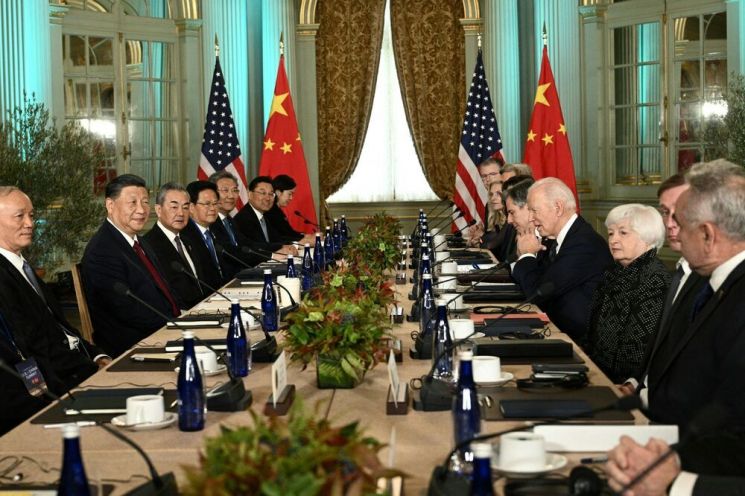
On the 15th (local time), President Biden and President Xi held their second face-to-face summit near Woodside, close to San Francisco, where the Asia-Pacific Economic Cooperation (APEC) summit was taking place. This meeting came 366 days after their first in-person summit in Bali, Indonesia, last November, starting in the afternoon and lasting about four hours.
A senior U.S. official stated after the summit, "China took measures to restore military communications and agreed to suppress fentanyl production." President Biden requested President Xi to institutionalize military dialogue between the two countries. President Xi agreed to restore dialogue to prevent potential military miscalculations and emphasized the need to establish channels through which both sides can communicate their concerns. Both sides agreed to resume high-level military communications, working-level talks between defense ministries, maritime military security consultations, and commander-level phone calls. This restored the U.S.-China military dialogue channels that had been closed since then-House Speaker Nancy Pelosi's visit to Taiwan in August last year. Foreign media expect tensions between the U.S. and China, which have clashed over issues in the Taiwan Strait and the South China Sea, to ease.
The two countries also agreed to cooperate on the fentanyl issue, a serious social problem in the U.S. President Biden mentioned to President Xi that fentanyl is one of the worst drug problems facing the U.S., and President Xi promised to crack down on fentanyl. A U.S. official attending the meeting said, "China agreed to track companies producing the chemical substances used as precursors for fentanyl, which triggered the drug crisis in the U.S.," adding, "The U.S. will closely monitor whether China fulfills its promises."
However, clear differences emerged regarding the U.S.'s advanced technology hegemony competition, including semiconductor export controls on China. A U.S. official said, "President Biden told President Xi that the U.S. will not provide China with technology that could be used against the U.S. military." The U.S. has implemented export control measures on semiconductor equipment to China since October last year, citing national security, and from August this year, it has also restricted U.S. companies' investments in advanced technologies such as semiconductors, AI, and quantum computing in China. In response, President Xi expressed blatant dissatisfaction with U.S. export controls on China, stating, "The U.S. continues to target China with export controls, investment reviews, and unilateral sanctions, seriously damaging China's legitimate interests. Suppressing China's science and technology development is suppressing China's progress and depriving the people of their right to development."
Regarding the Taiwan issue, a U.S. official said President Xi stated that there has been no military action plan for years but explained the conditions under which force could be used. In response, President Biden emphasized the need for peace and stability in the Taiwan Strait and that China should respect Taiwan's electoral process.
Additionally, President Biden mentioned the need for China's role in preventing Iran from escalating tensions amid growing concerns over the expansion of the war between Israel and the Palestinian armed group Hamas in the Middle East. He also stressed that China should take additional measures to address climate change.
Immediately after the meeting with President Xi, President Biden told reporters, "The dialogue went well," and assessed, "Real progress was made."
This summit took place amid the overt U.S.-China advanced technology hegemony war and the turbulent international situation caused by the wars in Israel and Ukraine. With the U.S. presidential election scheduled for November next year and President Xi also facing difficulties due to China's economic slowdown, both leaders found it increasingly necessary to manage U.S.-China relations to prevent further escalation of conflicts.
Bloomberg News analyzed, "The U.S.-China summit held in Bali, Indonesia, a year ago was seen as a breakthrough to resolve issues in bilateral relations, but the thaw did not last, and relations derailed due to the Chinese surveillance balloon incident. This summit was held simply because both sides felt it was in their interest. However, it is uncertain how long the thaw mood will last and how meaningful it will be."
© The Asia Business Daily(www.asiae.co.kr). All rights reserved.

















