Democratic Party Pushes Windfall Tax Legislation Targeting 'Banking Sector'
Impose Levy Up to 40% on Excess Profits of Financial Companies
Yoon Says "Bank Servitude"... Ruling Party Considers Pain-Sharing Measures
The Democratic Party of Korea has begun legislative efforts to introduce a so-called 'windfall tax' by collecting up to 40% of a 'win-win contribution' on excess income in the banking sector due to interest rate hikes. With President Yoon Suk-yeol strongly criticizing the banking sector's 'interest business,' even using the term "slave labor," attention is focused on whether related legislation will accelerate.
On the 14th, Kim Sung-joo, Senior Deputy Chairman of the Democratic Party's Policy Committee, introduced amendments to the Financial Consumer Protection Act and the Basic Act on Burden Management as the main sponsor.
The amendments stipulate that if a financial company earns 'excess profits' exceeding 120% of the average net interest income over the past five years, it must pay a 'win-win financial contribution' not exceeding 40% of the excess profits. The collected contributions, characterized as 'contributions,' will be used to alleviate the burdens of financially vulnerable groups such as the disabled, youth, and elderly, as well as financial consumers. This includes extending loan repayment periods and reducing loan interest rates.
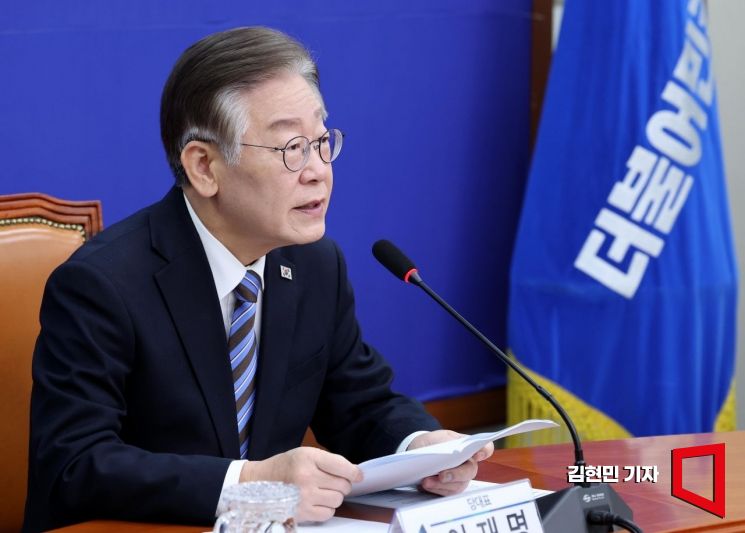 Lee Jae-myung, leader of the Democratic Party of Korea, is speaking at a 'Livelihood Economy Press Conference' held at the National Assembly on the 2nd. Photo by Hyunmin Kim kimhyun81@
The windfall tax was strongly advocated earlier this year by Lee Jae-myung, leader of the Democratic Party of Korea, on the grounds that a tax system is needed to share the pain by collecting taxes from industries that have posted record profits due to high interest rates and high oil prices to support ordinary citizens. Previously proposed amendments to the Corporate Tax Act and the Small Business Act include provisions to impose an additional corporate tax of 20-50% on excess profits. However, the form of windfall tax that collects additional taxes has been criticized as 'double taxation' and faces strong opposition from the industry.
In the financial sector, concerns have been raised that the banks' burden may be passed on to consumers, leading to higher loan interest rates. The refining industry also opposes the introduction of the windfall tax, emphasizing that unlike foreign oil companies with exclusive mining rights, domestic refiners' profit structures are limited solely to 'refining margins.'
The Democratic Party believes that introducing the windfall tax in the form of a 'contribution' rather than additional taxation will somewhat resolve the 'double taxation' controversy. Deputy Chairman Kim Sung-joo said, "Following academic opinions that a contribution format is more appropriate than a tax, we have created a bill to collect contributions that recover excess profits only from financial companies," emphasizing, "Instead of government intervention that forces banks, we chose institutionalization through the National Assembly." This bill is expected to accelerate the preliminary introduction of the windfall tax targeting the banking sector. A Democratic Party official said, "Since oil companies' profits fluctuate greatly depending on market conditions, opinions are gathering to first discuss the introduction of the windfall tax for the banking sector."
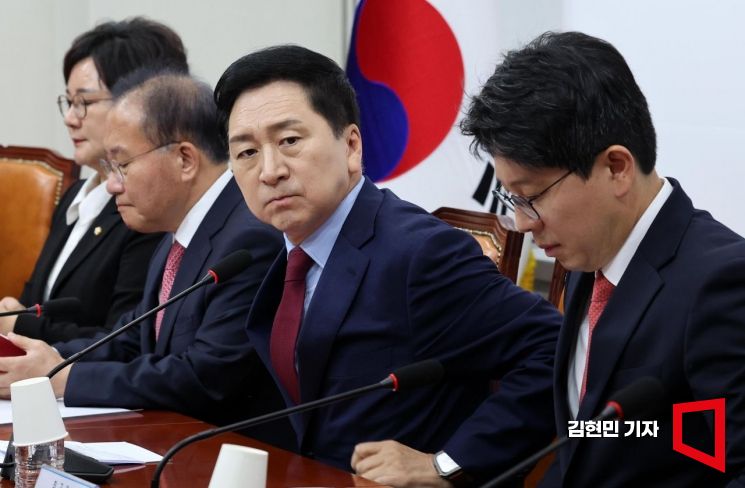 Kim Ki-hyun, the leader of the People Power Party, is speaking at the Supreme Council meeting held at the National Assembly on the 30th. Photo by Kim Hyun-min kimhyun81@
The ruling party and government have maintained opposition to the introduction of the windfall tax, but recent shifts in sentiment have been detected. For example, on the 1st, President Yoon Suk-yeol criticized at an emergency economic and livelihood meeting held at a cafe in Mapo-gu, Seoul, saying, "Our country's banks have a kind of monopoly, so they often engage in 'gapjil' (abuse of power)," and added, "We must somehow make the monopoly system of our banks competitive. The government's passive stance on the banks' monopolistic behavior is unacceptable. We must push strongly."
Financial Supervisory Service Governor Lee Bok-hyun also pointed out on the 6th, "It is questionable what kind of innovation led banks to earn 60 trillion won in interest profits this year," and stressed, "Special efforts are needed to reduce the burden on small business owners."
The People Power Party still places emphasis on the 'voluntary social contribution' of the banking sector. However, with the general election five months away, it has not taken a clear stance on the introduction of the windfall tax. Yoo Ui-dong, Policy Committee Chairman of the People Power Party, said at the party's Supreme Council meeting on the 9th, criticizing the bonus celebrations of bank executives and employees, "We firmly oppose politically distorted expressions and attempts such as 'predatory finance' and 'windfall tax,' but we hope to examine and reflect on why such expressions are circulating in the market."
The Democratic Party plans to push the introduction of the windfall tax as a de facto 'party line.' Recently, as the ruling party took the lead in the political arena with the cards of incorporating Gimpo City in Gyeonggi Province into Seoul and banning short selling, it appears to have launched a counterattack with the windfall tax. At the Supreme Council meeting on the 10th, Leader Lee Jae-myung stated, "We will promote the introduction of the windfall tax to share the pain of people's livelihoods," and the bill introduced by Deputy Chairman Kim was co-sponsored by Leader Lee, Floor Leader Hong Ik-pyo, Policy Committee Chairman Lee Gae-ho, and 55 opposition lawmakers. A Democratic Party official said, "It is premature to say it is a 'party line confirmation' since the party caucus has not yet been held, but we plan to proceed accordingly," adding, "We will gather various opinions and deliberate through standing committees (such as the Strategy and Finance Committee)."
© The Asia Business Daily(www.asiae.co.kr). All rights reserved.


















