Biden Administration Plans to Announce Negotiation Results Across All Sectors
Democratic Senators Express Concerns Over Insufficient Worker Protections
"Delay to Next Year as Opposition Statements Become More Likely"
The Biden administration in the United States planned to announce an agreement containing the results of negotiations across all sectors at the Indo-Pacific Economic Framework (IPEF) summit on the 16th (local time), but decided to postpone it until next year, the New York Times (NYT) reported on the 13th. This is interpreted as being due to difficulties in announcing the results of discussions on 'trade,' one of the negotiation areas, amid opposition movements within the U.S. Democratic Party. The U.S. plan to showcase the strengthening of IPEF's cohesion ahead of a meeting between President Biden and Chinese President Xi Jinping is expected to face setbacks.
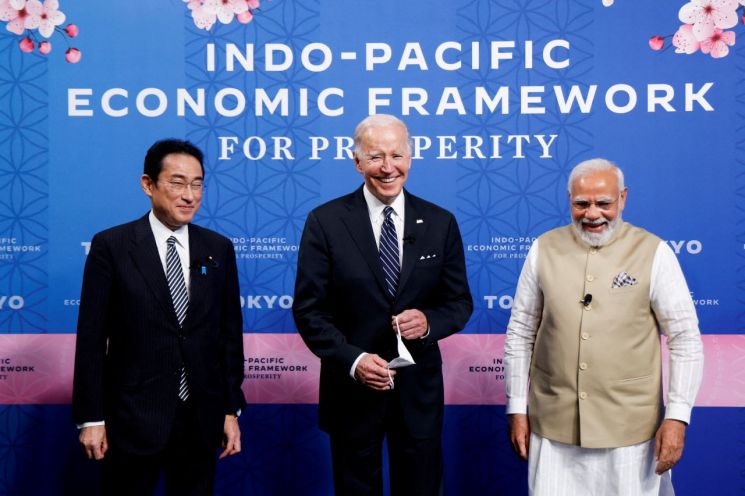
IPEF is an economic consultation body officially launched in May last year under the leadership of the Biden administration, regarded as a forum to counter the China-led Regional Comprehensive Economic Partnership (RCEP). Fourteen Indo-Pacific countries, including South Korea, the U.S., and Japan, participate in it.
So far, IPEF member countries have been negotiating in four areas: trade (Pillar 1), supply chains (Pillar 2), clean economy (Pillar 3), and fair economy (Pillar 4). Among these, the supply chain agreement was created and announced at the IPEF ministerial meeting held in the U.S. last May. Attention was focused on whether agreements in the remaining three areas would be released at this meeting.
NYT cited multiple sources saying that the Biden administration had completed negotiations on most of the agreements and intended to announce them at this summit. However, it reported that the announcement on the trade sector, led by the U.S. Trade Representative (USTR), was postponed until next year. NYT stated, "Significant announcements on the clean economy and fair economy sectors are expected this week," but added, "The most difficult part of the framework is the trade sector, which is handled by USTR Katherine Tai."
The reason the Biden administration gave up announcing the trade sector this time is that some Democratic lawmakers, including Senator Sherrod Brown (Ohio), opposed it, citing insufficient worker protection provisions in Pillar 1, the trade area. Initially, the Biden administration aimed to announce negotiation achievements in three sectors at this summit and reportedly pressured trade officials from participating countries in recent weeks. Worker protection provisions were not included in the agreement, intending to finalize them through additional discussions next year.
However, Democratic lawmakers strongly opposed the Biden administration's decision, arguing that the announcement should not be made without worker protection provisions. Although this message was conveyed to the Biden administration over several months in Congress, the administration seemed to have pushed forward until recently. But after opposition voices from Senator Brown and Senate Finance Committee Chairman Ron Wyden emerged, and with the possibility of Democratic lawmakers issuing public statements against the announcement, the situation changed.
Ultimately, USTR officials reportedly suggested at a meeting with White House officials this fall to announce the trade negotiation results next year. Subsequently, sources said the Biden administration communicated this decision to IPEF participating countries and the U.S. Congress.
The U.S. National Security Council (NSC) issued a statement to NYT saying the Biden administration is focusing on enhancing workers' rights and raising standards through negotiations and that discussions are ongoing to achieve meaningful progress. The USTR also stated that it is negotiating the Indo-Pacific framework through 70 meetings with Congress and will continue discussions to reach a high-level agreement.
NYT evaluated, "The decision to delay the final trade measures until next year represents a setback in the Biden administration's strategic plan for Asia," and added, "It shows the difficulty of pursuing trade policies under the Democratic Party, which has often criticized trade agreements for failing to protect workers and the environment."
© The Asia Business Daily(www.asiae.co.kr). All rights reserved.

















