A new method to regulate dopamine secretion has been discovered. It is expected to contribute to the development of treatments for dopamine-related brain disorders.
Professor Kim Jae-ik's team from the Department of Life Sciences at UNIST announced new research findings that the PLCy1 protein, a key signaling element in dopamine neurons, regulates dopamine secretion.
Dopamine is a neurotransmitter present in the central nervous system that performs various functions related to voluntary movement, motivation, and emotion regulation.
Proper dopamine secretion induces positive effects such as feelings of happiness and reward. However, problems in secretion can lead to various brain dysfunctions, including depression, anxiety, hyperactivity, and impaired motor skills.
Dopamine is mainly synthesized in dopamine neurons located in the midbrain. The synthesized dopamine is secreted into the striatum and nucleus accumbens, where the nerve fiber terminals of neurons are distributed. The striatum plays an important role in voluntary movement, while the nucleus accumbens is a part of the brain that processes information related to motivation and reward.
The synthesized dopamine moves to ‘synaptic vesicles’ that store neurotransmitters for secretion. The accumulated dopamine then seeks synapses capable of release.
In this process, the vesicular monoamine transporter 2 (VMAT2), which transports dopamine into synaptic vesicles, and synapsin III, which moves vesicles to releasable synapses, are known to play important roles.
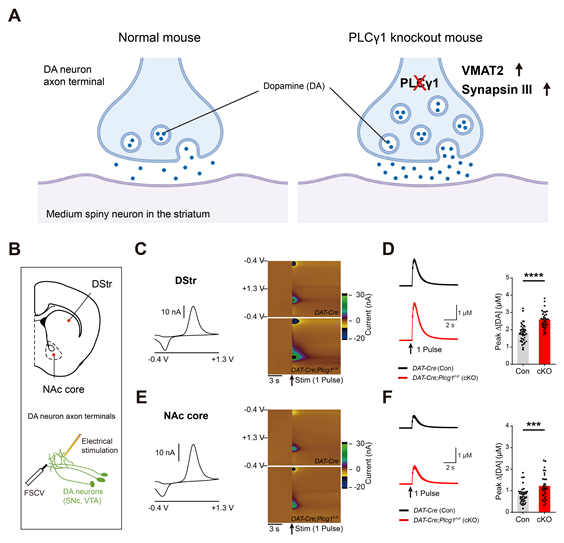
The research team found increased dopamine secretion in the striatum and nucleus accumbens of a mouse model with an incomplete knockout of the PLCy1 gene in dopamine neurons.
They revealed that the amounts of VMAT2 and synapsin III increased at dopamine nerve terminals, and these changes play a decisive role in the increased dopamine secretion. This study is the first to demonstrate that the PLCy1 protein directly regulates dopamine secretion.
Professor Kim Jae-ik explained, “Until now, there were difficulties in elucidating the signaling mechanisms within dopamine neurons due to limitations in experimental methods. However, improvements in real-time in vivo dopamine measurement and high-resolution synapse imaging techniques allowed us to newly identify the role of dopamine neuron-specific PLCy1.”
First author Researcher Kim Hye-yoon said, “By elucidating the PLCy1-mediated signaling pathway involved in dopamine secretion regulation, this research can contribute to the development of treatments for dopamine-related brain disorders.”
This study was conducted in collaboration with the Korea Brain Research Institute and was published on November 1 in the major life sciences journal Experimental & Molecular Medicine (EMM).
The research was supported by the Ministry of Science and ICT, the National Research Foundation of Korea’s mid-career research program, the Basic Research Laboratory support project, and the Brain Function Regulation Technology Development Project.
© The Asia Business Daily(www.asiae.co.kr). All rights reserved.
!["The Woman Who Threw Herself into the Water Clutching a Stolen Dior Bag"...A Grotesque Success Story That Shakes the Korean Psyche [Slate]](https://cwcontent.asiae.co.kr/asiaresize/183/2026021902243444107_1771435474.jpg)
















