Implementation of Dual-Class Share System on the 17th
Final Investment Must Exceed 5 Billion KRW, Total Investment Over 10 Billion KRW
Issuance Requires Consent of Over Three-Quarters of Total Shares
Proposals on Compensation, Audit, Dividends Not Applicable
The "Special Measures for the Promotion of Venture Businesses Act," which allows venture business founders to have multiple voting rights of up to 10 votes per share, will be enforced starting on the 17th. Once the system begins, about 400 venture companies that had been reluctant to accept large-scale investments due to hostile mergers and acquisitions (M&A) are expected to benefit. However, since the voting rights of existing shareholders are restricted, companies must meet stringent requirements to receive these benefits.
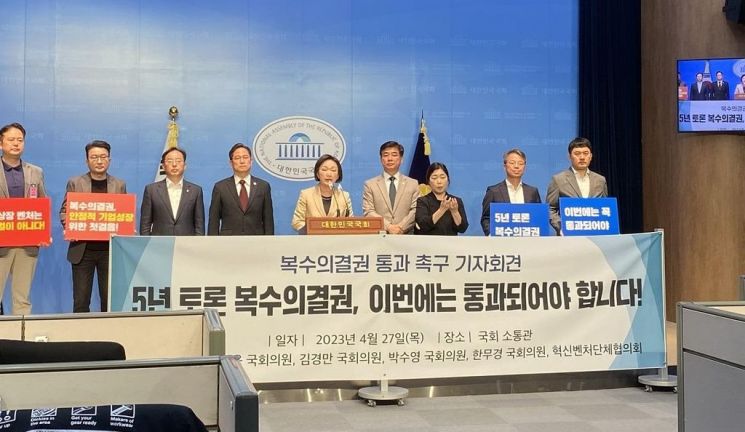 Representatives of organizations related to venture companies and members of the National Assembly held a press conference at the National Assembly Communication Office on April 27, urging the passage of the amendment to the "Special Measures for the Promotion of Venture Companies Act" to introduce multiple voting rights in the plenary session of the National Assembly.
According to related ministries on the 13th, the Ministry of SMEs and Startups will hold a preliminary briefing session on the multiple voting rights system at EL Tower in Seocho-gu, Seoul. Ahead of the full implementation of the multiple voting rights system, eight companies interested in the system will attend. The Ministry plans to listen to the companies' questions and distribute related manuals.
Multiple voting rights refer to a system that grants certain shareholders, such as founders, more voting rights than the number of shares they hold, marking the first exception to the Korean Commercial Act. Currently, the Commercial Act adheres to the "principle of shareholder equality," where voting rights are proportional to invested capital. Therefore, only one vote per share has been recognized.
The introduction of multiple voting rights is motivated by hostile M&A. Venture companies require large-scale investments for growth. Investors often demand equity in exchange for funding. As a result, many venture companies have taken a passive stance due to concerns over management control despite needing investment.
The industry has also called for the introduction of the multiple voting rights system. If founders can exercise more voting rights than their equity, they can maintain management control while actively attracting investment. Among the 38 OECD countries, 17?including the United States, the United Kingdom, and France?have already introduced and implemented multiple voting rights systems.
The Ministry of SMEs and Startups has been promoting a bill centered on multiple voting rights since October 2020. However, criticism that entrepreneurs might misuse multiple voting rights to solidify governance structures and illegitimately succeed management prevented the bill from passing the National Assembly. The stalled bill passed the plenary session of the National Assembly last April after the Ministry prioritized the multiple voting rights system as a key agenda.
Must Obtain Consent from 75% of Issued Shares and Total Investment of Over 10 Billion KRW
The passed bill includes requirements for issuing multiple voting rights. First, the company must be an unlisted venture business that has received investments totaling over 10 billion KRW since its founding, with the most recent investment being at least 5 billion KRW. Additionally, the founder must be a promoter listed in the articles of incorporation at the time of establishment and registered as a director upon share issuance. At the same time, if the founder's equity falls below 30% or they lose the status of the largest shareholder due to investment attraction, the conditions for issuing multiple voting rights are met.
The issuance process and post-management regulations are also strict. Companies wishing to issue multiple voting rights must include all related details in their articles of incorporation and pass a special resolution. Subsequently, they must obtain consent from at least three-quarters of the total issued shares. All important matters related to issuance and subsequent changes must be reported to the Ministry of SMEs and Startups without omission. If multiple voting rights are issued fraudulently, penalties include imprisonment for up to 10 years or fines up to 50 million KRW.
Due to concerns about misuse, the duration of multiple voting rights is limited to a maximum of 10 years. Even if issuance is successful, the rights convert to common shares after 10 years. If an unlisted company becomes listed, the period shortens to a maximum of 3 years. Conversion to common shares also occurs in cases of inheritance, transfer, loss of director position, or inclusion in a publicly disclosed business group.
Multiple voting rights cannot be used for agenda items related to shareholder interests or the founder's private interests. For matters such as directors' remuneration, exemption from liability, appointment of auditors and audit committee members, and dividends, multiple voting rights shares have only one vote per share.
A Ministry of SMEs and Startups official stated, "According to our research, about 300 to 400 companies are estimated to be eligible to use the multiple voting rights system," adding, "If there are difficulties during the system's establishment, we will consider easing regulations based on market trends."
© The Asia Business Daily(www.asiae.co.kr). All rights reserved.

















