Easier English and Harder Math than September Mock Test
Possible Grade Cut Changes Due to Large Number of Repeat Test Takers
"Students Should Try to Stay Positive"
With the 2024 College Scholastic Ability Test (CSAT) scheduled for the 16th just three days away, attention is focused on the difficulty level of this year's exam, which excludes killer questions. The admissions industry predicted that the difficulty of the Korean, Math, and English subjects would be adjusted based on the September mock evaluation conducted by the Korea Institute for Curriculum and Evaluation.

◆ 'Exclusion of Killer Questions' and CSAT Differentiation Power = Killer questions were excluded starting from the September mock evaluation. However, since the Korean and English subjects were not set at a low difficulty level in the September mock evaluation, there is a forecast that difficult questions capable of differentiating students may appear in the actual CSAT. At that time, the admissions industry analyzed that 'quasi-killer questions' with a correct answer rate within 5-10% or questions with a complex process linking the passage to the answer choices were included.
There is also an analysis that the proportion of students meeting the minimum CSAT standards decreased due to English being more difficult than expected in the September mock evaluation. JinHakSa, based on its own data analysis, stated that the proportion of students meeting the minimum CSAT standards in this year's September mock evaluation was lower than in last year's September mock evaluation. Woo Yeon-cheol, head of the JinHakSa Admissions Strategy Research Institute, explained, "For students who must meet the minimum CSAT standards, the more difficult English section inevitably becomes a significant burden," adding, "Of course, the actual CSAT may be easier than the September mock evaluation."
To maintain differentiation power, it is predicted that the difficulty level of Korean and English subjects will either maintain the level of the September mock evaluation or become easier, but the difficulty of Math is expected to increase. Lim Seong-ho, CEO of Jongro Academy, said, "From the perspective of the test's intent, Math is expected to be set at the level of last year's CSAT or the September mock evaluation," adding, "However, since there may be issues with differentiating top-tier students, there is a possibility that a '4-point subjective' question will be presented at a difficult level."
◆ 'Repeat Test Takers' at a 27-Year High, Possible Changes in Grade Cutoffs = According to the Korea Institute for Curriculum and Evaluation on the 9th, 504,588 test-takers submitted applications for this year's CSAT. Among them, 326,646 (64.7%) are current high school seniors, and 159,742 (31.7%) are graduates retaking the exam (commonly called N-su students). This is the highest level in 27 years since the 1997 CSAT (32.5%). With the continued preference for medical schools and the government's policy to exclude killer questions, there is an interpretation that more students are retaking the CSAT. In fact, last year's number of N-su students was 122,300, but this year it increased by 12.2%.
With a large influx of N-su students, it is expected to become difficult to predict score ranges for current students. CEO Lim explained, "About 89,000 students who did not take the June mock evaluation but registered for the actual CSAT are repeat test takers," adding, "Considering that repeat test takers generally have higher scores, middle and lower-tier current students may see somewhat lower results compared to the June and September mock evaluations."
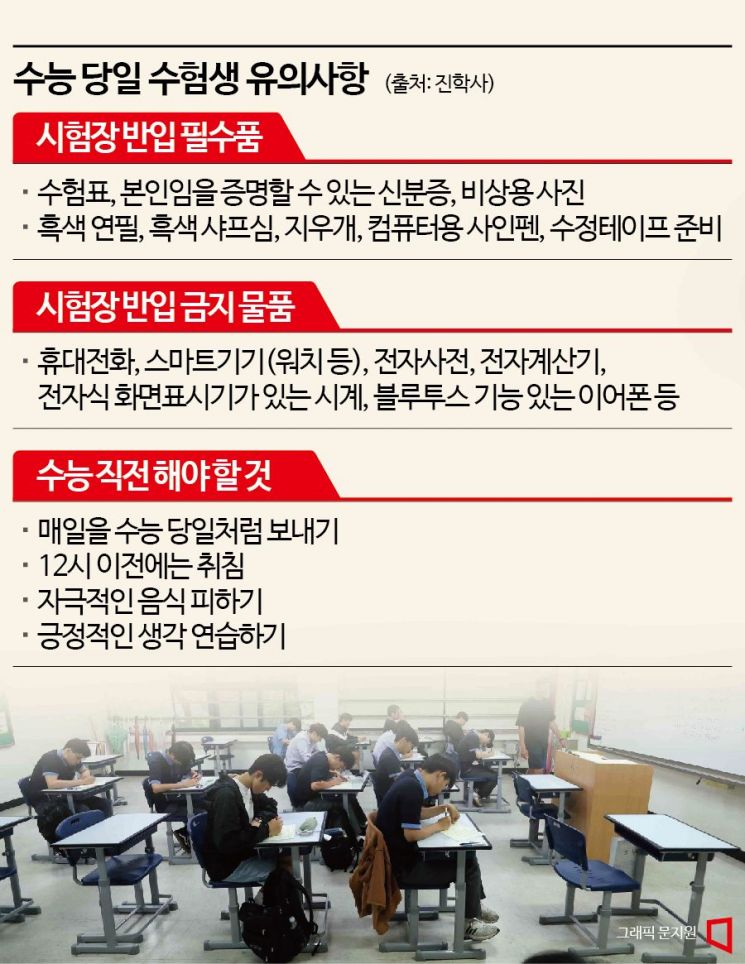
◆ COVID-19 Positive Cases Also in the Same Classroom, Admission Ticket and ID Required = Starting from this CSAT, COVID-19 positive or symptomatic students will take the exam in the same classroom as other test-takers, so caution is necessary. However, positive cases are required to wear masks at all times, and it is recommended that lunch be taken in a separately prepared location. Students with suspected symptoms must wear health masks rated FK80 or higher.
Test-takers must attend the preliminary gathering held on the 15th, the day before the exam. On the exam day, the 16th, they must bring their admission ticket and photo ID and enter the designated exam room by 8:10 a.m. All electronic devices, including mobile phones, smart devices (including smartwatches), tablet PCs, earphones with communication (Bluetooth) functions, and electronic cigarettes, are prohibited in the exam room. Only analog watches without payment functions or electronic displays are allowed.
The admissions industry advised test-takers to maintain optimal condition ahead of the CSAT. Woo, head of the strategy office, said, "At this point, one week before the CSAT, it is advisable to avoid studying late and to go to bed at a set time," adding, "Negative emotions increase the burden of the exam, so it is necessary to consciously change them to positive thoughts."
© The Asia Business Daily(www.asiae.co.kr). All rights reserved.


















