Estimated Consumer Damage Amounting to Tens of Billions of Won Over One Year
Recently, another case of fake cashmere products being sold at major domestic shopping malls was uncovered. Once again, the products were made by companies that deceived customers by labeling cheap fabrics as cashmere.
On the 9th, Yonhap News reported that well-known shopping malls such as Musinsa, 29CM, SSF Shop (Samsung C&T), EQL (Hansome), and W Concept (a subsidiary of SSG) sold three HALDEN products that did not contain cashmere as cashmere scarves over the past year.
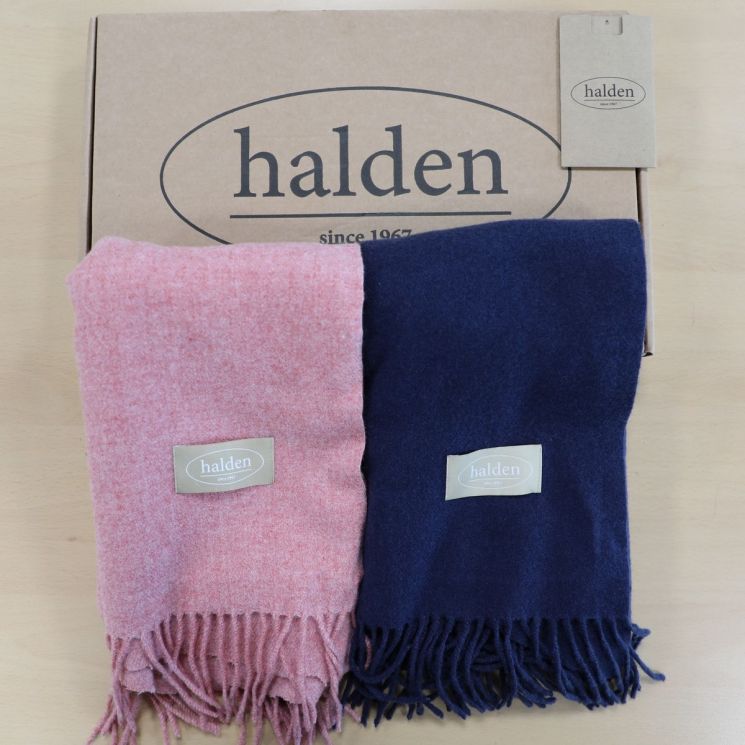 Hallen's (left) Premium Cashmere Muffler (M014) and (right) Solid Cashmere Muffler (M012) [Photo by Yonhap News]
According to the report, after directly requesting a composition analysis from the Korea Apparel Testing & Research Institute, the 'Premium Cashmere Scarf (M014)' from HALDEN sold at these shopping malls was found to be composed of 82.4% polyester and 17.6% rayon, while the 'Solid Cashmere Scarf (M012)' consisted of 72.5% polyester and 27.5% rayon.
Contrary to the shopping malls' claims that the products contained 60% cashmere, these scarves were made from inexpensive synthetic fibers such as polyester and rayon, disguised as high-quality wool scarves once again.
Having already experienced a fake cashmere scarf incident, EQL sent individual text messages to consumers who purchased HALDEN and 247Seoul products and posted refund notices on their website. W Concept also posted notices regarding HALDEN and 247Seoul products on their homepage. In contrast, SSF Shop did not post any announcements.
Musinsa Criticized for 'Delayed Response'
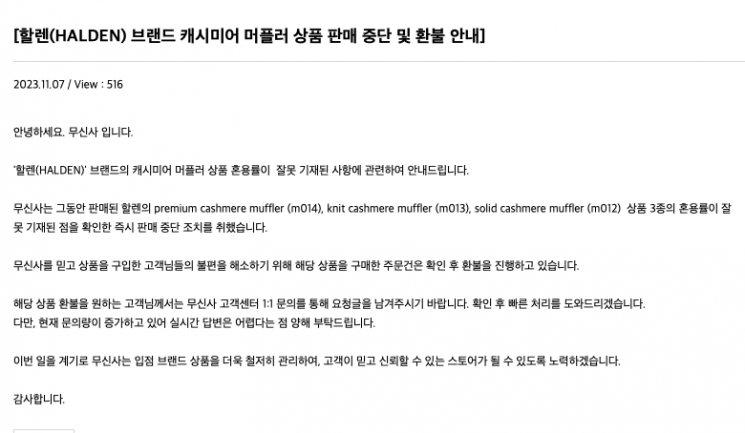 Musinsa posted a notice on its website stating that it will refund the cashmere muffler product from Hallen for seven days, receiving criticism for a "delayed response."
Musinsa, a major shopping mall preparing for listing with a corporate value reaching the mid-3 trillion won range, required vendors to submit fabric test reports following this incident.
However, Musinsa's fabric verification only applies to 'scarf' products labeled as containing 'cashmere' and does not cover scarves without cashmere or other products containing cashmere but not scarves. Industry insiders testified that "there are many false descriptions in other categories such as knits and cardigans," suggesting that Musinsa's future measures may not fundamentally prevent vendors from deceiving customers.
As the controversy over false cashmere blend rates grew, Musinsa posted a notice on its website on the 6th and 7th, announcing refunds for 247Seoul and HALDEN cashmere scarf products, respectively, drawing criticism for its 'delayed response.'
A Musinsa official stated, "Along with investigating the materials of all cashmere scarf products, we plan to take unprecedented measures such as blind purchasing and direct composition testing for top-selling brands. We will strengthen monitoring to ensure that our vendors provide accurate information and do our best to become a trustworthy store."
A textile material expert said, "This reveals the open secret of fabric material deception in the apparel industry," adding, "Many companies only started conducting blend rate tests after the news broke."
HALDEN Sold Out the Controversial Products and Gave False Responses as the Controversy Grew
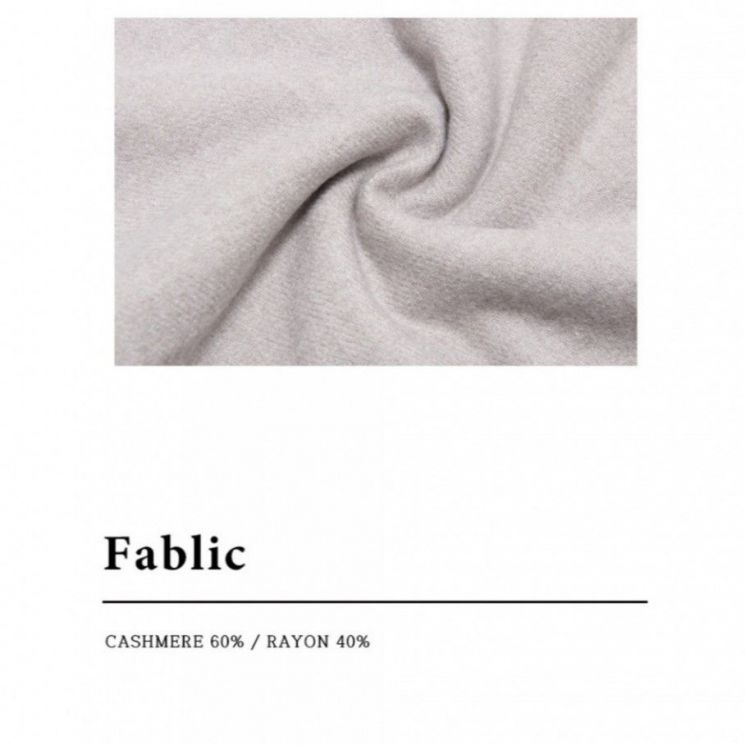 Contrary to the claim that the product contains 60% cashmere, it has been disguised once again as a luxury wool scarf, made from inexpensive synthetic fibers such as polyester and rayon instead of cashmere.
 [Photo by Yonhap News]
HALDEN, the manufacturer and distributor of the products in question, suddenly marked the products as sold out and changed the product names after repeated consumer complaints. They stated, "From the 2023 winter collection, the product materials have changed, and the quality has been implemented to be as close as possible to the previous products." When asked if the previous products were truly cashmere, they falsely replied, "The blend rates for shipments before the change are correct."
As criticism grew that HALDEN was attempting to downplay or conceal the incident, the company responded, like 247Seoul, that they learned some of their products did not contain cashmere through consumer feedback.
In their apology, the company bowed and said, "Although the detailed pages were created based on information provided by overseas production factories, all responsibility lies entirely with us."
They added, "Since we have many products, it is common in the apparel industry not to test the composition of all products. Because it was our fault for not testing, we are issuing full refunds without recalling all scarves purchased by customers and will do our best in follow-up measures."
Meanwhile, a Fair Trade Commission official stated, "Misrepresenting textile materials is a rare but serious case," adding, "Sellers who falsely state blend rates violate the Electronic Commerce Act, which can result in administrative penalties such as fines, business suspension, and corrective orders."
© The Asia Business Daily(www.asiae.co.kr). All rights reserved.



















