Seoul City to Hold Discussion on Improving Preliminary Feasibility Study System on the 7th... Seoul Area Preliminary Feasibility Studies Expected to Decline Further in Economic Feasibility (B/C) Due to Significant Construction Cost Increases Affecting Economic Evaluation... Excessive Weight on Economic Feasibility to Be Reduced by Adjusting Economic and Policy Ratios and Introducing New Benefits... Need to Reflect Future Potential Demand Value, Commuting Time, Congestion Costs, and Socioeconomic Costs
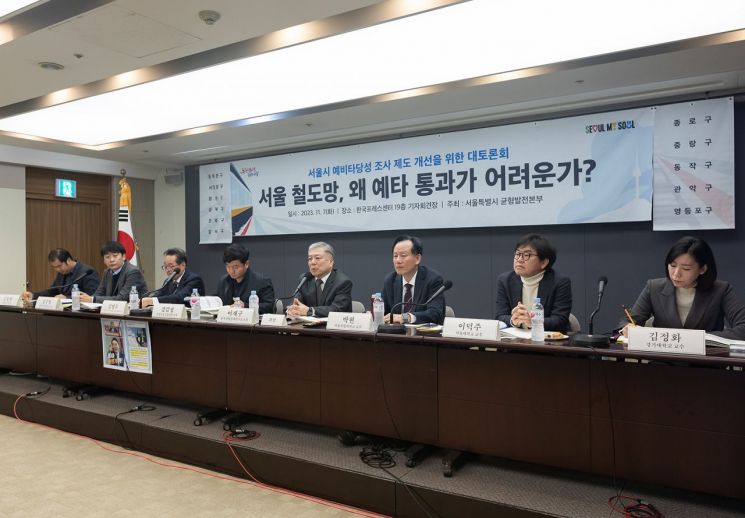
The Seoul Mokdong Line, Gangbuk Transversal Line, and the northwest extension project of the Shinbundang Line have failed to pass the preliminary feasibility study stage, causing the residents of transportation-disadvantaged areas such as Yangcheon-gu and Eunpyeong-gu to voice their grievances loudly.
Accordingly, on the morning of the 7th, the Seoul Metropolitan Government held a "Large Forum on Improving the Preliminary Feasibility Study System" at the Korea Press Center press conference hall to listen to citizens' hardships and complaints regarding the preliminary feasibility study system and delays in railway network construction projects, and to prepare improvement measures for the feasibility study system.
About 200 people, including 11 district mayors related to Seoul's urban railway network construction and local citizens, attended the forum.
In particular, Lee Gi-jae, mayor of Yangcheon-gu, and Kim Mi-kyung, mayor of Eunpyeong-gu, participated in the forum and strongly raised issues such as ▲the problems of the evaluation system focused on economic feasibility, the damage to railway-disadvantaged areas under the current system, the need for non-discriminatory improvements, and the necessity to resolve transportation blind spots including the Mokdong Line, Gangbuk Transversal Line, and the establishment of Sinwol Sageori Station (Lee Gi-jae, mayor of Yangcheon-gu), and ▲the need to look beyond immediate economic logic and reflect the future value of the city in evaluations for balanced development between Gangnam and Gangbuk (Kim Mi-kyung, mayor of Eunpyeong-gu).
The first presenter, Kim Ki-bong, head of the Seoul Metropolitan Government's Balanced Development Policy Division, gave a presentation titled "Why is it difficult for Seoul's railway network construction to pass the preliminary feasibility study?" explaining the necessity of improving the preliminary feasibility study system and Seoul's railway network construction.
Reduction of social costs during commuting hours and alleviation of subway congestion
(Social costs) Annual social costs due to commuting amount to 170 trillion to 190 trillion KRW (LAB2050 survey).
(Subway congestion) The average congestion rate of Seoul subways during commuting hours reached 195% on Line 9, 186% on Line 4, and 172% on Line 2 (as of 2022), indicating an urgent need to alleviate congestion.
Metropolitan area expansion and increase in railway passengers
(Metropolitan area expansion) With new towns emerging around Seoul and Seoul, Gyeonggi, and Incheon forming a single metropolitan living area, building a dense railway network in Seoul is directly linked to expanding metropolitan transportation infrastructure.
(Railway passengers) The daily public transportation modal share of the subway is 40%, higher than buses (22%) and private cars (28%).
* Annual subway ridership in Seoul (persons): 2.13 billion (’20) → 2.15 billion (’21) → 2.4 billion (’22)
Lower carbon emissions and traffic accidents of rail compared to other transportation modes
(Carbon emissions) Rail is advantageous in reducing carbon emissions compared to other transportation modes.
* Carbon emissions per km by transportation mode: mid-sized car (192g) > bus (105g) > electric car (53g) > rail (41g)
(Traffic accidents) Rail traffic accidents numbered 64 annually as of 2021, which is very low compared to 203,130 road accidents. Annual casualties were 41 for rail and 294,524 for roads, indicating rail is safer than other public transportation (KOTI - Korea Transport Institute statistics yearbook).
Improvement of transportation convenience for foreign tourists and establishment of transportation welfare
(Foreign tourists) Need to improve transportation convenience in preparation for the era of 30 million tourists visiting Seoul.
* Foreign tourist status: Seoul visits (2.83 million, 82%), non-Seoul visits (630,000, 18%)
* Transportation mode usage rate by foreign tourists visiting Seoul: subway (59.1%), taxi (27.2%), bus (9.3%)
(Transportation welfare) Growing need to enhance mobility convenience due to accelerating aging population.
* Seoul elderly population: 1.69 million in ’22 (18% of city population) → 3.07 million in ’40 (35% of city population)
Expansion of railway accessibility in underdeveloped areas
(Accessibility in underdeveloped areas) Average commuting time in Gangbuk-gu, Nowon-gu, and Yangcheon-gu is about 58 minutes, longer than Seoul's average commuting time of about 45 minutes. Therefore, securing public transportation accessibility in underdeveloped areas such as the northeast, northwest, and southwest regions is necessary.
(Citizen complaints) Urgent need to resolve residents' dissatisfaction and social conflicts caused by stagnant railway projects for over a decade.
Kim said, "The current preliminary feasibility study system places excessive weight on economic feasibility evaluation, which limits its application to underdeveloped areas such as northwest and northeast Seoul," and added, "The system should be improved by enhancing and adding benefit items in anticipation of further declines in economic feasibility due to increased construction costs."
The second presenter, Professor Kim Jeong-hwa of Kyonggi University, gave a presentation titled "Improvement directions for economic feasibility evaluation items of transportation infrastructure reflecting urban core characteristics," proposing the development of an "urban-type economic feasibility evaluation model" that considers the concentration phenomenon in Seoul's urban core and disparities in living environment levels within the city center.
Professor Kim pointed out that the current preliminary feasibility study system applies an evaluation method biased toward economic feasibility in the metropolitan area, and that underdeveloped areas within the metropolitan area do not receive balanced development bonus points. She suggested improving existing economic feasibility evaluation items and establishing new evaluation items.
Proposed improvements to economic feasibility evaluation items: ① Reassessment of leisure travel time value, ② Improvement of traffic accident reduction index, ③ Consideration of eco-friendly vehicles
Proposed new economic feasibility evaluation items: ① Benefits of congestion alleviation, ② Benefits reflecting metropolitan transportation axes
Benefits of congestion alleviation: Newly introduced benefits from improved comfort due to reduced congestion inside urban railway vehicles.
Benefits reflecting metropolitan transportation axes: Reflecting the value of absorbing increased metropolitan transportation demand due to urban metropolitan expansion and living area enlargement in the benefits.
In the designated discussion, detailed discussions focused on improving existing benefits and discovering new benefits.
Moderator: Lee Se-gu, Director of Korea Institute for Industrial Economics and Trade
Discussants: Kim Jeong-hwa, Professor at Kyonggi University; Kim Ju-young, Professor at Korea National University of Transportation; Park Hyun, Professor at University of Seoul; Lee Deok-joo, Professor at Seoul National University; Kim Dong-hyun, Deputy Editor at Seoul Shinmun; Kang Gap-saeng, Transportation Specialist Reporter at JoongAng Ilbo; Kim Byung-moo, Citizen Promotion Committee Member for Shinbundang Line Northwest Extension
Professor Park Hyun of University of Seoul said, "The current preliminary feasibility study system is an obstacle to enhancing global competitiveness and the development of urban transportation and spatial structure in Seoul," and added, "Environmental damage reduction and reorganization of the time value of non-work trips should be included in economic feasibility evaluation."
Professor Lee Deok-joo of Seoul National University said, "The original purpose of the preliminary feasibility study is to prioritize fiscal projects, not to independently decide whether to implement fiscal projects," and argued, "To preserve the original purpose, a relative evaluation should be additionally conducted for projects scoring around 0.5 in the comprehensive evaluation score (AHP)."
Kim Dong-hyun, reporter at Seoul Shinmun, emphasized the need to quantify regional economic revitalization, development potential, and environmental improvement as economic benefits in economic feasibility evaluation. He suggested considering infrastructure disparities between regions within Seoul in policy evaluation and ensuring transparency and clear scoring criteria in comprehensive evaluation.
Professor Kim Ju-young of Korea National University of Transportation said that in economic feasibility evaluation, it is necessary to re-measure travel time value and reflect new benefits such as urban landscape improvement, health benefits, and indirect tax revenue benefits. Regarding comprehensive evaluation, he said that when reflecting economic feasibility in comprehensive evaluation, differences between metropolitan and non-metropolitan areas should be considered.
Kim Byung-moo, citizen promotion committee member for the Shinbundang Line northwest extension, said, "The Shinbundang Line northwest extension project has been proposed as a pledge by many politicians over the past decade, raising hopes among residents for a long time, but it failed to pass the preliminary feasibility study, causing disappointment and frustration among 300,000 Eunpyeong-gu residents," and raised his voice saying, "The current preliminary feasibility study system cannot continue as it is."
Kang Gap-saeng, reporter at JoongAng Ilbo, stated that while railway expansion is necessary considering citizen convenience and increasing metropolitan transportation share, the justification for the project must be sufficiently secured through objective research proving efficiency compared to other transportation modes such as buses.
Yeo Jang-kwon, head of Seoul Metropolitan Government's Balanced Development Headquarters, said, "If Seoul's railway network becomes denser, urban competitiveness will improve through enhanced transportation accessibility, and the quality of life of citizens will improve by resolving regional disparities within Seoul such as the western and northeastern areas," adding, "Based on the results of this forum, we will concretize improvement plans for the preliminary feasibility study system and propose them to the central government."
© The Asia Business Daily(www.asiae.co.kr). All rights reserved.
![User Who Sold Erroneously Deposited Bitcoins to Repay Debt and Fund Entertainment... What Did the Supreme Court Decide in 2021? [Legal Issue Check]](https://cwcontent.asiae.co.kr/asiaresize/183/2026020910431234020_1770601391.png)















